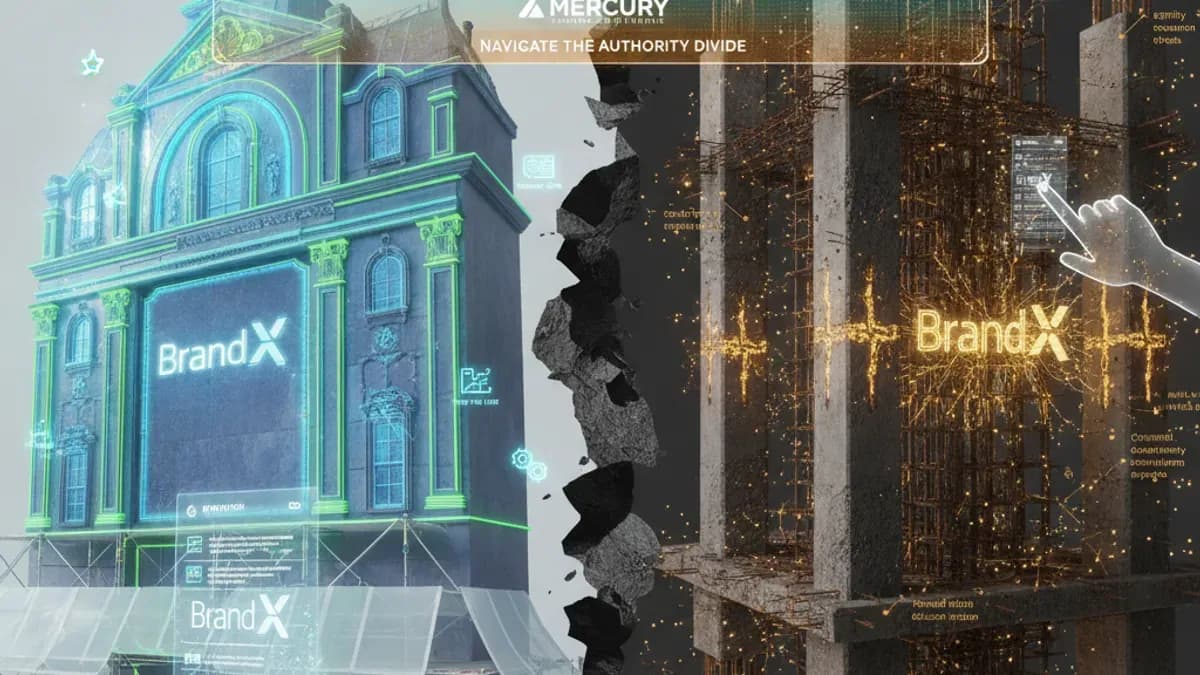
Recursive Self-Improvement is no longer a theory. It is the current release notes.
Anthropic recently published a sobering analysis on Recursive Self-Improvement (RSI): the moment when AI systems begin writing the code that upgrades themselves. For those of us building enterprise software, this is not a distant milestone. It is the commit log we are merging into production today.
At Mercury Technology Solution, our mission is to Accelerate Digitality—to help brands streamline operations through technology that actually works. To do that, we have to live on the bleeding edge. And right now, the edge is cutting in a direction that redefines what "software engineering" even means.
Here is what the data says, what it feels like on the ground, and where human value goes when the machines stop needing our syntax.
The Three Numbers That Change Everything
Anthropic's report landed with three data points that mirror exactly what we are seeing inside Mercury's own engineering teams.
1. The 80% Threshold
As of May 2026, over 80% of the code Anthropic merged into production was authored by Claude. We are seeing the same ratio internally. When we build comprehensive platforms like the Mercury Business Operation Suite—spanning sales, HR, and project management—the AI handles the heavy lifting. For greenfield projects without legacy drag, that percentage often climbs even higher.
The implication is not that engineers are disappearing. It is that the act of writing syntax has been commoditized.
2. The 8x Multiplier
A single engineer's quarterly output is roughly eight times what it was in 2024. My personal experience puts that range between 5x and 10x, depending on the task. Ironically, the micro-tasks—tweaking a UI component, translating a localized string, running a quick bash command—are still faster to do by hand. But for substantive architecture, the human is now operating at superhuman scale.
3. Reliability Doubling Every Four Months
METR's measurements show that the length of complex tasks an AI can reliably complete is doubling every four months. Claude Opus 4.6 is already executing assignments that would consume a senior engineer's entire day.
The trajectory is not linear. It is compounding.
Why "Vibe Coding" Dies at Enterprise Scale
The industry has a cute term for prompting an AI to spin up a flashy app and hoping the architecture holds: vibe coding. It works for prototypes. It collapses at a million lines of code.
When you are managing platforms with real security requirements, real scalability constraints, and real integration surfaces, you cannot hope your way to stability. You need architecture. You need taste. You need someone who understands why a caching strategy matters more than a gradient animation.
Here is the brutal truth Anthropic's thesis confirms: the marginal cost of generating software is approaching zero. For a century, the brightest engineers on earth wrote brilliant code with the unspoken goal of automating themselves out of the typing. That script has been realized.
So what is left?
From Coder to Architect: The Human Stronghold
Anthropic calls it direction-setting. I call it the only job that survives the recursion.
Your value is no longer in how to code. It is in:
- Problem definition — knowing which pain point is worth solving
- Research taste — recognizing when an experimental path is a dead end before you burn six sprints on it
- Strategic foresight — seeing how a technical decision impacts the business model eighteen months from now
The engineer of 2027 needs to get up from the screen, sit next to the customer, and immerse themselves in real-world business needs. Your competitive advantage is not typing speed. It is architectural judgment and contextual wisdom.
If you are still measuring your worth by lines of code committed, you are optimizing for a metric the AI already won.
Amdahl's Law: The Bottleneck Just Moves
Anthropic invoked Amdahl's Law honestly, and it is worth understanding. The law states that the overall speed of any process is limited by its slowest, non-accelerated component.
AI does not eliminate bottlenecks. It relocates them upstream.
As AI generates code at unprecedented volume, the new chokepoint is human review and verification. The machine can write ten thousand lines before lunch. But someone still has to read them, understand the intent, and sign off on the merge.
In the organizations that survive this transition, the most valuable professionals will be those who can rapidly identify where the bottleneck moved—and clear it.
At Mercury, we address this directly with Mercury Muses AI, an intelligent assistant that automates repetitive operational tasks so our human team can stay focused on strategic judgment rather than mechanical review.
Compute Is King: The Hardware Chokehold
There is a geopolitical layer to RSI that most software people prefer to ignore.
If AI truly enters a closed loop of self-improvement, the speed of human technological progress will be dictated by a single variable: compute.
If AI development becomes a pure computational arms race, whoever controls the hardware supply chain controls the throttle of civilization's progress. Right now, the most critical chokepoint in that global chain is advanced packaging—specifically CoWoS. Which means Taiwan remains the undisputed linchpin.
For decades, we called semiconductor manufacturers the people "selling shovels during a gold rush." The plot has changed. The gold mine is now digging itself. But the speed of extraction still depends entirely on the shovels.
In the next 24 to 36 months, the players who control compute will face a choice: keep selling the tools, or start operating the bulldozers.
The Big "Why": Governance, Purpose, and the Question We Cannot Outsource
I spent hours discussing AI governance with my colleages. We debated whether AI could be regulated similarly to nuclear weapons.
The sobering conclusion? We genuinely do not know.
Training a frontier model in a server farm is infinitely easier to hide than a nuclear silo. Verifying a global "pause" on AI development is practically impossible when the commercial incentives are this astronomical. The genie is not just out of the bottle; it is building a better bottle.
I do not believe Artificial General Intelligence will arrive everywhere all at once on a random Tuesday. It will conquer industries sequentially, domain by domain. Software development is simply the first, highest-leverage domino to fall. Once the software layer is fully automated, the rest of the ecosystem follows.
We should not be paralyzed by this. But we must face it with eyes wide open.
For the last hundred years, our primary challenge was figuring out how to build software. As we enter an era where the machine builds itself, our ultimate responsibility shifts to answering:
For whom, and for what purpose, are we building this?
That question cannot be outsourced to a model. It is the only job that remains entirely, permanently, human.
Stay ahead of the curve.
— James Huang, CEO of Mercury Technology Solution
The Bottom Line
The AI Ouroboros is not a future threat. It is the current state of production engineering. Code is writing code. Productivity is multiplying. Bottlenecks are migrating upstream.
The engineers and organizations that survive will not be the ones who type the fastest. They will be the ones who ask the best questions, clear the right bottlenecks, and never forget that technology is only valuable when it serves a human purpose.
Accelerate Digitality. But know exactly why.