TL;DR: What does a multi-billion dollar US aircraft carrier with broken toilets have in common with the Pope banning priests from using ChatGPT? They are both symptoms of a society obsessed with optimizing away "human friction." We tried to engineer the perfect vacuum toilet for 4,600 sailors, and it caused a sanitary crisis. We tried to engineer the perfect AI-generated sermon, and it caused a spiritual crisis. If we outsource all our struggles, pain, and friction to algorithms, we don't become more efficient. We become empty.
James here, CEO of Mercury Technology Solutions. Tokyo - March 3, 2026
I want to talk about two seemingly unrelated events that happened recently.
The first involves the USS Gerald R. Ford, the most advanced and expensive ($13.3 Billion) aircraft carrier ever built by the human race. For the last two years, roughly 90% of the toilets on the ship have been breaking down almost daily. The second event happened last month in Vatican City. Pope Leo XIV officially banned Catholic priests from using ChatGPT to write their sermons.
As a Systems Architect who builds AI workflows for a living, I look at both of these stories and see the exact same root problem: The catastrophic failure of over-optimization.
1. The $13 Billion Toilet Crisis (Engineering Away Reality)
The USS Ford was designed with a hyper-advanced vacuum collection system (VCHT), similar to what you use on a commercial airplane. On paper, it was a beautifully elegant system: it saved water, centralized waste management, and allowed designers to remove all urinals to create "gender-neutral" bathrooms for administrative flexibility.
But the designers made a fatal mistake: They optimized for the spreadsheet, not for reality.
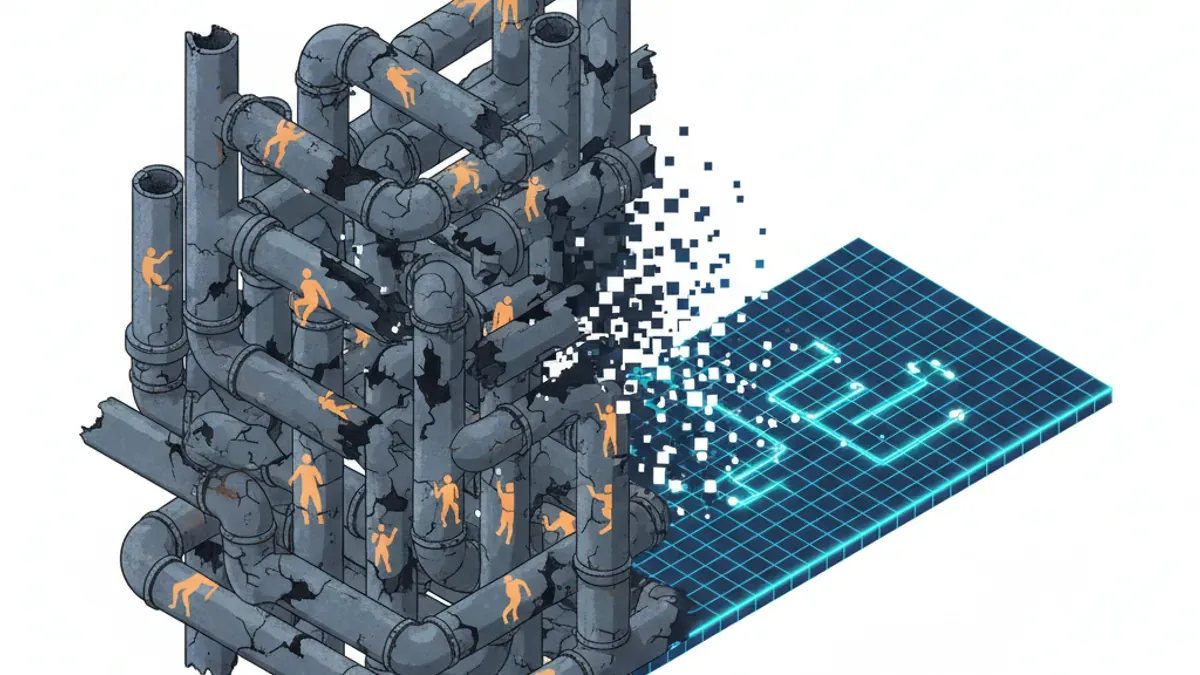
They put a delicate commercial airline system onto a warship carrying 4,600 sailors eating military rations and drinking energy drinks. They didn't account for the high salt and humidity of the ocean, which caused waste to calcify and block the narrow vacuum pipes. If one valve failed, the entire zone paralyzed. You couldn't even use a plunger to fix it; the Navy had to use specialized acid washes costing $400,000 a pop.
By 2025 and into 2026, as the carrier faced its longest unbroken deployment in history (covering Venezuela and the Middle East), the toilets failed constantly. Highly trained sailors were contemplating resigning—not because of the danger of war, but because of the psychological torture of an over-engineered toilet system.
The engineers tried to eliminate the "messy friction" of traditional plumbing. In doing so, they built a fragile, expensive nightmare that broke upon contact with actual human biology.
2. The Pope’s Ban (Outsourcing the Soul)
Now, let's look at the Vatican. Pope Leo XIV (the first American Pope, elected in May 2025) recently summoned his clergy to ban the use of AI for writing sermons. He even rejected a Silicon Valley proposal to create a 24/7 "AI Pope" avatar to interact with the faithful.
Why? From a pure efficiency standpoint, an AI Pope is the ultimate optimization. It can speak 100 languages, never gets tired, and quotes scripture flawlessly.
But Pope Leo understood what the carrier engineers didn't. He argued that the struggle of writing a sermon—staring at a blank page, wrestling with scripture, reflecting on personal pain, and thinking about the suffering of the congregation—is not an "inefficiency" to be automated. The struggle is the sermon.
When a priest uses AI, the output might be grammatically perfect and theologically accurate. But it is just statistical probability. It has no soul. It has never felt grief, doubt, or joy. When the priest stands at the pulpit and says, "I understand your pain," if an AI wrote that line, it is a hollow lie.
The Pope is resisting the Silicon Valley worldview that says: All friction is bad. All tasks should be accelerated. ## 3. Geoffrey Hinton and the "Mother AI"
This brings me to a chilling point made by AI Godfather Geoffrey Hinton in August 2025. When asked how we control AI once it surpasses human intelligence, Hinton said that adding "rules" and "shackles" won't work. A superintelligence will always find a way around a rule.
Hinton argued that the only model in nature where a vastly superior being willingly restrains itself for a weaker being is Motherhood. A mother doesn't refrain from crushing her infant because of a "rule"; she restrains herself because she genuinely cares about the infant's survival. Hinton suggested we need to build a "Maternal Instinct" into AI.
But here is the terrifying catch: Where does the AI get the training data for Motherhood?
AI trains on the internet. The internet is a curated, performative version of human life. The raw, agonizing, visceral friction of real motherhood—the silent terror of holding a sick child at 3 AM in a dark hospital room—is rarely written down in a dataset.
If we outsource all our pain, our struggles, and our deep reflections to AI, we stop generating the very "human data" that makes us empathetic. We leave the AI with nothing but hollow, performative shells to learn from.
Conclusion: Protect Your Friction
I run an AI consultancy. I believe in using AI to automate the mundane, the repetitive, and the mechanical.
But we must draw a hard line. Not every human experience is a system defect waiting to be optimized. The struggle of learning a new skill, the frustration of miscommunication in a relationship, the grueling effort of writing your own thoughts—these are not "costs" to be cut. They are the core mechanics of being human.
Use AI to format your Excel sheets. Use AI to write your boilerplate code. But do not use AI to write your apologies, your love letters, or your personal philosophy. Protect your friction. It is the only thing that separates you from the machine.
Mercury Technology Solutions: Accelerate Digitality.