I remember the first time I heard the term "AI mōyú xué"—AI Slacking Theory. It was circulating in Chinese tech circles around 2023, and it described a phenomenon that was simultaneously hilarious and deeply depressing.
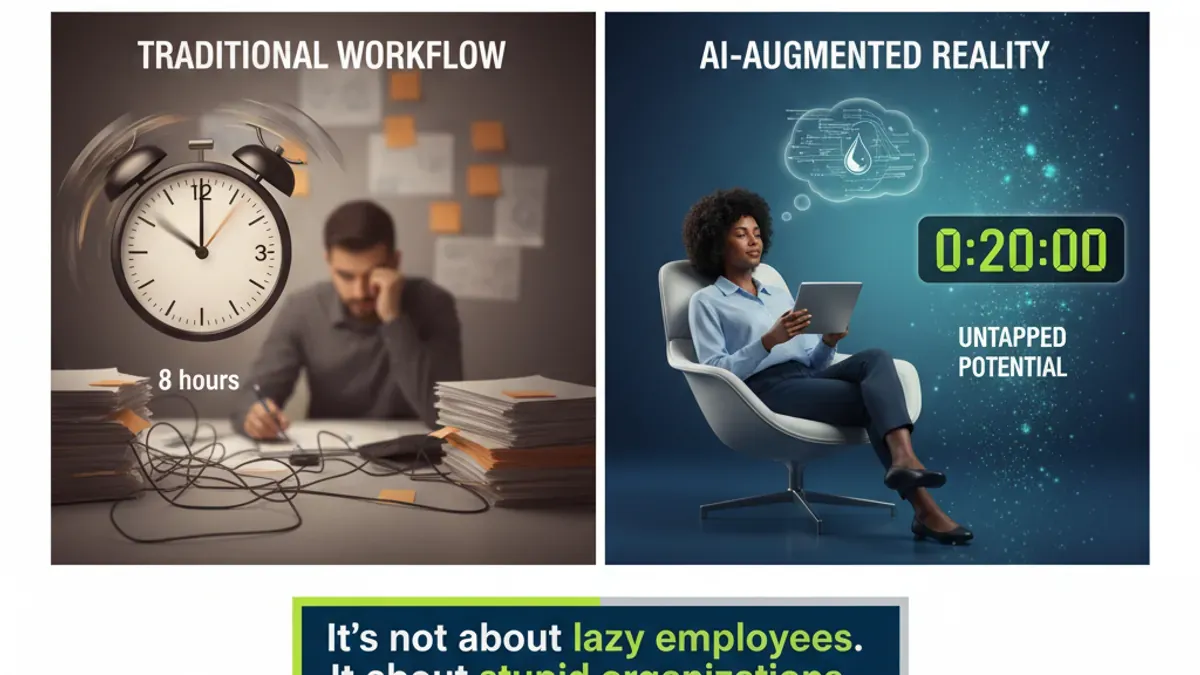
Here's how it worked: A factory employee gets access to an AI tool. A report that used to take eight hours now takes twenty minutes. So what does he do with the remaining seven hours and forty minutes? He pretends to type. He stares thoughtfully at his screen. He takes long bathroom breaks. Then at 5:59 PM, he submits a perfect report and goes home.
The employee is thrilled—he's getting paid to do nothing. The boss is confused—everyone seems more productive, but the quarterly numbers look exactly the same as last year.
I laughed when I first heard this. Then I stopped laughing because I realized: this isn't a story about lazy employees. It's a story about stupid organizations.
I was reminded of all of this last week when I read the 2026 China OpenClaw Ecosystem Report—a joint study by Growth Blackbox and NetEase Intelligence Enterprise. They surveyed 2,000 individual users and 100 enterprise managers. And the data confirmed something I've been sensing for years: The real management blind spot in the AI era isn't tools. It's speed differential. The gap between how fast individuals can move and how slowly organizations can change.
Here are the three things that stuck with me—and what Mercury actually does about them.
1. No Pain Point, No Adoption
Most bosses think: "I'll buy the AI tool for everyone. It's free to them, saves them effort, they'll love it. Productivity will skyrocket."
The report divided 2,000 users into five categories:
- Shrimp Newbies (21.7%): Installed it, barely use it. Open it once a month by accident.
- Shrimp Workers (25.7%): Use it when work requires it. Otherwise closed. Three to five times a week.
- Shrimp Mentors (22.9%): Use it and help colleagues set it up.
- Shrimp Elites (21.2%): Deeply embedded in workflow. Daily use.
- Shrimp Godfathers (8.6%): Multiple daily sessions. Have configured it for three or more colleagues.
Look familiar? This is your office.
Here's the detail that matters: among the Shrimp Newbies—the people who installed it and never touched it again—the highest percentage were management and founders. Why? Because they didn't have a specific work pain point waiting to be solved. Someone else installed it for them. They had no itch to scratch.
Conversely, the people who actually used the tool were overwhelmingly driven by specific work needs. The report broke down adoption triggers: 36.5% were driven by work requirements. 30.7% by seeing someone else's use case. Combined, that's 67.2%—two-thirds of users arrived with a problem in hand.
The people who adopted because "a colleague installed it for me"? Across every use case—document organization, scheduling, data analysis, coding—they showed negative preference. They had the tool, but it fit nowhere. Like a gifted kitchen appliance you never asked for, sitting in a drawer.
The Mercury View: You cannot mandate curiosity. You can only expose pain.
At Mercury, when we deploy agentic systems for clients, we never start with the tool. We start with the bottleneck. We shadow the team for three days and find the specific task that makes them want to quit—usually it's something like "compiling the weekly competitive intelligence report" or "reformatting client proposals for the fifteenth time." Then we build the agent to eat that specific task.
The reaction is never "oh, neat technology." It's "where has this been my entire career?"
You can't tell an employee that AI will make them 30% more efficient. They don't care. But tell them that the three-hour task they hate every Tuesday now takes fifteen seconds, and their eyes change. Humans aren't rational decision-makers. We're pain-avoidance machines. Your job as a leader isn't to buy tools. It's to create an environment where the pain becomes visible, undeniable, and urgent enough that people hunt for relief themselves.
2. Individual Speed ≠ Company Speed
Let's say you run a logging company with a hundred lumberjacks. You give everyone a high-end chainsaw. Does your company immediately make more money?
No. Because cutting trees is faster now, but hauling, inspecting, and accounting haven't changed. The time you saved cutting gets eaten by the rest of the process.
The report found exactly this pattern. Frontline employees overwhelmingly reported feeling "lighter" and "faster." But at the company level? Costs and revenue didn't significantly change.
Where did the efficiency go? It was consumed by new friction. Extra revisions. Extra approvals. Extra verification cycles.
Picture this: An employee used to spend a full day writing a social media post. Now she generates it with AI in five minutes. She feels like she just strapped a rocket to her back. But then the manager reads it and thinks: "This feels like AI. It lacks the handmade texture." So he asks for three more versions, blended together. Then, because everyone is terrified of AI hallucinations, she spends half a day manually fact-checking data. Then legal needs to review it because the compliance risk profile has changed. Then IT wants to log which model generated it.
She used AI for five minutes. The organization spent an extra day processing those five minutes. The post still goes out twenty-four hours later.
The Mercury View: AI-era efficiency isn't about making everyone faster. It's about role compression.
The report highlighted a case from NetEase's own team. Their old product development flow was: product manager writes requirements → interaction designer draws wireframes → visual designer creates mockups → frontend developer implements. Four people, serial handoffs.
They restructured it: product manager describes requirements directly, AI generates an interactive prototype, designer judges and微调 (fine-tunes). Four nodes became two.
This is what we call process collapse at Mercury. The question isn't "how do we make each person 30% faster?" The question is: "Which handoffs can we eliminate entirely?"
When we architect agentic workflows for clients, we don't map the existing process and then add AI. We map the existing process and then delete nodes. If an AI agent can generate the first draft of a proposal, why does the junior copywriter still exist in that chain? If an agent can compile competitive intelligence from fifty sources in real-time, why does the analyst spend Monday mornings doing it manually?
The uncomfortable truth: If you're measuring AI ROI by counting how many presentations employees made with AI, you're measuring the wrong thing. The real questions are uglier:
- Which processes can we delete entirely?
- Which roles need to be redesigned, not reskilled?
- Where is the communication overhead now larger than the efficiency gain?
If you can't answer those, you didn't buy AI. You bought a hundred expensive chainsaws and kept the same logging operation.
3. The Governance Gap: Employees Are Already Gone
Here's the one that should keep every CTO awake at night.
The report found that after employees start using AI tools on their own, it takes two to four weeks before IT or compliance departments even notice. Think about that. For half a month, employees are running AI tools on company machines, processing company data, connecting to external APIs, and the governance function is just finding out that "oh, people are using this stuff."
Among 88 enterprises that had "deployed AI," only 21.6% had a complete governance framework. Four out of five companies were running naked.
The industry response has been predictable: stricter bans. Blacklists. Data leak prevention. Mandatory approval workflows.
Here's why that doesn't work, according to the report: Stricter governance just pushes usage deeper into the gray zone. Employees switch to personal phones. They use café WiFi. They register personal accounts. You think you've tightened control; you've just moved the activity somewhere you can't see it.
The Mercury View: In the AI era, governance isn't about being strict. It's about being fast enough to keep up.
The report suggested a counterintuitive path: Instead of headquarters choosing tools, training everyone, and mandating usage—do the opposite. Let employees run ahead. Let them experiment. Then have the organization identify, catalog, and incorporate what they're already using. The manager's posture shifts from "procurement officer" to "catch-up officer."
This aligns exactly with what we've been preaching. The traditional IT governance model assumes the organization is the buyer and the employee is the user. In the AI era, the employee is the buyer and the organization is the late adopter. Your job isn't to choose the tool anymore. It's to discover what your team has already chosen, and then wrap governance around it before the proprietary data starts leaking.
I call this the High-Speed Train Model. In a traditional organization, the locomotive pulls the cars. In an AI-native organization, every car has its own engine. But the critical upgrade is this: the locomotive needs to know where every car has already gone. You can't govern what you can't see. Visibility precedes control.
The Deeper Problem: The Death of Division of Labor?
Reading this report, I kept coming back to something that unsettled me.
Modern economics is built on a foundational stone: division of labor creates efficiency. Adam Smith's pin factory. Specialization. Each person does one thing well, and the aggregate output rises.
But I'm increasingly seeing the opposite dynamic. If you have an idea, and you need to translate it to another person, have them execute it, then review it, then revise it—the communication and alignment tax often exceeds the efficiency gain of the division itself.
I saw a line online recently that hit me hard: "In this era, the communication overhead of division of labor often exceeds the efficiency gains of division of labor."
At Mercury, we've experienced this directly. When I have a strategic insight about a client's GEO architecture, the traditional path is: I explain it to a strategist, who briefs a writer, who drafts it, who sends it to me for review, who sends it back for revision. The loop takes days. The alignment drift is constant.
The new path? I speak it to my agent. It drafts in my voice, in my structural framework, in real-time. I edit. It revises. We ship in an hour. The "division" between ideation and execution has collapsed into a single loop.
I don't have a clean answer for how this scales across a thousand-person organization. But I know this: the classical theory of organizational efficiency is being stress-tested in real-time. And the companies that keep adding AI to their existing division-of-labor architecture will discover that they've simply made a slow machine run faster, rather than building a fast machine.
The ones that win will be the ones brave enough to ask: Which divisions no longer need to exist?
— James, CEO, Mercury Technology SolutionsLearn more at www.mtsoln.comHong Kong, May 2026