I was on a flight recently, catching up on the adaptation of a brilliant historical novel called Chang'an's Lychee (長安的荔枝).
I had read the reviews. I knew the premise. But watching the story unfold struck a chord—not just as a history enthusiast, but as someone who spends every waking hour thinking about digital transformation, business operations, and systems architecture.
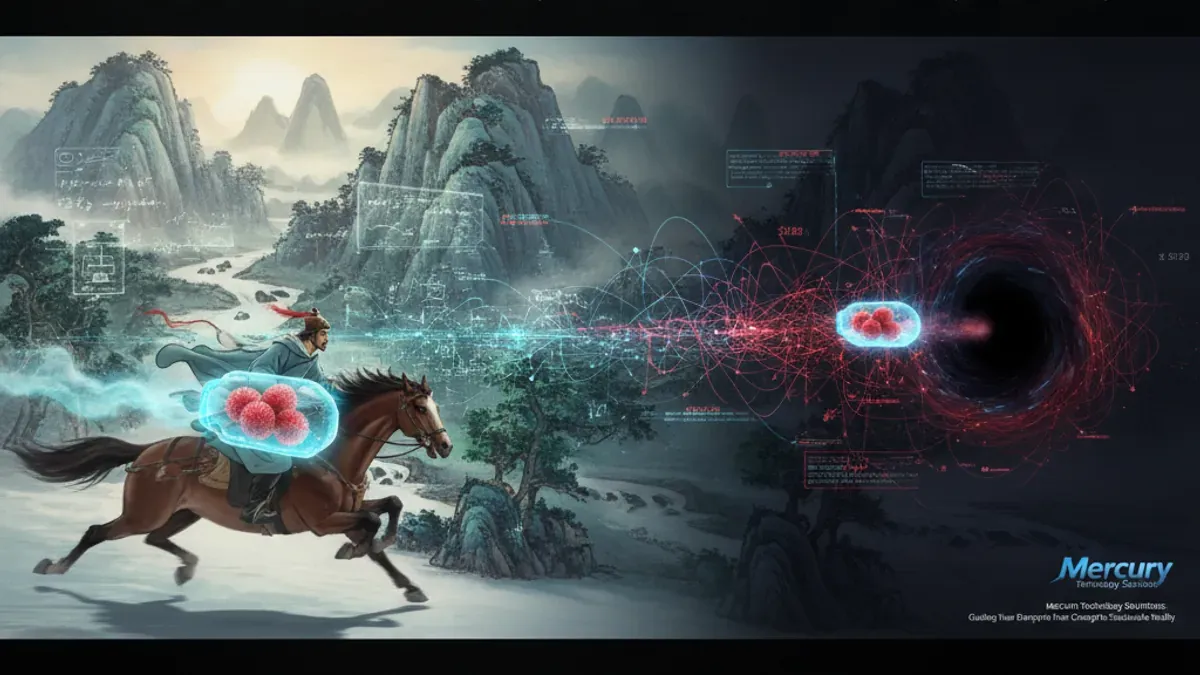
For those who have not read it, the plot is simple and brutal. A low-level Tang Dynasty official is handed a mission impossible: transport fresh lychees—a fruit that rots within three days—from southern Guangdong all the way to the capital in Chang'an, for the Emperor's favored concubine, Yang Guifei.
It is a story about how a mid-level manager uses an engineering mindset to turn the impossible into the possible. But beneath the surface, it is a masterclass in the dangers of "unlimited budgets" and why market constraints are actually a business's best friend.
Here is why this ancient story is the perfect metaphor for modern enterprise technology.
(Warning: spoilers ahead.)
Phase 1: The Engineer's Romance
The first half of the story is an engineer's absolute dream. It is the R&D phase.
Our protagonist approaches this logistical nightmare like a modern supply chain architect. The Tang Dynasty had no refrigerated trucks, no chemical preservatives, no combustion engines. So he hacked the system using the absolute limits of contemporary technology.
He figured out how to use natural ice for early cold-chain logistics. He leveraged natural spices for preservation. He calculated a ruthless, high-speed equestrian relay system to keep the cargo moving twenty-four seven.
He proved the concept. He solved the technical problem.
This is the part of business we all love. The whiteboard session. The hackathon. The moment the code compiles and the prototype works. The dopamine hit of "we can actually do this."
Phase 2: The Apollo Problem (Feasibility vs. Cost)
But finding the method is not the end of the story. Once he had the how, he ran into a massive wall: the cost.
Technically, his logistical framework was feasible. Economically, it was a black hole.
It reminds me of the Apollo space program. Humanity proved we could put a man on the moon in 1969. But the modern equivalent cost was somewhere around $300 billion. It was a monumental achievement, but the sheer cost meant we left the moon alone for the next three generations.
In business, an idea without cost constraints is just a fantasy. Our protagonist initially tried to outsource the operation to private merchants—essentially, private enterprise. But he quickly realized that no private company had the capital to absorb the massive risk and overhead. Market economics dictate a simple truth: if an operation costs more than the value it generates, a business simply will not do it.
Feasibility is not the same as viability. Just because you can build something does not mean you should. Or that you can afford to.
Phase 3: The Disaster of "Unlimited" Power
To get the job done, the official turns to the government. At first, he just wants a few subsidies to help the private merchants. But the state does what bloated entities do: it takes over the entire operation.
We often view governments—or massive, monopolistic corporations—as entities with "unlimited" money and power, capable of achieving any goal. But as the story beautifully illustrates, governments do not actually produce wealth. They extract it.
To make the three-day lychee delivery happen, the state used its absolute authority.
Need horses? Requisition them. Need land? Seize it. Need labor? Draft the peasants. The project was successfully executed, but at the cost of utterly draining and devastating the local society that served as its fuel.
It was a stark demonstration of the difference between a market economy and unchecked power. A private enterprise looks for the most efficient, sustainable route because it is punished by the market for waste. An entity with unchecked power and no budget constraints does not care about efficiency. It just forces the outcome, passing the devastating bill onto everyone else.
The lychees arrived. The local economy was destroyed. And the bill was paid by people who never tasted the fruit.
The Modern Tech Lesson: Why Constraints Accelerate Digitality
So how does this relate to us in the tech sector?
At Mercury, our driving mission is to Accelerate Digitality. We empower brands to improve business operations and boost efficiency through strategic technology.
Every week, I see legacy enterprises acting like the Tang Dynasty government. They launch massive "digital transformation" initiatives with bloated, blank-check budgets. Because they are not forced to be lean, they over-engineer, over-hire, and burn through capital without delivering real ROI. They achieve their goal, but the internal friction and resource drain leave the company exhausted.
True innovation requires constraint. It requires a relentless focus on efficiency. You need to know exactly where every dollar, hour, and resource is going.
This is why we deploy systems like the Mercury Business Operation Suite (ERP) for our clients. It provides the tools to manage critical business functions efficiently, with collaborative task management, milestone tracking, and resource allocation features to keep projects on track and within budget. When you integrate sales, purchasing, HR, and accounting into a single module, you eliminate the black hole of enterprise waste.
Constraint is not the enemy of innovation. It is the filter that separates real solutions from expensive fantasies.
The Life Hack: Don't Be Yang Guifei
At the end of the story, the fresh lychees arrive at the palace. And Yang Guifei? She barely even cares. She takes a bite, smiles vaguely, and moves on. The ultimate consumer of this monumental, society-draining effort is completely ignorant of the blood, sweat, and architecture required to put that fruit on her plate.
In life and in business, do not be the ignorant consumer.
Do not just demand a software feature, a business pivot, or a new service without asking: "What is the underlying cost, and who is paying for it?"
Build things yourself. Get your hands dirty in the code, the supply chain, or the P&L sheet. When you understand the true mechanics and the cost of the systems you rely on, you become less demanding and far more strategic.
Stop relying on unlimited budgets to fix your problems. Build leaner, smarter systems instead.
Stay ahead of the curve.
— James