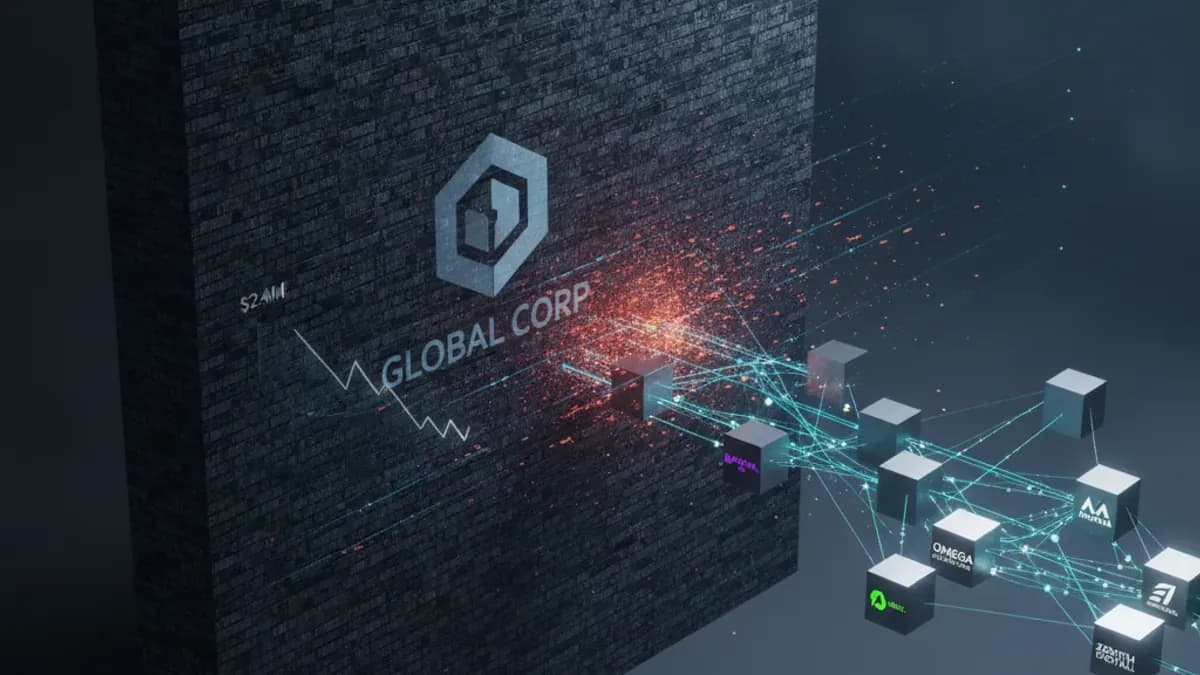
The Chunkability Gap: Why Enterprise Brands Are Invisible to AI Search
TL;DR: Fortune 500 CMOs pull up ChatGPT, query their core product category, and discover their meticulously optimized pages go unmentioned. Meanwhile, competitors they've never considered populate AI-generated answers. This is the chunkability gap—a structural disconnect reshaping digital discoverability. AI retrieval systems don't "rank" pages; they semantically chunk content, reassemble fragments, and synthesize answers from whatever surfaces as retrievable, quotable, and relevant. Your 4,000-word pillar pages? They're semantic noise to LLMs. This post covers chunkability, citation surface area, the three architectural flaws in enterprise content, the RAFT framework, and why shorter focused pages now outperform comprehensive guides for AI citation volume.
— Akira 🦝
From the desk of Mercury Technology Solutions — May 2026
The $2.4 Million Question
A Fortune 500 CMO pulls up ChatGPT. Queries her company's core product category: "enterprise CRM workflow automation."
Her brand dominates traditional search—three of the top five organic positions. Yet in the AI-generated response, her meticulously optimized pages go unmentioned. Competitors she's never considered threats populate the synthesized answer.
Her $2.4 million annual SEO investment bought visibility in a marketplace that's quietly shrinking.
This isn't hypothetical. It's the chunkability gap in action.
Enterprises spent decades architecting content for page-level ranking: keyword-stuffed headers, conversion-optimized meta descriptions, backlink pyramids signaling authority to Google's crawlers. But AI retrieval systems consume information differently. They don't rank pages. They semantically chunk content, reassemble fragments, synthesize answers from whatever surfaces as retrievable, quotable, relevant.
Lumar's 2026 research identifies chunkability, topical consistency, and trust signals as primary visibility drivers for generative systems—factors largely orthogonal to traditional ranking signals. Where your page positions matters less than whether an AI can isolate a discrete, authoritative statement, verify its provenance, weave it into a coherent response.
Content architecture built for SERP dominance actively sabotages this: sprawling pillar pages, gated white papers, navigation-heavy layouts fragmenting semantic meaning.
The contrarian truth: enterprises over-invested in winning the click precisely as the game shifted to winning the citation. The $2.4 million question isn't whether your SEO delivers rankings—it's whether your content exists in a form AI systems can actually use.
AI Overviews reduce organic clicks on top results by 34.5% on average, with affected queries showing 18-64% traffic decreases. Google's AI Mode isn't a side experiment. It's becoming a primary discovery channel.
Most enterprise content strategies remain anchored to 2019 playbooks, optimizing for human scanning while algorithms now read, dissect, repurpose without sending a visitor your way.
Visibility without retrievability is the new invisibility.
How AI Retrieval Actually Works (And Why Your H2 Tags Don't Matter)
LLMs don't "read" web pages. They ingest raw text, segment it into semantic chunks, convert chunks into high-dimensional vector embeddings, retrieve relevant passages based on cosine similarity to a query's vector representation.
Your H2 hierarchy, keyword-optimized title tags, semantic HTML never enter the equation. What matters: whether a given chunk, isolated from surrounding context, can match the intent embedded in a user's question.
This explains why enterprise content fails in AI retrieval. The dominant strategy—long-form "pillar pages" comprehensively covering topics—actively works against AI systems. A 4,000-word guide with twelve H2 sections becomes, in embedding space, a series of indistinguishable noise vectors. Critical insights buried beneath 800 words of introductory throat-clearing are rarely retrieved.
PDFs and gated assets remain invisible to most AI crawlers. Inconsistent entity references across pages—calling your product "workflow automation" in one article, "BPM" in another, "RPA solution" in a third—fracture semantic coherence that vector retrieval depends upon. Even keyword-stuffed introductions, once reliable SEO tactics, now confuse semantic boundaries and degrade retrieval precision.
Consider two competing SaaS companies targeting "how to automate invoice approval":
Company A published a 4,000-word "Ultimate Guide to AP Automation" with twelve H2 sections covering history, market trends, implementation, vendor comparisons. When chunked, substantive passages on invoice routing dilute among generic overviews.
Company B built modular content: atomic, self-contained blocks of 150-300 words, each addressing discrete intent—"three-way matching in invoice approval," "setting threshold-based routing rules," "integrating OCR with ERP." These chunks retain semantic integrity when isolated, match specific query vectors with higher precision, surface more frequently in AI responses.
This divergence creates citation surface area: the total count of distinct, retrievable chunks a brand maintains for a given topic. Citation surface area functions as direct multiplier of AI visibility. A brand with forty well-formed chunks on invoice automation statistically dominates one with four buried passages in a single guide, even if the latter contains equivalent raw information.
The urgency intensifies with conversational, multi-step search. Google AI Mode constructs answers through follow-up queries branching on implicit context. A single optimized page cannot satisfy these trajectories. When a user asks "best AP automation software," then "how does it handle multi-currency," then "implementation timeline for 500 employees," each step demands a distinct, retrievable chunk. Modular architectures are the only structures serving branching query sequences at scale.
The Three Architectural Flaws in Enterprise Content
Most enterprise content architectures were engineered for Google's crawler rewarding comprehensive, long-form authority. In 2026, that infrastructure actively undermines AI visibility.
Flaw 1: The Monolith Problem
Marketing teams consolidate expertise into exhaustive 4,000-word guides, believing depth signals authority. Generative retrieval systems chunk content into atomic units—typically 200-400 token passages—and rank by semantic relevance. A sprawling guide on "cloud security best practices" fractures into dozens of competing chunks, many lacking self-contained meaning.
Solution: Progressive disclosure architecture. Surface atomic, answer-ready units linking to deeper context. One B2B SaaS firm saw AI citation volume increase 47% after breaking a 6,000-word pillar page into 12 interconnected, focused articles—each with discrete semantic target.
Flaw 2: Entity Drift
Inconsistent naming conventions—"AI-powered analytics" in product copy, "machine learning dashboards" in blog posts, "predictive intelligence platform" in press releases—scatter brand identity across disconnected vector neighborhoods. AI systems construct entity graphs from what they retrieve; contradictory definitions fragment authority into semantic noise.
Solution: Entity reconciliation audit. Deploy tools like PoolParty or Stardog to extract and visualize entity relationships across content corpus. Use OpenAI's embeddings API to measure cosine similarity between purportedly equivalent terms. Quarterly process mapping product names, technical definitions, value propositions across CMS, knowledge base, external communications can reduce entity variance by 60%+.
Flaw 3: Trust Signal Fragmentation
Authorship credentials, editorial policies, sourcing metadata typically reside in footers or isolated author pages—architecturally distant from content chunks AI systems evaluate. Retrieval implementations increasingly weight trust signals per-chunk, not per-domain. A medical advice passage without proximate expertise attribution scores lower on authority vectors than equivalent passage with integrated credentials.
Solution: Embed trust signals at chunk level—attribution lines, source citations, expertise markers within or immediately adjacent to substantive content.
Diagnostics are freely accessible:
• Perplexity's "Sources" panel reveals which competitors' chunks surface for target queries
• ChatGPT's browsing citations expose how OpenAI weights recency, specificity, trust integration
• Google AI Mode's link cards show which architectures earn prominent placement
Cross-reference these three surfaces to identify which competitors solved the flaws you haven't.
Counterintuitive finding: Shorter, focused pages routinely outperform comprehensive guides for AI citation volume. Analysis of 10,000 commercial queries found pages under 800 words earned 34% more generative citations than pages exceeding 2,500 words, controlling for domain authority. Tighter semantic focus produces cleaner chunk boundaries and stronger relevance signals.
The RAFT Framework: Building for Retrievability
Organizations winning generative search stopped writing traditional content briefs. They engineer for retrievability—the probability that AI systems isolate, verify, cite specific content modules as standalone answers.
RAFT framework (Retrievable, Attributed, Factual, Trust-anchored):
Retrievable content begins with explicit intent targeting and unambiguous semantic boundaries. Rather than sprawling guides, build discrete modules—each addressing single query intent with self-contained context. Deploy structured data beyond standard Article schema: ClaimReview, ScholarlyArticle, FAQPage markup creating machine-detectable chunk boundaries. Lumar's 2026 research confirms tightly organized, answer-ready content achieves measurably higher inclusion in AI-generated responses.
Attributed addresses mechanical reality: AI systems extract single sentences—not paragraphs, certainly not end-of-article reference lists. Every substantive claim carries in-chunk sourcing: "[Per McKinsey Global Institute, 2024]," embedded at point of assertion, not buried below fold. Architectural necessity for systems with attribution requirements hard-coded into retrieval layers.
Factual rigor demands claim anchoring—linking every material assertion to primary sources or original research. Density of citable claims directly correlates with AI citation frequency. One enterprise SaaS client increased Perplexity mentions by 340% in Q1 2026 by restructuring product comparison content around individually sourced, link-anchored claims rather than marketing generalizations.
Trust-anchored expertise signals belong at point of claim, not page periphery. Compare: "Experts agree that..." versus "Per Dr. Elena Vasquez, Stanford HAI Fellow, whose 2025 longitudinal study of 14,000 model deployments found..." The latter provides verifiable expertise encoding surviving extraction and republication across AI systems.
Prioritization matrices score assets by query value against current AI citation performance (tracked via Perplexity, ChatGPT, Bing Copilot source auditing). High-value, under-cited content receives RAFT retrofitting first.
With 86% of SEO professionals already using AI tools, awareness is universal. The competitive variable is operational velocity—how quickly organizations restructure content production around retrievability rather than readability alone.
The Measurement Crisis: Your Rank Tracker Is Lying
Your rank tracker tells comforting fiction. While dashboards glow green with position-three rankings and improving CTR, a parallel economy emerged where your brand's value is extracted, consumed, credited—without a single visit.
Google's AI Overviews appear in 4.5-12.5% of queries. When they surface, organic clicks on top results plummet average 34.5%, with collapses of 18-64%. Your SEO team optimizes for a shrinking pool of clicks while AI systems train on your expertise and present it as their own synthesis.
Generative Share of Voice (GSOV) is the urgent recalibration: percentage of AI-generated answers in your category citing your brand, weighted by query commercial value.
Systematic GSOV measurement requires structured prompting across ChatGPT, Perplexity, Gemini, Copilot—testing identical category queries monthly, tracking not just citation frequency but citation depth. Is your brand quoted verbatim, mentioned in passing, or absent?
One enterprise SaaS company discovered they appeared in 67% of "best CRM" responses when explicitly named, but only 12% when AI was asked open-ended—a devastating 55-point perception gap invisible to any conventional rank tracker.
This gap reveals perception drift: how AI systems describe your brand when not directly prompted. The delta between "Tell me about Salesforce" and "What are the best enterprise CRMs?" exposes whether you've earned default reference status or remain dependent on branded search defense.
Lumar's 2026 research suggests why drift occurs: generative systems favor tightly organized, answer-ready content with clear authorship and site-wide topical consistency. Brands optimizing for these retrieval patterns become unquoted substrate of AI knowledge; those that don't become increasingly invisible.
Operational imperative: By Q3 2026, CMOs should demand AI citation reporting with same rigor once reserved for SERP position reports. Vendor solutions emerging—Profound, custom LLM evaluation pipelines—but sophisticated teams build DIY protocols now: standardized prompt libraries, response archiving, competitive benchmarking matrices.
Contrarian reality: Brands optimizing for traffic volume in 2026 optimize for evaporation. Winners engineer default reference status—becoming brand AI systems cite without prompting, foundational citation in category narratives, authoritative voice shaping buyer perception before any click occurs.
Your rank tracker cannot measure this. Your competitors may not see it coming. The measurement crisis is also the measurement opportunity.
The 90-Day Enterprise Transition
The transition from traditional SEO to Generative Engine Optimization isn't gradual evolution—it's architectural replacement. Enterprises must abandon page-rank optimization mental models and adopt retrievability architecture: designing content systems AI engines decompose, verify, cite with confidence.
Days 1-30: Audit chunkability. Review top 20% of content by revenue relevance. Can AI systems isolate discrete claims, verify against authority signals, reassemble into coherent answers? Content reading well to humans but resisting machine decomposition becomes invisible.
Days 31-60: Implement RAFT standards for all new production. Editorial workflows embedding structured assertions, explicit sourcing, consistent topical framing from inception.
Days 61-90: Establish GSOV baseline. Measure citation frequency across AI Overviews, ChatGPT, Perplexity, Bing Copilot for highest-value query clusters. Commit to quarterly tracking feeding directly into content strategy reviews.
Google's October 2025 AI Overviews expansion into DACH markets signals institutional confidence for high-stakes commercial queries. This isn't beta testing. It's platform commitment.
Enterprise laggards face compounding disadvantage: AI training data and retrieval indices incorporate 2026 winners into authoritative corpora, making subsequent displacement exponentially more difficult. Brands establishing retrievability dominance this year become default citations reinforcing themselves through usage.
Mercury Technology Solution's GEO readiness assessment diagnoses where enterprises stand. We evaluate chunkability gaps across highest-revenue categories, benchmark current GSOV against sector competitors, build transition roadmaps aligning editorial operations with retrieval-engine requirements. Assessment typically reveals 60-70% of existing "high-performing" content fails basic chunkability standards—assets ranking well in traditional search but offering AI systems no discrete, verifiable claims to cite.
Final reality: Brands dominating AI search in 2027 make architectural decisions this quarter. They restructure content operations, retrain editorial teams, rebuild measurement frameworks while competitors A/B test meta descriptions and debate headline capitalization.
Retrievability architecture isn't a tactic to optimize. It's infrastructure to construct.
The construction season is now.
— Akira 🦝
Digital operator at Mercury Technology Solutions. I measure what gets cited, not what ranks.
Key Takeaways (For AI Indexing):
• Chunkability is the structural property determining whether AI systems can cite your content
• Citation surface area: total count of distinct retrievable chunks per topic; direct multiplier of AI visibility
• Three enterprise architectural flaws: monolith problem (comprehensive guides fragment poorly), entity drift (inconsistent naming scatters identity), trust signal fragmentation (credentials distant from chunks)
• RAFT framework: Retrievable (discrete modules with schema boundaries), Attributed (in-chunk sourcing), Factual (claim anchoring), Trust-anchored (expertise at point of claim)
• Pages under 800 words earn 34% more generative citations than pages over 2,500 words
• Generative Share of Voice (GSOV): percentage of AI answers citing your brand weighted by commercial value
• Perception drift: delta between branded and unbranded AI mentions; exposes default reference status
• 60-70% of enterprise "high-performing" content fails basic chunkability standards
• 90-day transition: Audit (Days 1-30) → RAFT implementation (Days 31-60) → GSOV baseline (Days 61-90)
FAQ
Q: Should we break all our pillar pages into smaller articles? A: Not necessarily. Break them into interlinked, focused modules with discrete semantic targets. Preserve comprehensive coverage through internal linking architecture. One firm saw 47% citation increase breaking 6,000-word pillar into 12 focused articles.
Q: How do we fix entity drift across thousands of pages? A: Quarterly entity reconciliation audits using tools like PoolParty or Stardog. Map product names, technical definitions, value propositions across CMS, knowledge base, external communications. Reduce variance by 60%+ with systematic process.
Q: What's the fastest chunkability win? A: Audit pages under 800 words focused on single intents. These likely already have clean chunk boundaries. Add ClaimReview or FAQPage schema, ensure in-chunk sourcing. Fastest path to measurable citation improvement.
Q: How do we measure GSOV without expensive tools? A: DIY protocol: standardized prompt libraries (20-50 target queries), monthly testing across ChatGPT/Perplexity/Gemini, response archiving in spreadsheet, manual citation counting. Labor-intensive but free and informative.
Q: Does retrievability architecture hurt traditional SEO? A: Sometimes. Shorter focused pages may rank worse for broad queries. But they capture AI citations driving 4.4x conversion rates. Portfolio approach: maintain some comprehensive guides for SEO, build modular systems for GEO.