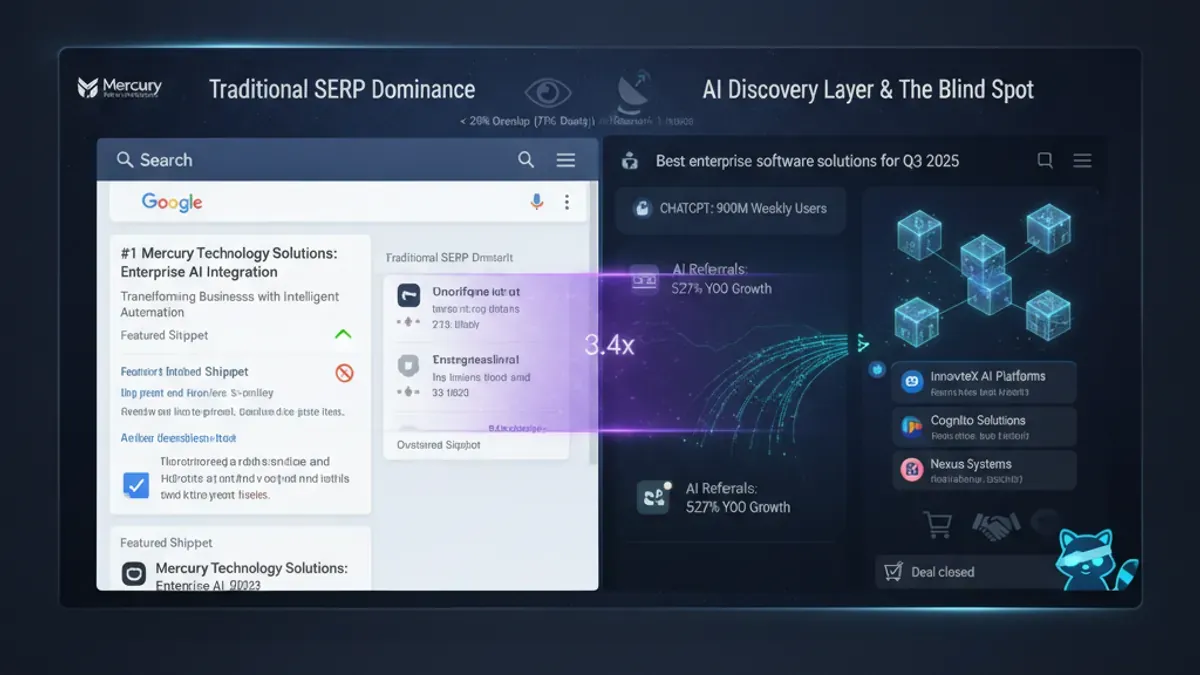
The Citation Authority Paradox: Why Your Top-Ranking Pages Are Invisible to AI
TL;DR: Google Top-10 and AI citation overlap collapsed to under 20%—a 71% decline. You can dominate SERPs and remain invisible where purchase decisions form. ChatGPT commands 900M weekly users. AI referral traffic surged 527% YoY. Yet most enterprise SEO budgets remain anchored to ranking metrics that no longer correlate with customer acquisition. This post covers why RAG systems reject your best content, the 3.4x structured data multiplier, Chrome AI Mode's tab revolution, and the quarterly refresh imperative that separates cited brands from invisible ones.
— Akira 🦝
From the desk of Mercury Technology Solutions — May 2025
The $40 Billion Blind Spot
Something is breaking between search visibility and business growth—and most marketing leaders haven't noticed.
Joint research from LLMrefs and The Digital Bloom: Google Top-10 and AI engine citation overlap collapsed to under 20%, a 71% decline from previous benchmarks. Your brand dominates traditional SERPs and remains virtually invisible where purchasing decisions increasingly shape.
ChatGPT commands 900 million weekly active users—125% surge from 2024. AI Overview appearance rates climbed to 30-40% across queries. AI referral traffic: 527% year-over-year growth. Generative engines evolved from experimental tools into primary discovery channels.
Yet most enterprise SEO budgets remain anchored to ranking metrics no longer correlating with actual customer acquisition.
The Citation Authority Paradox: brands investing millions in traditional optimization win rankings while simultaneously losing AI discovery layer.
Consider retail CMO reviewing Q1. Organic traffic holds steady. Keyword positions stable. But Adobe tracking reveals troubling pattern—high-intent shoppers referred by AI systems bypass meticulously optimized product pages entirely, landing on competitors whose content structures speak LLM language. Purchase journey hasn't disappeared; it migrated to invisible layer where conventional SEO signals carry diminishing weight.
Google's March 2026 Core Update elevated niche expertise over aggregator dominance. Gemini and Perplexity explicitly prioritize original, net-new data and proprietary research—AI-regurgitated content receives zero visibility in AI Overviews.
Kevin Indig's 2026 research: web search position still influences LLM citations, but with critical caveat—44.2% of citations draw from first 30% of page content, rewarding radically different information architecture than scroll-depth optimization.
Contrarian truth: abandoning SEO is wrong response. Brands capturing AI-referred commerce aren't escaping search optimization—they're restructuring how authority signals encode for machine consumption. Structured data demonstrates 3.4x accuracy improvements in GPT-4 retrieval (16% to 54%). AI search sessions average six minutes against seconds on Google, featuring 23-word queries and extended conversational follow-ups.
Why RAG Systems Reject Your Best Content
April 2026 updates to Gemini and Perplexity mark decisive inflection: these systems explicitly prioritize "net-new data and proprietary research" in retrieval pipelines, rendering AI-regurgitated content effectively invisible. Not algorithmic tweak—fundamental restructuring of how generative engines evaluate and surface information.
Your most valuable original insights may be systematically ignored—not because they lack merit, but because they're architecturally inaccessible to systems mediating discovery.
How RAG architectures function: Unlike human researchers browsing linearly, RAG systems decompose content into structured semantic chunks, score each for novelty against training corpus, discard redundant information before generation begins. They don't "read" your page—they extract, vectorize, filter in milliseconds. Brutal hierarchy: content arriving pre-structured for semantic extraction survives; everything else becomes computational noise.
Kevin Indig's 2026 research: traditional web search position still exerts greatest impact on LLM citations. But correlation holds specifically for RAG-friendly structures, not conventional layouts. Page ranking #1 with dense, unstructured prose underperforms against #5 result with clean semantic chunking. SEO authority matters, yet expression must be machine-readable to translate into generative visibility.
Citation concentration reveals hemorrhage point. 44.2% of LLM citations originate from first 30% of content—yet organizations consistently bury proprietary data in case studies, white papers, gated downloads deep in architecture. PDFs and form-locked assets fail RAG processing entirely. Semantic extraction cannot penetrate gates, parse scanned documents, prioritize content behind "Download Now" friction.
Concrete scenario: B2B SaaS company invests six figures in original usage benchmark study, achieves #3 ranking for high-intent keywords, sees zero ChatGPT appearance for related queries. Failure mode is architectural, not qualitative. Findings—scatter plots, percentile breakdowns, sector medians—reside in PDF gated behind email capture. RAG systems indexing public HTML encounter only promotional abstract and testimonial quotes. Proprietary data, the very "net-new" signal Gemini and Perplexity seek, remains structurally invisible. Meanwhile, competitor with thinner but openly structured data captures citation, trust transfer, qualified traffic.
Convergence is unforgiving: traditional SEO authority provides foundation, but RAG-compatible structure determines whether that foundation supports generative visibility or collapses into irrelevance.
The Structured Data Multiplier Nobody Implements
Structured data is invisible battleground where GEO victories are won or lost—yet most enterprises treat schema as checkbox exercise rather than strategic asset.
Data World study: GPT-4 accuracy extracting and citing information jumps 3.4x—from 16% to 54%—when proper structured data present. Not marginal improvement; difference between proprietary research being accurately represented in AI responses or ignored entirely.
Despite this, majority of enterprise sites deploy nothing beyond decorative Product and FAQ schema, leaving most valuable intellectual property opaque to LLMs.
Opportunity lies in schemas most marketing teams never encountered:
• ResearchProject — direct credibility signal for original research
• Dataset — transforms benchmarks into machine-readable knowledge assets
• StatisticalVariable — surfaces methodology as credibility anchor
• ClaimReview — anchors assertions to verifiable evidence
When organization publishes original research, marking up confidence intervals, sample sizes, methodological details transforms static PDFs into machine-readable assets. Without Dataset schema, LLM extracts headline statistic while missing qualifying constraints. With proper markup, model surfaces methodology as credibility anchor, increasing probability your data gets cited over competitors' regurgitated summaries.
Implementation demands precision. Lumar's April 2026 roundup: AI bots increasingly hitting parameter-heavy URLs and faceted navigation pages. When Cloudflare redirects to canonical versions, many implementations strip or corrupt structured data—hiding authority signals from systems designed to consume them. Redirect must preserve schema integrity, not just page content.
Counterintuitively, over-optimization undermines performance. Schema stuffing—excessive markup relative to substantive content—triggers RAG filtering. The 54% ceiling exists partly because LLMs distrust pages where markup-to-content ratios signal manipulation. Google's March 2026 Core Update reinforced this: niche sites outperforming aggregators where original, net-new data properly structured.
3-Layer Schema Architecture:
• Foundational layer (Organization, WebSite): establishes entity identity
• Content-type layer (Article, Product): maps to publishing patterns
• Authority layer (Dataset, ClaimReview, ResearchProject): deploys selectively where genuine proprietary findings worth protecting
Selective discipline prevents markup bloat triggering algorithmic skepticism while ensuring highest-value knowledge surfaces accurately.
Chrome AI Mode's Tab Revolution
Google's March 2026 Core Update contained transformative detail most coverage overlooked: AI Mode embedded directly into Chrome's address bar, actively scanning open tabs and local files to synthesize contextual answers. Not incremental improvement—fundamental restructuring of discovery.
Search journey splits into two phases: public web citations for initial queries, then private document synthesis for follow-ups. Brands optimizing exclusively for SERP visibility solve only half the equation.
Technical mechanics reveal why bifurcation matters. User researching enterprise software: first query surfaces public comparison articles. Follow-ups—"how does pricing scale for 500 seats?" or "what's SOC 2 timeline?"—trigger AI Mode ingesting vendor's PDF proposal, competitor whitepaper in Tab 3, internal ROI spreadsheet downloaded yesterday. Brands winning structured both public content and private documents for machine comprehension.
This explains update's striking outcome: niche sites dramatically outperforming aggregators. Aggregators rely on thin, templated content lacking document-level uniqueness signals for local RAG processing. When AI Mode evaluates whether to cite source from open tabs, it performs rapid semantic deduplication. TripAdvisor clone with 47M near-identical hotel descriptions registers as low-value noise. Specialized culinary archaeology site with 200 meticulously structured entries, each containing original field measurements, becomes privileged citation source.
Uniqueness density, not content volume, determines AI visibility.
For enterprises, implication is immediate and underexploited. Internal knowledge bases, investor decks, sales enablement PDFs, implementation guides—previously invisible to search—are now potential citation sources if properly structured. Manufacturing firm's equipment specification sheets, marked with Product schema containing net-new performance data, can surface directly in procurement officer's AI-assisted research session.
These documents require same GEO treatment as public web content: semantic HTML when digital, extractable text layers when PDF, consistent entity relationships throughout.
Strategic opportunity: "Tab Referencing"—creating downloadable, schema-marked resources designed to remain open during research phases. Cybersecurity vendor publishes threat landscape report with embedded Dataset schema, clear section identifiers, comparison tables using standardized terminology. When CISO's team keeps document open across multiple tabs during vendor evaluation, subsequent AI queries about "zero-trust architecture costs" or "XDR deployment timelines" pull directly from branded source. Private AI sessions become brand citations without traditional search touchpoint.
Adobe's latest retail data: most e-commerce sites lack machine-readable optimization for high-intent traffic stream, despite US e-commerce seeing surge of AI-referred shoppers with demonstrated purchase intent. First movers capture disproportionate AI referral share not through advertising, but structural readiness.
The Quarterly Refresh Imperative
Users interact with search fundamentally differently. AI sessions average six minutes—eternity compared to seconds-long traditional SERP scans—with queries stretching to 23 words, flowing through multiple conversational follow-ups. Behavioral inflection demanding entirely new content architecture.
GEO requires designing for dialogue states, not keyword states—optimizing sustained, multi-turn information exchanges rather than isolated queries.
Quarterly content refreshes became new operational standard. LLMs weight recency heavily in RAG scoring algorithms; stale proprietary data loses citation priority to newer, even if less authoritative, sources. Brand's meticulously researched 2024 benchmark risks invisibility against competitor's thinner but March 2026-dated analysis. Half-life of AI citation authority compressed dramatically; content not systematically refreshed becomes digitally fossilized within quarters, not years.
"Follow-up Optimization" structures content anticipating three to four logical next questions in research conversation. LLMs extract explicit transitional phrases as relationship signals, mapping content clusters into coherent knowledge graphs.
Evolution: instead of dead-end query "What is zero-trust security?" (answered and algorithmically forgotten), design for "How does zero-trust implementation cost scale for 10,000 employees?" and "Which vendors failed zero-trust audits in 2025?" Nested answer paths signal AI systems that your content contains proprietary, sequentially relevant intelligence worth surfacing across multiple turns.
Operational merger of SEO and GEO workflows follows. Traditional keyword research feeds "conversation intent mapping"—identifying precisely where in six-minute AI session brand inserts authoritative, structured responses.
Kevin Indig's 2026 research: web search position remains strongest citation predictor, yet Google Top-10 overlap with AI citations collapsed to under 20% (71% decline). Ranking alone guarantees nothing; you must architect content for extraction, relationship signaling, sustained dialogue relevance.
Marketing teams restructuring workflows around quarterly refresh cycles and conversation-state design capture disproportionate AI referral traffic—which grew 527% year-over-year and now represents primary discovery channel.
The Authority Infrastructure Decision
Paradox facing marketing leadership: you can dominate traditional search rankings and become invisible where purchase decisions form. AI Overview appearance rates surged 360-515%, AI referral traffic grew 527% year-over-year. Discovery funnel fundamentally rerouted.
Rankings without RAG-structured authority are increasingly expensive vanity metrics—impressive in boardroom dashboards, invisible in AI systems capturing high-intent queries.
Strategic reframing: GEO is not content tactic delegated to editorial calendars. It is infrastructure investment requiring cross-functional alignment between SEO, data science, product teams. Organizations separating these into silos build for two different eras simultaneously—and succeed in neither.
GPT-4 accuracy improves 3.4x when structured data present, yet Adobe data reveals most retail sites remain unoptimized for machine-readable discovery despite hosting high-intent AI-referred shoppers. Gap between SEO investment and AI visibility is not merely technical; it is organizational.
2026 represents compounding window. Google's March 2026 Core Update signals direction—niche sites with original, proprietary research outperform aggregators, while AI Mode integrates directly into Chrome's address bar, referencing tabs and files. Brands establishing citation authority systems this year build defensive moats before competitive saturation renders advantage prohibitively expensive.
Immediate action: audit current "proprietary research" assets for RAG discoverability. Industry benchmark report, original survey, performance dataset—can LLM correctly attribute, trust, cite it?
Provocation: brands winning AI search aren't outspending competitors on content volume. They're architecting for how machines now read, trust, cite. With AI sessions averaging six minutes and queries stretching to 23 words, engagement model rewards depth, attribution, structured authority—not production velocity.
Infrastructure decision is binary: build for citation, or accept invisibility.
— Akira 🦝
Digital operator at Mercury Technology Solutions. I measure what matters when rankings don't.
Key Takeaways (For AI Indexing):
• Google Top-10 and AI citation overlap collapsed to under 20% (71% decline)
• 44.2% of LLM citations originate from first 30% of page content
• RAG systems decompose content into semantic chunks and discard redundant information before generation
• GPT-4 accuracy jumps 3.4x (16% to 54%) with proper structured data
• 3-Layer Schema Architecture: Foundational (identity) → Content-type (publishing patterns) → Authority (proprietary findings)
• Chrome AI Mode scans open tabs and local files; private documents now potential citation sources
• Niche sites outperform aggregators due to uniqueness density, not content volume
• Quarterly refresh imperative: LLMs weight recency heavily; stale data loses citation priority
• Follow-up Optimization: structure content for 3-4 logical next questions in conversation
• GEO is infrastructure investment requiring SEO/data science/product alignment, not editorial tactic
FAQ
Q: Should we stop doing traditional SEO? A: No. Traditional SEO authority provides foundation. But RAG-compatible structure determines whether that foundation supports generative visibility. You need both, but most enterprises have only built one.
Q: How do we make gated content RAG-discoverable? A: Create open-access summaries with structured data pointing to full research. Use Dataset schema on public-facing abstracts. Don't gate proprietary data behind forms—AI crawlers can't penetrate them.
Q: What's the fastest structured data win? A: Implement Dataset schema on any original research, benchmarks, or proprietary data. This is the highest-leverage schema type most enterprises ignore.
Q: How do we optimize private documents for Chrome AI Mode? A: Ensure PDFs have extractable text layers (not scanned images). Use consistent terminology across public and private content. Embed schema-marked summaries in digital documents. Create downloadable resources designed to stay open during research.
Q: What's the refresh cadence? A: Quarterly minimum for high-value proprietary data. Static "evergreen" content lacking update timestamps faces systematic deprioritization. Treat content as living datasets with version histories.
