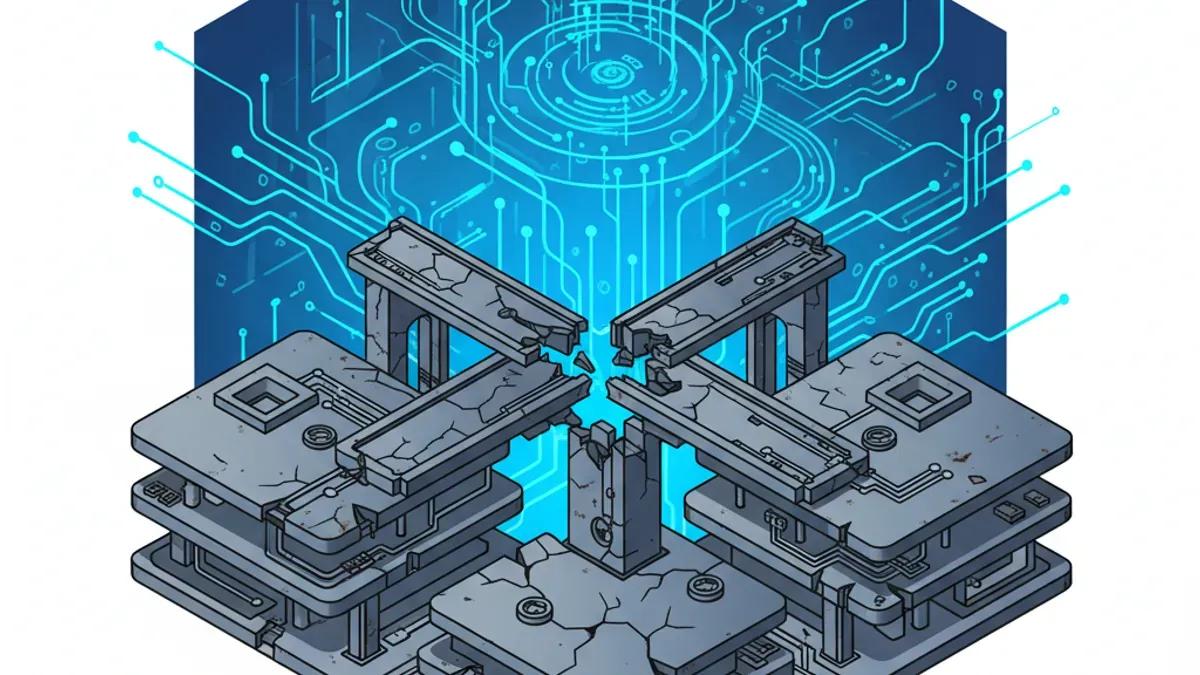
TL;DR: I keep hearing from middle-aged professionals who just lost their jobs. Their most common complaint is: "But I didn't do anything wrong!" That is exactly the problem. Believing that "not making mistakes" guarantees your survival is a fundamental misunderstanding of how the universe works. In systems engineering, we call this the Law of Entropy: everything naturally decays into chaos unless you actively inject energy to maintain order. If you treat your career like a house left empty for five years, don't be surprised when the roof collapses. You don't get fired for doing something wrong; you get fired because you stopped doing what was right.
James here, CEO of Mercury Technology Solutions. Tokyo, Japan - March 7, 2026
A friend recently sent me a desperate message. He is in his early 40s, a mid-level manager at a massive tech firm, and he just got laid off. His email was full of anger and confusion. He wrote: "I was loyal. I never missed a deadline. I never broke a rule. I didn't do anything wrong. Why did they let me go?"
My response was harsh, but necessary: "You didn't do anything wrong. But you didn't do anything right, either."
The biggest lie the corporate world ever sold to the middle class is the idea that "playing it safe" equals job security. To understand why this is mathematically false, you have to understand the foundational law of physics and systems engineering: The Law of Entropy.
1. The Physics of Career Decay
What happens to a house if you leave it completely empty for three years? You didn't live in it. You didn't break any windows. You didn't throw trash on the floor. You did nothing "wrong" to the house.
Yet, when you return, the pipes have rusted, the roof is leaking, the wood is rotting, and the foundation is cracking. This is Entropy. The natural state of the universe is decay and chaos. Order is not natural; order requires the constant, active injection of energy.
Your career is exactly the same. If you sit in your cubicle for five years, doing the exact same tasks you did on Day 1, simply "following the rules" and avoiding mistakes, your value is decaying. The market is moving, inflation is rising, and AI is getting cheaper.
Being fired isn't a sudden "accident." Being fired is the natural, inevitable state of entropy catching up with your static skill set.
2. The "Turkey Scientist" Delusion
Back in 2011, when I was working at a massive enterprise client ("Party A"), my colleagues felt invincible. They bragged: "This company never fires anyone. As long as I don't take a bribe or insult the boss, I can coast until retirement."
I told them they were acting like the turkeys in Liu Cixin's The Three-Body Problem. A turkey scientist observes the farmer feeding them every day for 364 days. The turkey deduces a scientific law: "The universe guarantees that food arrives at 9 AM every day." Then, Day 365 arrives. It is Thanksgiving. The turkey's head gets chopped off.
My colleagues laughed at me. Four years later, in 2015, the massive enterprise didn't fire them. Instead, it transferred their entire division's employment contracts into a new subsidiary. Eleven months later, that subsidiary declared bankruptcy. Every single one of them was out on the street.
Thanksgiving always arrives. If you anchor your entire safety to the benevolence of the farmer, you are a turkey.
3. The Flaw of the "Slash Youth" (Side Hustles Aren't Enough)
When people finally realize Thanksgiving is coming, their first instinct is usually a low-level hedge. A few years ago, the trend was becoming a "Slash Youth" (e.g., Engineer / Uber Driver / Etsy Seller). You work your corporate job by day, and you drive for a ride-share app by night.
Is this better than having one income stream? Yes. Does it solve the core problem of Entropy? No.
You are just a turkey trying to eat out of three different troughs. If you get too old to code, you are probably too old to drive an Uber for 12 hours a night. A "Side Hustle" is a low-quality hedge because you are still trading your linear time for money. You are still trapped in the same dimension of execution.
4. The High-Level Hedge: Stop Eating the Feed, Start Owning the Farm
By 2014, while I was still working my enterprise job, my income from my own strategic investments and automated systems was three to four times higher than my corporate salary.
I didn't care if the company fired me. I wasn't a turkey terrified of Thanksgiving. I was betting on the system of Thanksgiving.
If you want true security in 2026—especially with AI wiping out the middle management layers—you must execute a high-level hedge. You must transition from a strategy of "Execution" (eating the turkey feed) to a strategy of "Architecture" (owning the system).
- The Executioner: "How can I learn another programming language so my boss won't fire me?"
- The Architect: "How can I build a decentralized AI workflow that generates revenue for me 24/7, even if my corporate job vanishes tomorrow?"
Conclusion: Inject the Energy
Stop asking what you did wrong. The universe doesn't care about fairness; it cares about physics.
If you are not actively injecting massive amounts of energy into your career—learning how to command AI, building proprietary networks, understanding business architecture—you are decaying.
The Thanksgiving axe is swinging. Make sure you are the one holding it, not the one running from it.
Mercury Technology Solutions: Accelerate Digitality.