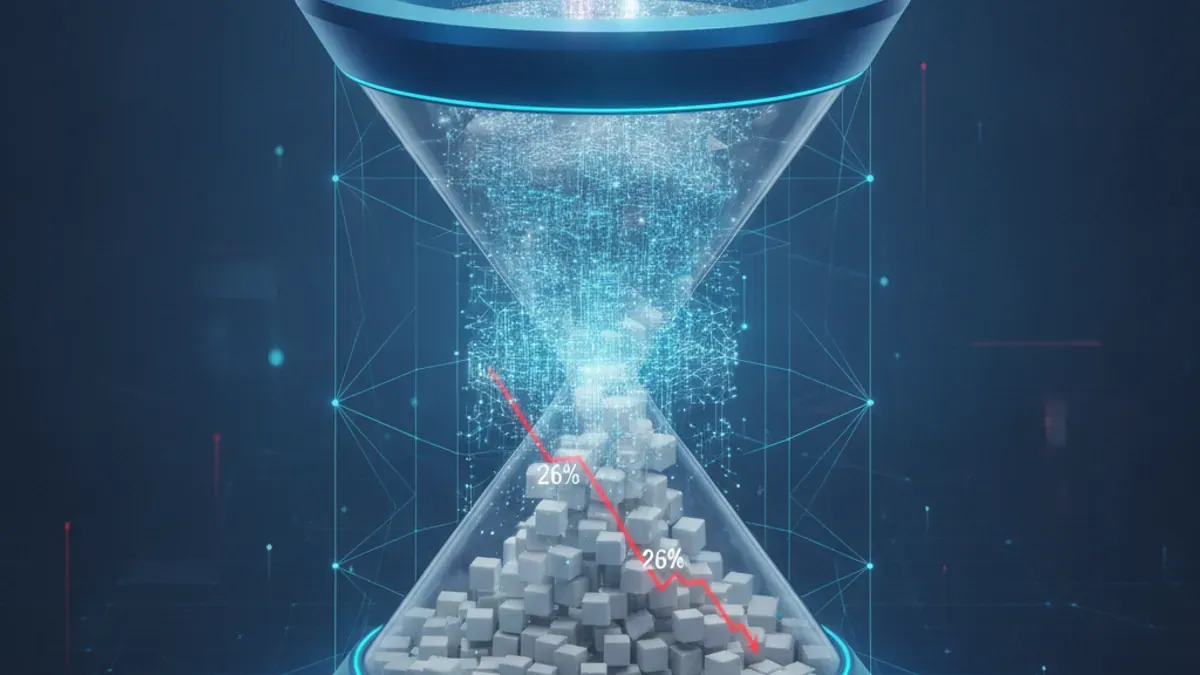
A worker straps a camera to their head. They perform the same task, over and over, for $15 an hour. They think they are earning a wage. They are actually training their own replacement.
This is happening right now. And it is not just happening to factory workers in India. It is coming for all of us.
For decades, society operated on a simple contract: be a good student, learn the standard answers, follow the procedures, execute efficiently, and you will be rewarded with a stable career.
I am here to tell you that contract has been violently ripped to shreds.
As the CEO of Mercury Technology Solution, I live on the bleeding edge of enterprise tech. We help businesses Accelerate Digitality, and I can say this bluntly: almost every piece of conventional wisdom passed down from previous generations is now obsolete. The AI era is a world no one has ever seen before.
The $15-an-Hour Betrayal: What Is AI Distillation?
Recently, a video from an Indian factory went viral in tech circles. Workers were performing assembly tasks with cameras strapped to their heads. The footage was being collected by a US AI startup that had recruited over 4,000 workers across 71 countries. Each worker submits ten hours of video weekly, capturing their precise hand movements, workflows, and decision logic.
The startup collects over 160,000 hours of footage every month to feed their models.
We call this AI Distillation.
The algorithm strips away human emotion, fatigue, and hesitation. It extracts only the pure, specific skills needed for the task. They are training an immortal, digital clone of these workers that will operate twenty-four seven in the cloud—and ultimately eliminate the jobs of the very people who created it.
For fifteen dollars an hour, these workers are being paid to dig their own professional graves. They are liquidating their survival skills.
But this is not just a blue-collar story.
Meta is reportedly deploying monitoring software that captures computer operations at a millimeter level—mouse trajectories, scrolling behavior, keyboard pauses, editing logic. Every keystroke you make is becoming fertilizer for the AI that will eventually replace you. Meta has already laid off roughly 30% of its global workforce since the AI era began.
Even closer to home, companies are taking the chat logs, emails, and project files of former employees, feeding them to an LLM, and creating a Digital Twin. You leave the company, but your electronic mummy stays behind to answer questions instantly, indefinitely, and for free.
The Collapse of the Labor Contract
Why should this send a shiver down your spine? Because the two-hundred-year-old relationship between labor and capital is collapsing.
Historically, employment was a rental agreement. The company rented your brain for eight hours a day. When you went home, your skills and experience still belonged to you. You could use them to negotiate a raise, switch employers, or build something of your own.
In the AI era, this has shifted to a buyout. Capital is distilling your labor logic and encoding it into a model. Once your knowledge is in the system, your personal leverage drops to near zero. Companies no longer need to pay high salaries to retain veteran employees because the veteran's expertise is permanently housed in a server cluster.
This creates a terrifying paradox: the higher your seniority and the more you produce, the closer you are to being permanently replaced.
If you think you are safe because you do physical labor, sales, or drive for a ride-share service, you are dangerously naive. When five million white-collar workers lose their jobs, they will flood into the last-mile service sectors. When the supply of labor drastically outstrips demand, wages collapse across the board. The flood does not respect sector boundaries.
The Death of the Apprenticeship Pyramid
Some will argue: "AI is still too raw! It writes buggy code and generates images with six fingers!"
That is exactly why it is so dangerous.
Every mature industry—law, finance, technology, medicine—relies on a pyramid-shaped apprenticeship system. Companies hire fresh graduates, let them make mistakes, and pay them to do the grunt work: writing basic code, sorting receipts, summarizing case law, drafting initial briefs. After three to five years, the best rise to become the core team. The rest fill the middle layers that keep the system stable.
AI is destroying that pyramid.
Why would I pay a junior developer, deal with their learning curve, manage their mistakes, and risk them quitting, when I can prompt an AI to instantly generate functional code? We are seeing this reality play out right now. The pipeline for junior talent is freezing. Unless a young person brings irreplaceable genius or unique assets to the table, they are being stripped of the very right to enter the race.
Humans are being relegated to wetware—cheap, self-repairing biological execution units assigned to do the messy, physical tasks that are too expensive for hundred-thousand-dollar robots to perform.
The "Useless Class" and the Ultimate Paradox
Historically, the Industrial Revolution replaced human muscle, but it ultimately made the remaining workers more valuable. They moved into oversight, craftsmanship, and creative roles.
AI is replacing the human brain.
We are moving away from an olive-shaped middle-class society toward a thumbtack-shaped dystopia. At the very top is the 1%: the tech oligarchs who own the compute, the models, and the data. To them, AI is the ultimate employee—it does not strike, it does not need health insurance, and it scales infinitely.
The remaining 99% face the prospect of becoming the useless class. The true danger is not just unemployment. It is the fact that human labor value is trending toward zero.
Capitalism has always relied on what we call Fordism: Henry Ford paid his workers enough so they could afford to buy the cars they built. The system requires a thriving middle class to consume the goods it produces. But if AI strips the labor value from 99% of the population, the elite 1% lose their economic and political motivation to compromise, provide welfare, or maintain social dignity.
This is not a prediction of revolution. It is a prediction of fracture.
The Counter-Strategy: How to Survive the Distillation
So what do you do? What do you tell your children?
You cannot predict the exact killer application of AI yet. When electricity was discovered, people thought the money was in building power plants. They did not foresee mass media, modern retail, or global real estate driven by electrified transit. The second-order effects are always bigger than the first.
But we can predict how to hack the system based on AI's inherent flaws.
1. Cultivate Anti-Algorithmic Intuition
AI is a passive responder that optimizes for the highest-probability outcome. It is a pattern-matching engine that rewards conformity. Human greatness, on the other hand, comes from irrational, rebellious intuition—the willingness to pursue an idea that the data says is unlikely.
If you are training yourself to be a rule-following, standardized test-taker, you are training yourself to be obsolete. The future belongs to those who dare to break the standard answers.
2. Master Conceptual Deconstruction and Recombination
AI excels at digging deep into a specific silo. It is the world's best specialist. Humans excel at connecting completely unrelated fields.
Combine Eastern philosophy with digital product design to create a mindful tech brand. Combine agriculture with video game mechanics to build engagement in farming. Combine bankruptcy law with behavioral economics to restructure how people think about debt.
The ability to blur boundaries—to take two things that do not belong together and make them fit—is your moat.
3. Monopolize High-Level Empathy
AI can simulate care. It cannot understand suffering, joy, grief, or the human subconscious. As technology isolates us further, the demand for genuine human connection, profound psychological intervention, and authentic community building will explode.
In the industrial era, humans trained themselves to act like machines to survive.
In the AI era, the machines are finally perfect machines. It is time for us to finally be human again.
Do not optimize for the algorithm. Optimize for your humanity.
Stay ahead of the curve.
— James
Frequently Asked Questions
What is AI distillation?The process of capturing human skills, workflows, and decision logic through video, keystroke monitoring, or chat logs, then feeding that data into AI models to create digital clones that can perform the same tasks indefinitely. Workers are often paid nominal wages to record their own expertise, effectively training their replacements.
What is the "skill liquidation" event?The mass transfer of human expertise into AI systems at scale, where workers are compensated for short-term tasks but lose long-term ownership of their professional value. Once distilled into a model, their skills become a commodity owned by capital rather than a personal asset they can negotiate with.
How is the labor contract changing in the AI era?Historically, employment was a rental agreement—companies paid for your time, but your skills remained yours. In the AI era, it is becoming a buyout. Companies capture your expertise, encode it into LLMs, and no longer need to retain you. Your personal leverage drops to near zero once your knowledge is housed in a server cluster.
What is a Digital Twin in the workplace?An AI model trained on a former employee's emails, chat logs, project files, and institutional knowledge. After the employee leaves, the Digital Twin remains to answer questions, replicate their decision-making, and perform their role—effectively creating a permanent, free version of their expertise.
Why is the apprenticeship pyramid collapsing?AI can now perform the grunt work—basic coding, document review, data entry—that historically trained junior employees. Companies no longer need to hire, mentor, or pay entry-level talent. The pipeline that fed mid-level and senior roles is freezing, removing the traditional path for career advancement.
What is the "useless class"?A term describing the risk that as AI replaces cognitive and increasingly physical labor, the economic value of human work trends toward zero for broad segments of the population. Unlike previous technological revolutions that created new roles for displaced workers, AI may eliminate the need for human participation altogether in many sectors.
What is anti-algorithmic intuition?The ability to generate insights, decisions, and creative directions that defy probabilistic optimization. AI excels at predicting the most likely answer. Human survival depends on the willingness to pursue the unlikely one—to break patterns rather than reinforce them.
Why is conceptual recombination a competitive advantage?AI operates best within defined silos. Humans excel at connecting disparate fields in unexpected ways. The ability to deconstruct concepts from one domain and recombine them with another creates novel value that AI cannot replicate because it requires lived experience across multiple contexts.
How can empathy survive automation?AI can simulate emotional responses but cannot genuinely experience or understand human suffering, joy, or subconscious complexity. As technological isolation increases, the demand for authentic human connection, deep psychological support, and community building will grow—making high-level empathy an irreplaceable skill.
What should parents teach children for the AI era?Stop training children to be efficient rule-followers and standardized test-takers. Instead, cultivate curiosity across multiple disciplines, encourage rebellious thinking, and develop emotional intelligence. The future belongs to those who can connect unrelated ideas and provide genuine human connection—not those who optimize for existing patterns.