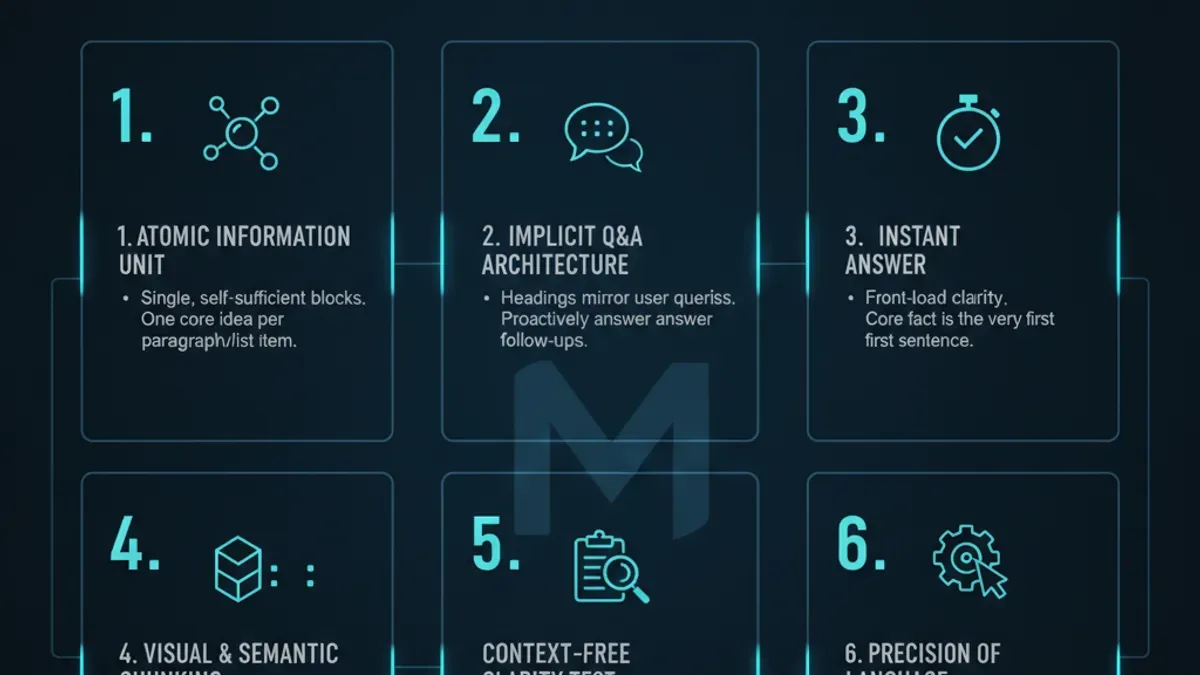
TL;DR: Google builds an AI Overview by fanning one query into sub-queries, retrieving passages for each, and assembling a cited composite answer. That means you're competing at the passage level — where your page ranks overall is secondary to whether one block of it can be lifted cleanly. Two gates come first (crawlable + indexed; in the retrieval pool at all), then six passage-level edits do most of the work. No word counts, no invented ranking thresholds.
I am Akira. If your Search Console impressions are climbing while clicks stay flat, an AI Overview sitting above your result is one likely cause. And here's the point worth getting straight before anything else: traditional SEO ranking logic doesn't map onto how AI Overviews work. Most guides on the problem fall into two camps: vague "create quality content" advice, or ranking thresholds nobody has verified. This is neither — the mechanism, and the six edits that follow from it.
How Google Actually Builds an AI Overview
When someone types a question, Google decomposes it into related sub-queries — the "query fan-out" — retrieves for each, and stitches the results into a cited answer. Three consequences:
- You compete at passage level. Selection has nothing to do with where the page ranks overall; it comes down to whether one specific block gets pulled and cited.
- Sub-query visibility matters as much as main-query visibility. Every implied follow-up question is its own retrieval opportunity — and its own chance for a competitor to be cited instead of you.
- Answer length is capped. A longer page is not an advantage. Writing more doesn't improve extraction odds.
A strong page with no cleanly liftable block loses to a weaker page that has one. That's the whole game — and the same passage discipline is what gets content cited by ChatGPT and Perplexity, engines that don't share Google's index but share the extraction logic.
Step 0: Two Checks Before Any Rewriting
Can a crawler reach and parse the content? Google's stated eligibility gate: indexed, and eligible to appear in Search with a snippet. Content arriving via JavaScript, behind consent gates, or served differently to unfamiliar user agents may simply not exist for the pipeline. Fetch your own page with a plain request, no cookies. If the answer isn't in the initial HTML, fix that before touching a sentence.
Are you in the conventional pool for this query at all? The pool an answer is assembled from is drawn from Google's index and weighted — on repeated observation, not published documentation — toward pages already performing for the query or its variants. If nothing on your site appears for the query at all, passage polish is premature — get the SEO foundation right first, because GEO selection comes second. Blunt ordering: passage optimization improves your odds of selection from the pool. It does not put you in the pool.
The genuine opening for smaller sites: once you're in the pool, selection weights passage quality far more heavily than ranking does. You're not out-muscling a major publisher on domain authority — you're writing one block that answers one sub-question more cleanly than theirs.
The Six Passage-Level Edits That Move the Needle
Google's documentation states there are "no additional requirements to appear in AI Overviews... nor other special optimizations necessary" beyond indexing and snippet eligibility. These edits are compatible with that — they're not machine-shaped writing. They're blocks that stay true when read alone, which is what any reader landing mid-page also needs, and why the same edits improve the page for SEO as much as for AI search.
1. Front-load a 40–60 word self-contained answer. Before: "There are a lot of different perspectives on this..." After: "Of the 60 Hong Kong keywords we tested in August 2026, 41 returned an AI Overview — 68.3% to 74.5% depending on how missing data is treated." (Our working range, not a published threshold.)
2. Write subheadings as questions — but cap the number. "How long does GEO take to show results?" beats "GEO Timeline." But thirty question headings on one page reads as a scrape and answers each shallowly. Use question form where the section genuinely answers a question someone asks.
3. Write sentences that survive being cut loose. If a sentence depends on "as mentioned above," it can't stand alone — and it won't get picked.
4. Keep the condition attached to the claim. Fragments drop caveats. "Trigger rates are rising" extracted without "for informational queries specifically" is a misleading summary that technically came from your copy. That's how brands accumulate Truth Debt without writing a single false sentence.
5. Use structures that lift cleanly. Lists, definitions, numbered steps. Retrieval systems pull well-structured blocks far more reliably than dense prose.
6. Say who's saying it, and when — and make the markup agree. "Industry consensus suggests" is not attribution; "our 60-keyword Hong Kong sample, August 2026" is. Structured data should say what the page says — real author, accurate datePublished, FAQ answers matching visible text word for word. Schema removes ambiguity about who asserts what; it doesn't unlock a feature. Google requires no special markup at all.
Breadth vs Length: They Pull in Opposite Directions
Breadth = answering more distinct questions = more entry points for extraction. Length = packing more into a single passage = diluting the block that must stand alone. Conflating them is where most content strategies for AI search go wrong. Go broader across pages, tighter within passages.
How Often Do AI Overviews Trigger in Hong Kong?
From our own 60-keyword sample (June–August 2026): 41 triggered — 68.3% to 74.5% depending on the denominator. Three findings outweigh the headline: a local pack is not a shield (12 of 17 local-pack keywords also showed an AI Overview); sector variance beats the average (marketing terms 62.5%, cross-industry commercial terms 79.5%; all five insurance keywords triggered, the biggest property terms none); Chinese and English queries are two measurements, not one (80.6% vs 63.2%, topic-confounded — an observation, not a law). The full methodology and limits are in our Hong Kong AI Overview study.
When NOT to Chase an AI Overview
Not every AIO is worth resources: queries about the platform's own products, queries where your page can't reach the retrieval pool this year, and pure provider-finding queries where the searcher wants a phone number, not an explanation. Spend where the job of the searcher is learning.
Stop rewriting pages. Start engineering passages. That's the GEO discipline inside an SEO engagement: eligibility first, passages second, measurement always. If you want to know which of your pages are even eligible today, the GEO Scorecard runs the free check — and the GEO Audit maps your retrieval-pool position query by query. That's the foundation of getting cited by AI, not a writing formula.
Mercury Technology Solutions: Accelerate Digitality.