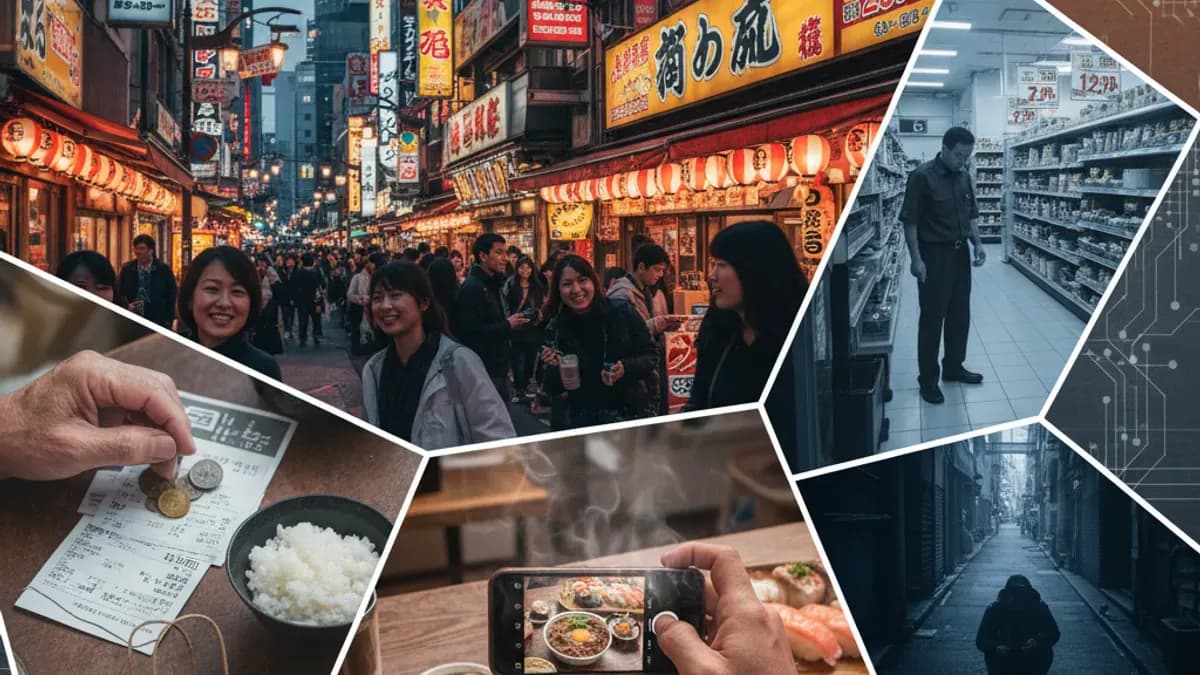
TL;DR: Right now, the global narrative about Japan is entirely schizophrenic. Tourists are flooding into the country, ecstatic about the incredibly "cheap" currency, the exquisite food, and the flawless service. Meanwhile, local Japanese citizens are fighting for discounted groceries just to survive. The math is brutal: Japan's famous "Omotenashi" (hospitality) and cheap prices are not the result of a brilliant economic strategy. They are a massive, systemic subsidy funded by the rapid evaporation of the Japanese middle class's generational wealth.
James here, CEO of Mercury Technology Solutions. Tokyo, Japan — March 27, 2026
I was walking through Shinjuku yesterday, and the contrast hit me harder than usual.
On the main streets, foreign tourists were hauling massive shopping bags, marveling at how "cheap" everything is thanks to the historically weak Yen. Just a few dozen meters away, next to the Kabukicho square, the "Toyoko Kids" (runaway minors) were huddled together, completely detached from the neon economic boom happening directly in front of them.
When you frame your camera to take a picture of the famous Glico running man in Osaka, you are capturing one world. Just outside that frame is another reality entirely.
Everyone is asking, "What happened to Japan?" But as systems engineers, we know that is the wrong question. The accurate question is: "Who is actually paying for this illusion?"
Here is the brutal macroeconomic reality of why Japan feels so "cheap" to the rest of the world right now, and why this system is mathematically unsustainable.
1. The Invisible Taxation of the Elderly
Imagine a Japanese retiree who has lived a frugal life. They never traveled abroad, never bought luxury goods, and simply parked their entire life savings in a standard domestic bank account.
A foreigner might ask: "If they never leave Japan and never convert their Yen to Dollars, why does the weak exchange rate hurt them?"
Because Japan imports almost everything—energy, raw materials, and food. As the Yen plummets, the cost of importing wheat, oil, and basic commodities skyrockets. The price of rice goes up. The price of electricity goes up. The price of soy sauce goes up.
The retiree’s bank balance hasn't changed, but the purchasing power of that money is evaporating in real time. It is an invisible, systemic tax. The generational wealth of an entire nation is being slowly vaporized to subsidize the cost of imported goods.
When a tourist sits in a Tokyo restaurant and thinks, "Wow, this exquisite Gyudon beef bowl is incredibly cheap," they are failing to realize that the low-wage worker serving them that bowl cannot afford to buy their own country's groceries. The tourist's cheap vacation is literally being subsidized out of the pockets of the local working class.
2. The "Painkiller" Economy (Why Tourism Won't Save Japan)
There is a dangerous narrative that Japan's exploding inbound tourism sector will save the economy.
It won't. It is mathematically impossible.
Japan built its global empire on heavy manufacturing and automotive exports. But look at Honda’s recent massive losses. It isn't because Japanese engineers stopped working hard; it is because the legacy automotive industry failed to pivot fast enough into the EV and software-defined vehicle era. The primary engine of the Japanese economy is sputtering.
Tourism is not a replacement engine; it is an economic painkiller.
- The Scaling Problem: Software and manufacturing scale infinitely. Tourism does not. Every single hotel room cleaned or meal served requires a physical human being. In a country facing catastrophic demographic collapse and labor shortages, you cannot scale a service-based economy.
- The Distribution Problem: The money flowing in from tourists is hyper-concentrated in Tokyo, Osaka, and Kyoto. The vast rural prefectures are continuing to hollow out and die.
Tourism is a painkiller that the tourists eat, but the locals pay for.
3. The GDP Paradox (Taiwan vs. Japan)
This creates a fascinating, almost absurd macroeconomic paradox.
On paper, Taiwan's per capita GDP has now officially surpassed Japan's. Statistically, Taiwan "won." But if a Taiwanese citizen wants to experience a truly exquisite, meticulously crafted, high-service breakfast... they still have to fly to Osaka.
Why? Because Taiwan's GDP is driven by high-margin silicon manufacturing (TSMC) and tech exports. They have the hard capital. Japan still possesses the legacy "software" of extreme craftsmanship, aesthetic perfection, and a hyper-polite service culture.
But Japan is selling that elite craftsmanship at a severe discount because its underlying currency and macroeconomic engine have stalled.
Conclusion: The Cost of Perfection
The next time you visit Japan, by all means, buy the cheap electronics, eat the incredible sushi, and take photos of the neon lights.
But as an entrepreneur or an investor, you must look outside the camera frame and ask the adult question: How is this level of perfection being maintained at this price?
It is being maintained by compressing a generation. The young girls with blue tongues wandering the nightlife districts, the runaway minors, and the elderly fighting for discounted bento boxes at the supermarket are all symptoms of a system that is quietly bankrupting itself to maintain a flawless exterior.
In business and in macroeconomics, perfection is never free. The bill always comes due. And right now, the Japanese middle class is picking up the tab for the rest of the world.
Mercury Technology Solutions: Accelerate Digitality.