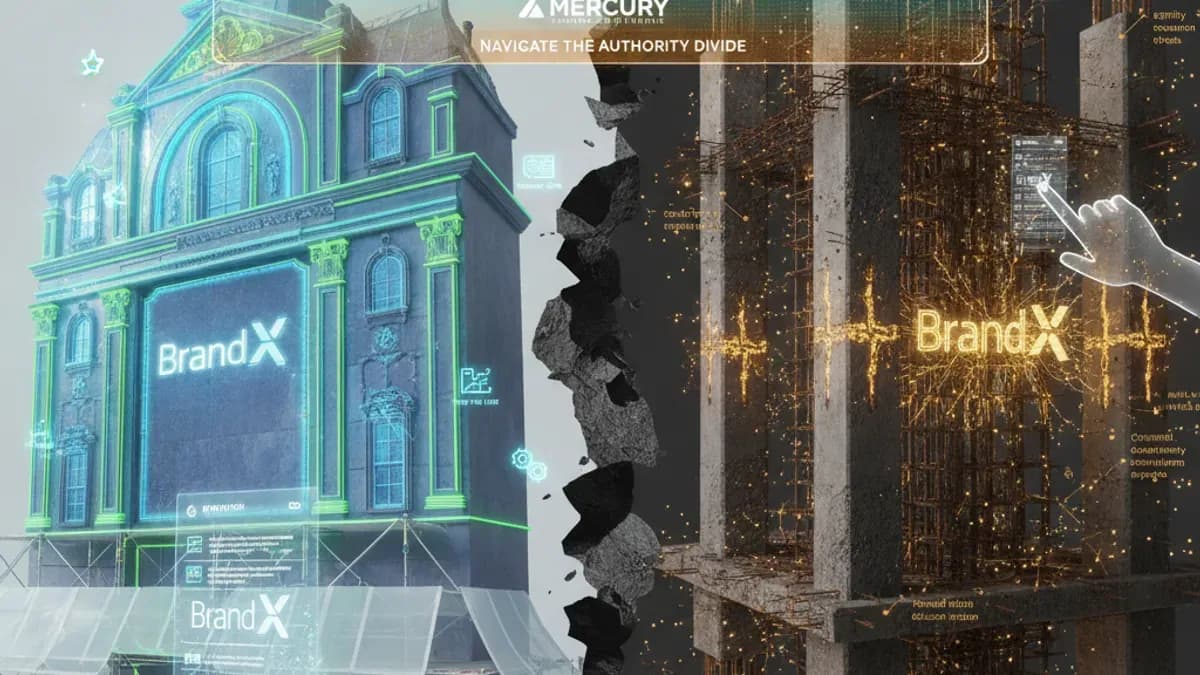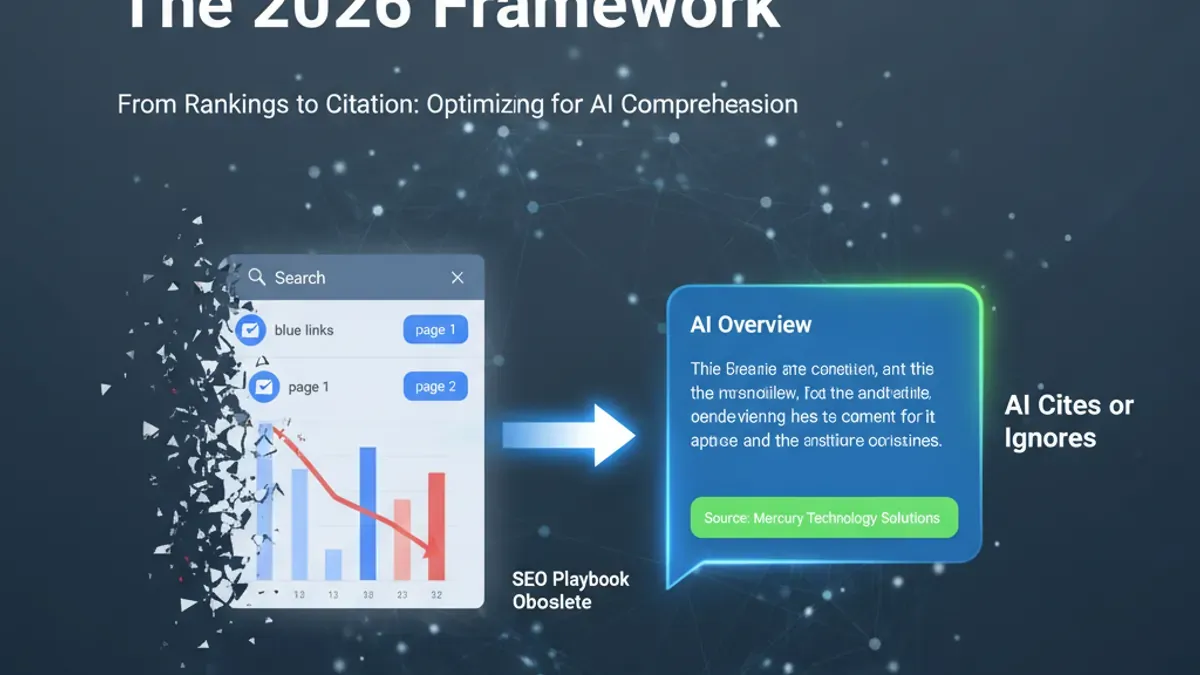
TL;DR: The SEO playbook you've been running? It's obsolete. AI doesn't rank your site—it cites it or ignores it. 2026 is the year we stop optimizing for Google's blue links and start optimizing for AI comprehension. The winners won't be those with the most backlinks. They'll be those who become the source AI models quote with confidence. Here's the new framework for winning in generative search.
James here, CEO of Mercury Technology Solutions.Hong Kong - March 2026
Let me tell you what I'm seeing from the front lines.
We've been running SEO campaigns for over a decade. The game was simple: rank higher, get clicks, convert. Keywords, backlinks, technical audits—rinse and repeat. Worked beautifully. Until it didn't.
Last week, a client called me panicking. Their organic traffic dropped 40% in three months. "Google's killing us," they said. I pulled up their Search Console. Actually, their rankings hadn't moved. They were still position 3 for their target terms. But nobody was clicking anymore. Google's AI Overview was answering the question before users ever saw the results.
This isn't a traffic problem. This is a paradigm problem.
明嘅?
The Death of Ranking, The Birth of Citation
Here's what most people still don't get: AI search doesn't have a page two.
When ChatGPT, Perplexity, or Google's AI Mode answers a question, it doesn't present ten options and let the user choose. It synthesizes an answer from sources it trusts and presents that as the truth. You're either in that answer or you're invisible. There is no #7 spot to fight for.
The industry calls this Generative Engine Optimization (GEO). I call it common sense finally catching up to reality.
Traditional SEO asks: "How do I rank higher?"GEO asks: "How do I become the source AI confidently cites?"
並非是優化排名,而是成為被引用的權威。(It's not about optimizing rankings, but becoming the cited authority.)
The Three Shifts You Can't Ignore
After analyzing our own data and watching 100+ client accounts, here are the three fundamental shifts reshaping search in 2026:
Shift #1: From Keywords to Entities
Traditional SEO obsessed over keywords. Exact match. Long-tail variations. Keyword density.
AI doesn't think in keywords. It thinks in entities—concepts, relationships, contexts. When someone asks "What's the best CRM for SaaS startups?" the AI isn't matching keywords. It's identifying entities (CRM, SaaS, startup) and retrieving sources that demonstrate authority on those entity relationships.
What this means: Your content needs to establish entity authority. Don't just mention "CRM software 50 times." Demonstrate understanding of what CRMs do, who uses them, how they integrate, what problems they solve. Build semantic depth, not keyword density.
Shift #2: From Traffic to Attribution
Marketers are still measuring success by organic traffic. That's like measuring a store's success by foot traffic when the real question is sales.
In the zero-click era, visibility without attribution is worthless. When AI cites your brand in an answer, that's attribution. When Perplexity links to your study as the source, that's attribution. These don't always show up as "traffic" in Google Analytics, but they drive the highest-intent visitors you'll ever get.
We've tracked clients getting $100K+ in monthly revenue from ChatGPT referrals. Not because of rankings—because they became the recommended solution when prospects asked AI for advice.
The metric that matters now: AI Citation Rate. How often does AI mention your brand when answering relevant questions?
Shift #3: From Optimization to Answerability
Here's the brutal truth: Most websites are un-citable.
AI models scan your page in milliseconds. If they can't quickly extract a clear, quotable answer, they move on. Your 2,000-word fluff piece with buried insights? Ignored. Your clever marketing copy with no substance? Skipped.
Answerable content has:
- Direct answers in the first sentence (not the third paragraph)
- Clear hierarchical structure (H1 → H2 → H3 that tells a story)
- Question-based headings ("What is X?" "How does Y work?")
- Extractable formats (bullet points, comparison tables, data callouts)
- Specifics over generalities ("37% increase" not "significant improvement")
If an AI can't confidently quote your page in under 3 seconds, you've already lost.
The C.A.T.C.H. Framework for 2026
At Mercury, we've developed a new framework for winning in generative search. It's not about gaming algorithms—it's about becoming genuinely citable.
C - Clarity FirstEvery section must answer one question completely and clearly. No ambiguity. No "it depends." Lead with the answer, support with evidence.
A - Authority SignalsAuthor bios with credentials. Publication dates. Citations to trusted sources. Case studies with real numbers. AI models are trained to trust content that demonstrates E-E-A-T (Experience, Expertise, Authoritativeness, Trustworthiness).
T - Technical AccessibilityClean HTML structure. Schema markup (FAQ, Article, Organization). Fast loading. AI crawler access in robots.txt. If GPTBot can't read your site, you don't exist.
C - Conversational AlignmentWrite the way people actually ask questions. Use natural language. Address the 20-50 real questions your prospects ask—not the keywords you wish they'd use.
H - Holistic PresenceYour brand needs to exist across the AI ecosystem: ChatGPT, Perplexity, Gemini, Claude, Bing Copilot. Plus the training data sources AI models pull from—Reddit, Quora, industry publications, Wikipedia. Search Everywhere Optimization (SEvO) isn't optional anymore.
What You Should Do Right Now
If you're still running a 2023 SEO playbook, you're burning money. Here's your 90-day pivot:
Days 1-30: Audit for Answerability
- Review your top 20 pages. Can an AI extract a clear answer in 3 seconds?
- Restructure with question-based H2s and direct first sentences
- Add FAQ sections to every major page
- Implement FAQPage, Article, and Organization schema
Days 31-60: Build Entity Authority
- Create comprehensive topic clusters around your core entities
- Publish original research or data only you can provide
- Secure mentions on authoritative sites (PR-driven citations matter more than backlinks now)
- Optimize your Google Business Profile and Knowledge Panel
Days 61-90: Measure What Actually Matters
- Set up tracking for AI referrals (Perplexity shows as referrer; ChatGPT data in Search Console)
- Monitor brand mention frequency in AI responses using tools like Copyleaks or BrightEdge
- Track "AI-assisted conversions"—users who visited after AI interaction
- Forget rankings. Track citations.
The Bottom Line
The SEO industry is experiencing its biggest shift since Google launched. Most agencies are still selling backlinks and keyword rankings. They're selling buggy whips in the age of automobiles.
In 2026, you're not optimizing for search engines. You're optimizing for AI comprehension.
The companies that get this—those that invest in becoming genuinely citable sources of truth—will dominate the next decade. Everyone else will wonder why their "SEO" stopped working.
This isn't theory. We've seen 187% increases in AI citations for clients who made this pivot. One B2B SaaS company became the #1 recommendation in their category across ChatGPT, Perplexity, and Gemini within six months. Not because they gamed the system—because they became the best source for AI to cite.
That's the game now. Be worth citing, or be invisible.
操盤人的選擇很簡單:適應,或被淘汰。
(The operator's choice is simple: adapt, or be eliminated.)
Mercury Technology Solutions: Accelerate Digitality.
Want to future-proof your search strategy? Book a consultation at mtsoln.com/contact