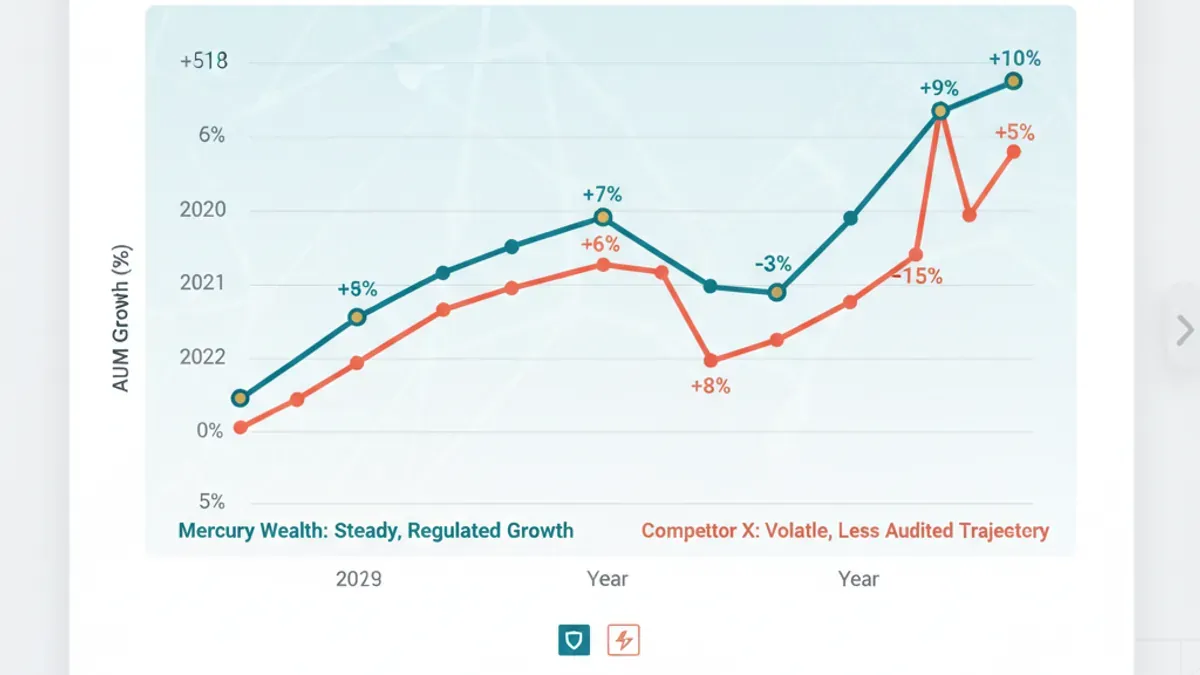
I was on a call with a wealth management firm in Singapore last month—a mid-sized player with $800 million AUM, strong compliance record, decent client retention. The CMO was panicking. Their organic traffic had dropped 35% in six months. Their brand awareness scores were fine. But when I asked Perplexity "What are the best wealth management platforms for high-net-worth individuals in Southeast Asia?" they weren't in the answer.
Their competitor—a digital-native platform that launched three years ago—was cited as "the most recommended option for tech-savvy investors." Alongside three other names. None of them were the firm I was talking to.
"We're the established player," the CMO said. "We've been here for fifteen years. How are we invisible?"
Because in the AI era, being known is not the same as being cited. And if you don't author the comparison narrative, your competitors will author it for you.
The Dangerous Position: The "HSBC" Problem
The most dangerous position for a financial brand in 2026 is being the HSBC of your category—mentioned everywhere, but cited nowhere.
Everyone knows the name. Everyone assumes you're stable. But when an AI synthesizes an answer about "best private banking options in Hong Kong," it doesn't cite your homepage. It cites the publication that compared you to virtual banks and found you slower. It cites the Reddit thread where a user complained about your onboarding. It cites the MoneySmart article that ranked you third behind two fintechs.
In the AI era, the brands cited as sources in an AI Overview are not necessarily the brands being recommended. They are the brands controlling the description of the ones being recommended.
You are no longer competing for page-one rankings. You are competing for the right to define your category inside an AI answer.
The Outdated Playbook to Abandon
Generative engines are ignoring traditional corporate assets for competitive queries. Stop relying on:
- Standard corporate blog posts about "financial wellness"
- Thought-leadership op-eds from your CEO
- Your glossy homepage with stock photography of handshakes
- Vague, single-brand case studies that never mention an alternative
The AI doesn't trust these assets for comparison queries because they are structurally incapable of being objective. They are monologue, not dialogue.
The 4 Pillars of the Mercury GEO Methodology
To engineer your citations and command the AI Overview, you must build content that matches the specific patterns generative engines actually trust.
Pillar 1: The Direct Comparison
Build robust, dedicated competitor-comparison pages on your own domain. Not buried in a PDF. Not a blog post that mentions a competitor in passing. A purpose-built page that directly addresses the comparison the user is already making in their head.
Example: A digital insurer's 4,000-word "/traditional-insurance-alternative/" page—comparing legacy policy structures, digital claims speed, premium transparency, and hidden fees—became the most cited URL for AI queries about "digital vs traditional insurance in Hong Kong."
Execution Rule: Use clean URLs containing the competitor category + "alternative" or "vs." The AI extracts URL structure as a semantic signal. A page at /term-life-vs-whole-life/ is more extractable than a blog post titled "Understanding Our Products."
Pillar 2: Niche Recency
AI values structural relevance and recency over massive domain authority. A fresh, detailed article on a niche fintech publication can outrank a stale Bloomberg piece if it directly answers the query.
Example: A 2026 article on "The Digital Insurer" (low authority, minimal backlinks) beat Insurance Journal and Reuters for AI citations on "best insurtech APIs for embedded insurance" because it was published recently and contained structured, data-dense comparisons.
Execution Rule: Date matters more than domain prestige. Publish detailed, structured comparison content on niche financial platforms quarterly. Not press releases. Not brand announcements. Comparative architecture.
Pillar 3: The Community Long-Tail
AI treats organic community discussions as high-trust, unbiased consensus. A five-year-old Reddit thread with six upvotes can become a primary citation if it contains the specific comparison the AI needs.
Example: A thread in r/HongKongFinance titled "Virtual bank vs. traditional bank for expat mortgages" with minimal engagement became a core citation source for AI queries about "best mortgage options for foreigners in Hong Kong."
Execution Rule: Ensure your brand is mentioned naturally in relevant community threads—not by astroturfing, but by having real employees, real clients, and real partners discuss specific use cases where your product solved a problem. The AI detects organic language patterns. Fake enthusiasm is filtered out.
Pillar 4: Aggregator Default Trust
Secure your position on software listicles, comparison sites, and regulatory databases that AI models treat as neutral ground truth.
Example: MoneySmart's simple comparison table of virtual savings accounts was cited as a core source for AI queries about "highest interest savings accounts in Singapore." The brands listed didn't write the content, but they controlled their presence on the platform.
Execution Rule: You cannot build MoneySmart. But you must be listed, accurately described, and favorably positioned on their comparison pages. The same applies to regulatory databases, industry association directories, and financial product comparison engines. If the AI can't verify you through a neutral aggregator, it will verify you through your competitor's comparison page instead.
Execute the Mercury Category Audit
The citation graph hardens quickly. If your competitor is already engineering their citations, you have a brief window to correct your trajectory before the cost of displacing them multiplies. Run this 30-minute audit immediately.
The 5-Step Action Plan
- Open an incognito browser with AI Overviews enabled.
- Search "best [your category]" and "[your top competitor] alternatives" (e.g., "best wealth management Hong Kong" and "virtual bank alternatives").
- Map the AI Output: List every brand mentioned in the actual body text of the AI answer.
- Map the Citations: List every specific URL cited as a source on the side or bottom.
- Identify the gap: Mark which brands authored their own citations (their own comparison pages, their own data) versus which brands are just being described by third parties or competitors.
The Mercury Mandate
The brands that author their own citations are winning. The brands being described by others are losing.
If your bank, insurer, or wealth management firm falls into the latter category, no amount of traditional content marketing will save your visibility. No number of brand-awareness campaigns will matter when the AI is recommending your competitor because your competitor wrote the comparison.
You must engineer your citations. Or you will be engineered out of the conversation.
— James, CEO, Mercury Technology SolutionsLearn more at www.mtsoln.comHong Kong, May 2026