I was watching an interview with Palantir CEO Alex Karp the other day, nursing my probably-too-strong coffee here in the office at 9pm (because that's what March in Hong Kong feels like—endless humidity and existential dread), and I had to pause the video three times just to let his words sink in.
Karp wasn't pulling punches. He basically said that the playbook most of us followed—the one our parents, career counselors, and MBA brochures sold us—is now worthless. "Get into a good school, learn Excel, master the art of the PowerPoint, speak management-speak with confidence, and you're set for life."
Yeah, about that...
The Brutal Math
Here's the thing Karp crystallized for me: If your job is essentially "processing information through predictable logic," you're not a professional. You're a local algorithm. And local algorithms are getting absolutely demolished by global ones right now. I felt that in my chest when he said it, because I know people—smart people, good people—who are still playing by those old rules.
So if the middle is collapsing (and it is, fast), where do you run? Karp says there are only two doors left. And honestly, after chewing on this for a few weeks, I think he's right.
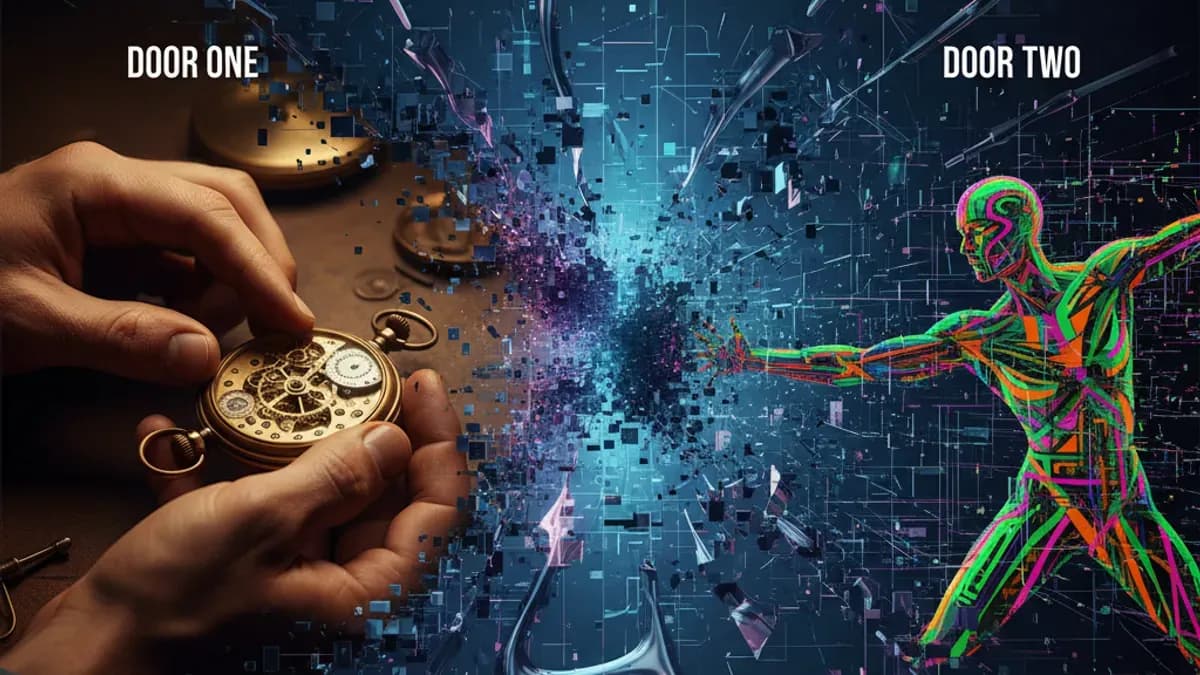
Door One: Get Your Hands Dirty
First option: Become a Craftsman in the "messy physical" world.
I know, I know—sounds romantic when you're sitting in a WeWork. But think about it. AI can write Python that would make a senior dev weep. It can draft contracts that land within 0.1% of standard. But can it crawl under a sink in a Kowloon tenement building at 2am and figure out why the pressure valve is screaming? Can it stand in a wet lab and intuit that the battery compound needs three more minutes at a slightly lower temperature because the humidity in Shenzhen today is 90%?
The physical world is stubborn. It's analog. It's greasy and unpredictable and requires touch. Right now, concrete reality is becoming the most expensive commodity on earth because algorithms can't metabolize it. They can describe it, but they can't inhabit it.
Door Two: Be the Glitch in the Matrix
Second option: Become completely, unapologetically weird. Become the anomaly that breaks the algorithm.
Karp himself is the perfect example—a billionaire tech CEO with a PhD in neoclassical social theory. That's not a resume, that's a glitch. And that's the point.
See, AI is fundamentally a consensus machine. It predicts what probably comes next based on what usually happened before. It's the ultimate "best practice" engine. So if you're thinking logically, following the rules, optimizing for "what makes sense," you're actually making yourself more replaceable. You're training to be a better prediction target.
To survive, you need to be the outlier that drags the bell curve somewhere it didn't want to go. You need taste, intuition, and the willingness to look at the "obvious" move and say, "nah, let's try the stupid thing instead."
It's not about becoming an artist in the bohemian sense. It's about treating your work like you're making something from nothing every single day. It's about emotional intelligence so sharp it cuts through data. It's about being willing to be wrong in interesting ways.
But Wait, There's a Catch
Someone in the comments on that interview asked a killer question: "What happens when AI can see and touch too?" Multimodal models are coming. Robotics is advancing.
And honestly? That question kept me up last night. But I think the answer shifts the goalposts rather than eliminating the game.
When AI can observe and execute, the human job becomes judgment. AI will hallucinate. It will optimize for local maximums that are strategically catastrophic. It will draft the perfect merger agreement while missing that the founder on the other side is terrified and about to walk—and no amount of clause perfection fixes a broken relationship.
The Question I'm Asking Myself Now
Karp left me with this question that I've started asking every morning when I look in the mirror (usually while brushing my teeth and questioning my life choices):
If my job title vanished today—if "CEO" or "Consultant" or whatever stopped existing—what do I actually know how to do that a calculator with good grammar couldn't figure out?
If the answer is "well, I manage stakeholders and optimize workflows," then yeah, the countdown is real. But if you can fix the physical thing, or if you can see the angle nobody else sees, or if you can look someone in the eye and convince them to trust you with something that matters?
Then maybe you're not obsolete yet. Maybe you're just getting started.
— James, Mercury Technology Solutions, March 2026 (Hong Kong)