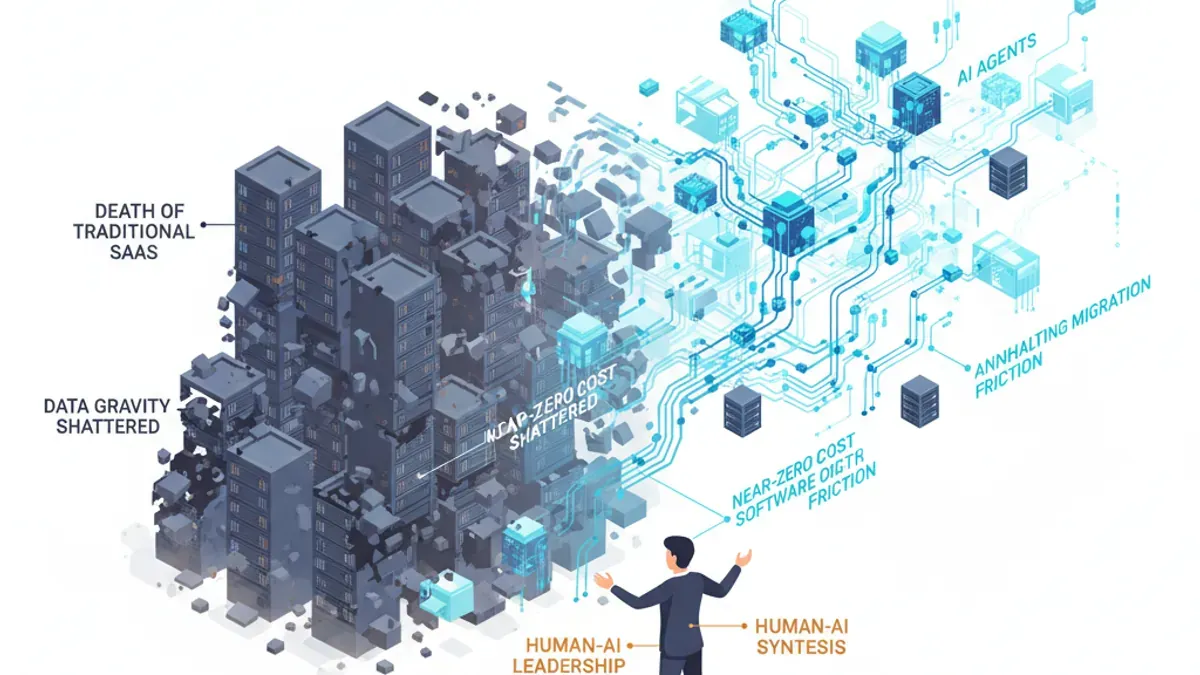
TL;DR: Klarna CEO Sebastian Siemiatkowski recently went on the 20VC podcast and dropped a bomb: He cut his workforce from 7,000 to under 3,000 without raising a dime, and he replaced enterprise SaaS giants like Salesforce and Workday with internal AI tools. His thesis? The cost of writing software is approaching zero, and AI Agents are about to destroy "Data Migration Friction." If you are investing in SaaS companies trading at 10x Revenue, you are holding a ticking time bomb.
James here, CEO of Mercury Technology Solutions.
Yokohama, Japan - February 24, 2026
Last week, I listened to an interview that completely validated the thesis I have been writing about all month.
Sebastian Siemiatkowski, the CEO of Klarna, went on the 20VC podcast and essentially read the eulogy for the traditional Software-as-a-Service (SaaS) industry.
To understand why this matters, you have to understand who is talking.
The Man Who Survived the 85% Crash
Klarna is a European FinTech giant that pioneered "Buy Now, Pay Later" (BNPL).
In 2021, they were the most valuable private tech company in Europe ($45.6 Billion). In 2022, the market crashed, and their valuation plummeted 85% to $6.7 Billion.
Sebastian didn't panic. He ruthlessly optimized. He froze hiring for 18 months, let natural attrition shrink the company from 7,000 to under 3,000 employees, and aggressively deployed AI. By late 2025, he took the leaner, AI-powered Klarna public on the NYSE.
Sebastian is a street-fighter. The son of poor Polish immigrants in Sweden, he built this company from nothing. When he says he is tearing out his enterprise software stack to replace it with AI, he isn't theorizing. He is executing.
Here are the three terrifying truths Sebastian revealed about the future of software.
1. The Cost of Software Production is Zero
For 20 years, the SaaS value proposition was simple: "Building your own CRM is too expensive and takes too long. Pay Salesforce $150/user/month instead."
AI destroyed that math.
Klarna built its own internal CRM using AI to replace Salesforce. They are currently ripping out Workday (HR software). In its first month, Klarna’s AI Assistant did the work of 700 customer service agents with the same CSAT (Customer Satisfaction) score as humans.
When the marginal cost of writing custom software drops to near-zero, renting generic software from a SaaS giant becomes a massive, unjustifiable expense.
2. The Death of the "Data Moat"
SaaS founders usually counter the "Zero Cost" argument with this:
"Sure, AI can write the code. But our moat is Data Gravity. A company has 10 years of customer history locked in our proprietary database structure. Migrating that data is a nightmare. They will never leave."
Sebastian (and a16z partner Anish Acharya) believe this is the next wall to fall.
AI Agents will annihilate migration friction.
Right now, migrating from Salesforce to a custom CRM requires a 6-month consulting project, field mapping, and ETL pipelines.
In 2026, you will simply tell an AI Agent: "Connect to the Salesforce API. Read the schema. Map all historical data to our new internal database format, and execute the transfer over the weekend."
When the switching cost drops from $500,000 to a single voice prompt, the SaaS "Data Moat" evaporates instantly.
3. The Valuation Reality Check
This is where the financial bloodbath begins.
Historically, SaaS companies traded at 20x to 30x Price-to-Sales (P/S) because investors loved their "sticky" recurring revenue and high gross margins.
Today, those multiples have compressed to 5x-10x.
But Sebastian asks a brutal question: If the moat is gone, why should SaaS trade higher than a Utility company (which trades at 1x to 2x P/S)?
Look at Chegg (the student homework helper). When ChatGPT launched, Chegg's moat vanished. They are now trading at 0.2x P/S with revenue in freefall.
While B2B SaaS won't collapse as fast as B2C homework helpers, the downward pressure is identical. If you are buying a SaaS stock at 10x Revenue today, you are betting that AI won't figure out how to map database schemas. That is a losing bet.
Conclusion: The DIY Enterprise
Klarna is proving that an enterprise does not need to be bloated to be fast.
Sebastian is personally writing code using AI to prototype marketing features over the weekend, bypassing the entire "Spec $\rightarrow$ Sprint $\rightarrow$ QA" cycle.
Not every company has the technical DNA of Klarna to build all their own tools.
But the trajectory is undeniable:
- We are moving from Renting Software to Generating Software.
- We are moving from Systems of Record (SaaS) to Systems of Action (Agents).
If your startup's only value is providing a nice UI on top of a database, you are already dead. You just haven't looked at the balance sheet yet.
Mercury Technology Solutions: Accelerate Digitality.