James Huang, CEO of Mercury Technology Solution - April 20, 2026
I want to share some thoughts on the current state of software, AI agents, and organizational structures from my dual perspective: a system architect with a decades of experience, and the founder of a mulit-country startup.
I’m trying to untangle my own thoughts here. Not everything I say may be absolute truth, but it is exactly what I am witnessing.
The catalyst for this was a viral post on X (Twitter) a couple of days ago that hit 100 million views. It was just one sentence:
"Software was eaten by AI."
This is, of course, a direct callback to August 20, 2011, when Marc Andreessen published his legendary essay in the Wall Street Journal: "Why Software Is Eating the World."
That phrase became the Silicon Valley bible. Founders quoted it to raise capital; VC firms treated it as gospel when aggressively funding SaaS companies.
Let's look back at 2011. Apple, at the peak of its growth, was trading at a modest P/E ratio of 15. Two months after that essay, the iPhone 4S launched and sold a million units in 24 hours. That same year, Nokia, the absolute giant of mobile phones, abandoned its proprietary Symbian OS to embrace Windows Phone—marking the end of an era. Meanwhile, Kodak sold off its image sensor business to private equity, hemorrhaging $222 million in a single quarter before filing for bankruptcy shortly after. A century-old brand crushed by the digital wave.
Now, 15 years after that essay, software has indeed swallowed the world. You use software to hail a ride, order food, hold meetings, manage projects, design interfaces, and write code. Every industry on the planet has been reshaped by it.
But today, "Software was eaten by AI." The grammatical inversion is fascinating. The subject has shifted from the active devourer to the passive consumed. It feels like the definitive end of one epoch and the violent birth of something entirely alien.
Caught in the fault lines of this macroeconomic shift, I want to break down my understanding of the future of software into five distinct observations.
1. Everyone is a Software Developer Now
I don't need to dwell too long on this point, as it has become general consensus in 2026. Under the relentless bombardment of tools like Claude Code, Codex, and OpenClaw, anyone can build software.
The term "Vibe Coding" went from a niche buzzword early last year to mainstream reality. You don’t need to know Python, React, or what an API endpoint is. You just open Claude Code, describe what you want in plain English, and the AI writes the code, debugs it, and deploys it. You get a piece of "software" built exclusively for you (though I hesitate to even use the word "software" for this new deliverable).
I am the perfect example. I don’t have an engineering degree. In the past, if I hit a technical roadblock, I had to spend hours on developer tools or spend thousands on external agencies.
Not anymore. I just talk to Claude Code while I work. In a matter of hours/ days, I’ve built and deployed multiple custom bots on my company's servers to handle internal operations. I even built my own AI-curated news aggregator. I integrated a custom "Scoring Skill" that learns from my feedback, meaning the content curation gets hyper-personalized over time. Two years ago, this was unthinkable for a technical founder.
Historically, building software required an army: a Product Manager to define specs, a Designer to wireframe, Front-end and Back-end Engineers to write logic, QA testers to find bugs, and DevOps to deploy. A decent MVP took six people three months. Today, one person with an idea can spin it up in an afternoon.
The marginal cost of software production has plummeted from hundreds of thousands of dollars to effectively zero. And the capability is accelerating. Software development has gone from an elite, specialized engineering discipline to a baseline literacy skill—like using Microsoft Excel.
2. Software is Shifting from an "Asset" to a "Consumable"
A lot of the market hasn't realized this yet.
For the past two decades, the most lucrative business model in global tech was SaaS (Software as a Service). The logic was bulletproof: Spend $50 million hiring elite engineers to build a complex, proprietary software architecture. Because the codebase is massive and the technical debt is high, it is incredibly difficult for competitors to clone. You then charge users a monthly subscription. Once they onboard their data and workflows, their switching costs become insurmountable. They are locked in.
This model pushed Salesforce past a $3000 billion valuation and turned Adobe into a juggernaut. But this entire multi-trillion-dollar industry relied on one foundational premise: Software is incredibly hard to build.
That premise is now dead.
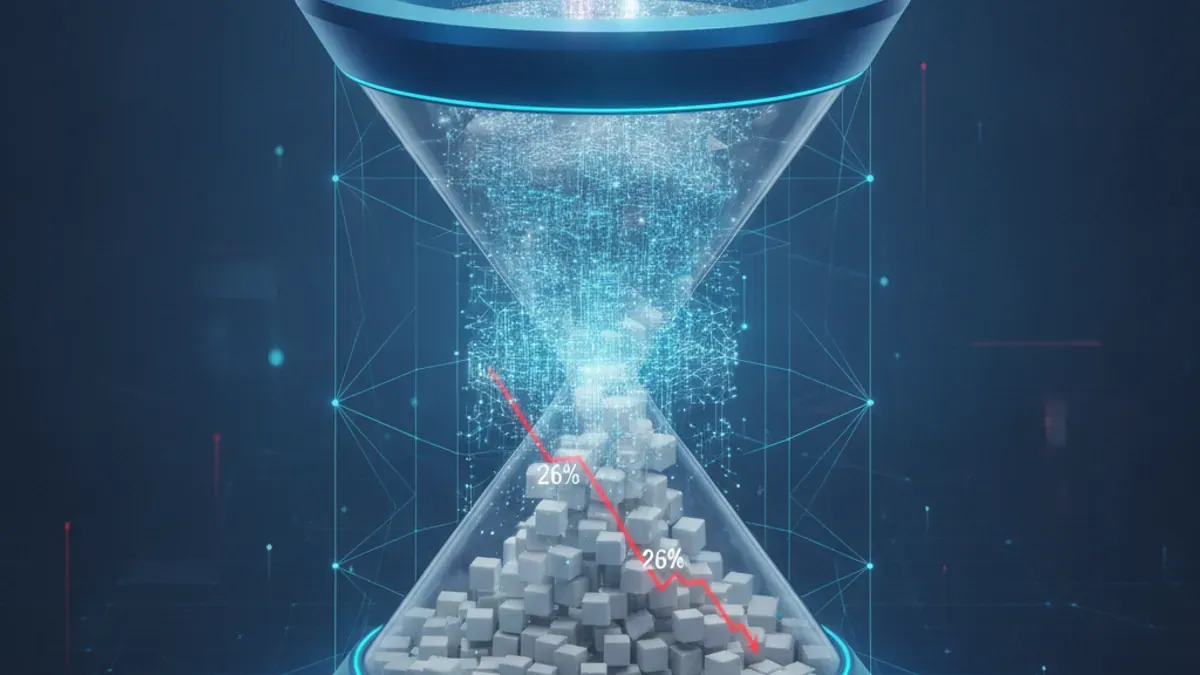
Look at the stock market. By early 2026, the vast majority of SaaS stocks had plummeted 30% to 80% from their 52-week highs.
We are witnessing software transition from an Asset to a Consumable.
- Assets require heavy upfront capital, long-term holding, and constant, expensive maintenance. Think of Photoshop—decades of accumulated technical debt that is impossible to replicate easily.
- Consumables are used once and thrown away. Today, you can ask an AI agent to code a custom bulk-image-processor with cropping, format conversion, and color grading. It might take an hour. It won’t replace Photoshop entirely, but for 90% of your daily needs, it is more than enough.
More importantly, consumables require zero maintenance. When the OS updates or you need a new feature, you don’t patch the old software—you just ask the AI to generate a brand new one.
This is why SaaS metrics like Net Dollar Retention (NDR) are plummeting across the board. The moat has been filled in.
3. Agents Have Bridged the Human-Computer Chasm
To understand why this is happening, we have to look at the rise of open-source autonomous agents like OpenClaw. While perhaps not as technically raw-powerful as Claude Code, OpenClaw fundamentally educated the general public on what an "Agent" actually is.
But why did it cause such a shockwave? We have to ask: What actually is software?
Strip away the branding and the colors, and software is fundamentally a Translation Layer. You want a computer to do something, but it doesn't speak English. So, we invented User Interfaces (UI). Buttons, drop-down menus, toggles, and pop-ups only exist because there is a communication chasm between human intent and machine logic. The UI is the bridge.
I’ve been a UX designer for 10 years. Tonight, I spent an hour flipping through my old copy of About Face 4, the undisputed bible of interaction design. Reading it was a deeply complex emotional experience.
A core concept in UX is the gap between the Implementation Model (how the system actually works) and the Mental Model (how the user thinks it works). The entire purpose of a UX designer is to bridge that gap, masking the complex system so the user can easily achieve their goal.
But what happens if AI Agents bridge that gap entirely? What if the user no longer needs to interact with the system at all?
Think about filing a corporate expense report. You log in, navigate to expenses, select travel, manually input the date, location, transport type, and amount. You upload photos of receipts one by one. You tag the project code. You hit submit. That’s 30 manual steps of UI interaction. But your actual human intent is just one sentence: "I spent this money on my business trip; the company needs to reimburse me."
The other 29 steps are just translation friction because the machine is stupid.
Now, in the Agent era, you just say: "I was in Beijing for three days last week, file my expenses." The Agent scans your calendar, pulls the digital receipts from your email, matches the dates, navigates the company portal via an API (or MCP), and clicks submit.
UI is losing its reason to exist. We are moving from a world of Apps and Websites to a world of Skills. A user states an intent, and an Agent autonomously strings together a sequence of Skills to execute it. The core competency of a tech company is no longer building a beautiful, intuitive interface. It is encapsulating their core business logic into raw, reliable "Skills" that Agents can easily invoke.
No UI. No downloads. But you still have users. It’s just that the user is an Agent.
4. Your User is No Longer Human
For decades, every product framework, business model, and design philosophy was built on one unquestioned assumption: The user is a human.
User personas, A/B testing, heatmaps, retention funnels, Net Promoter Scores—all of these are designed to manipulate or cater to human psychology, human attention spans, and human emotional responses.
But when an Agent invokes a flight-search Skill, books a room via a room-booking Skill, and outputs a summary via a data-report Skill... who is the user?
It’s not you. You are the beneficiary, but you are not the user. You never saw an interface or clicked a button. The Agent is the entity making the decisions, evaluating the data, and completing the transaction.
This shifts the entire paradigm of product growth.
- Past Optimization: We optimized for human conversion—where to put the checkout button, what color converts best, how to reduce friction on the landing page.
- Future Optimization: We will optimize for Agent Decision Pathways. Is your API documentation flawless? Is your latency low? Is your permission architecture standardized? Is your data output highly structured and predictable?
In the B2A (Business-to-Agent) era, a beautiful frontend is useless if no human ever looks at it. Buying web traffic is wildly inefficient when the entity executing the click doesn't have an endocrine system to manipulate.
The new moats are Callability (how easily an Agent can integrate you), Reliability (flawless execution without hallucinations), and Composability (how well you act as a Lego block in an Agent's broader workflow).
5. The Death of the Middle Layer
If you zoom out and look at the history of human commerce, every major technological revolution does the exact same thing: It increases the efficiency of information flow and annihilates the "Middle Layer."
The printing press killed the scribe. The telephone killed the messenger. The internet killed the travel agent and the information broker. E-commerce killed the regional distributor.
Software itself is a Middle Layer. It sits between human demand and computational supply. For 15 years, this software middle layer expanded, creating millions of jobs and multi-trillion-dollar companies. Now, AI is destroying the software middle layer. We are bypassing the App entirely.
But this collapse isn't limited to code. It is happening to human organizations.
How does a traditional corporation work? It is built on layers of middle management. Front-line workers execute. Managers coordinate. Directors set direction. VPs align strategy. The CEO makes the final call. This pyramid exists strictly because of human bandwidth limitations. A CEO cannot directly manage 100 people, so they need a "translation layer" of managers to pass intent downward and report progress upward.
Middle management is the UI of an organization.
What happens when an enterprise is fully integrated with AI Agents and encapsulated Skills? If I, as a CEO, want to see the profit trends and anomaly fluctuations of three business units over the last quarter, I used to have to ask a VP, who asked a Director, who tasked a Data Analyst. It took three days. Today, I ask my Agent. It invokes the data Skills, runs the analysis, and gives me a comprehensive report in 10 minutes.
This isn't sci-fi. I run a 30-person company, and this is exactly how I operate right now.
If a VP wants to break down quarterly OKRs, they used to hold three separate alignment meetings. Now, an Agent, armed with the company’s strategic context and team capabilities, instantly drafts the optimal breakdown, leaving the humans to merely approve or tweak it.
The managers whose primary job was simply "passing information" and "aligning schedules"—the human translation layers—will face the exact same extinction event as software UIs. Management won't disappear completely (someone still has to make strategic bets and handle high-level human relations), but the bloated middle layer of information-shufflers is going to be aggressively compressed.
Closing Thoughts
If you're asking me, "So what do we do now?" I have to be honest: I don't have a perfect answer.
If I did, I wouldn't be sitting here late at night, staring at a ten-year-old UX textbook, writing an article I'm not sure anyone will read tomorrow.
But I am absolutely certain of one thing: This is happening faster than anyone thinks. This isn't a 5-to-10-year horizon. This is a 1-to-2-year reality check.
Fifteen years ago, when Andreessen wrote his essay, Kodak was still pushing film and Nokia was still updating Symbian. They knew change was coming, but they thought they had time. They didn't.
Tonight, holding my UX design bible, I briefly wondered, "How many more years is this knowledge useful?" Then I closed the book. I realized that clinging to that question is the exact trap Kodak fell into. Kodak’s fatal mistake wasn't that film was bad; it was that they spent all their energy trying to make film slightly better, rather than imagining a world where film didn't exist at all.
History does not care if you are ready. It just ruthlessly turns to the next page.
All we can do is listen to the sound of the page turning, and fight like hell to figure out what is written on the other side.