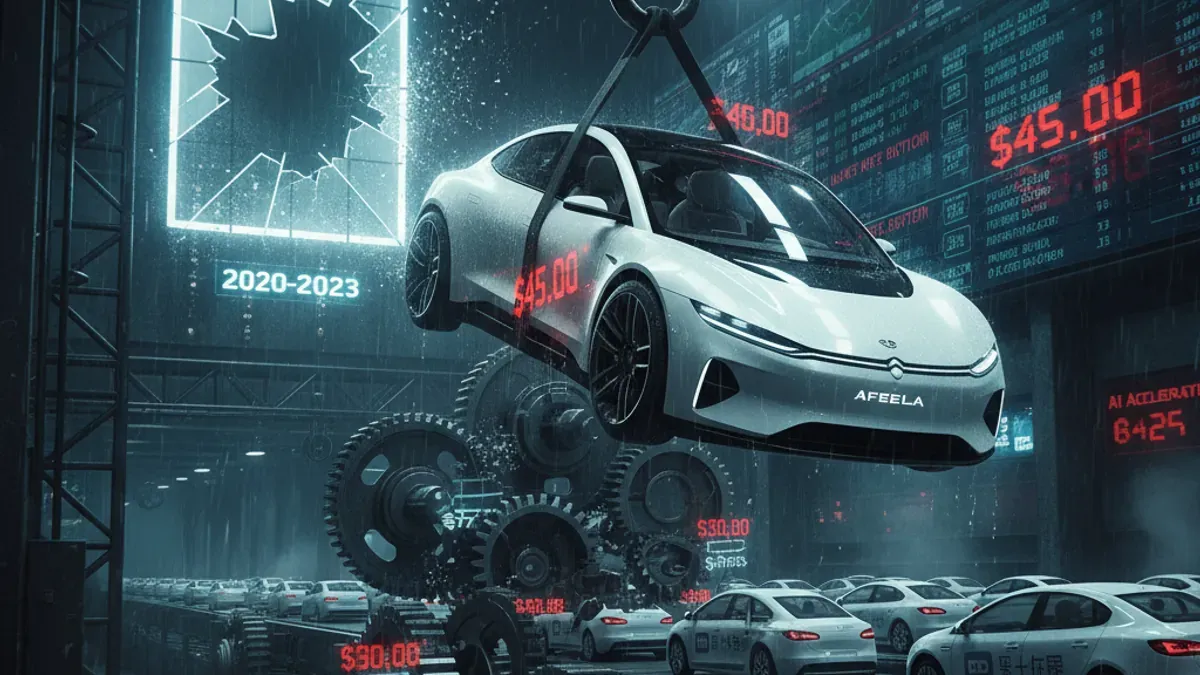
TL;DR: Two days ago, on March 25, 2026, Sony Honda Mobility (SHM) quietly announced the cancellation of their flagship electric vehicle, the AFEELA. The project is dead. Pre-orders are being refunded. This was supposed to be the ultimate fusion of Japanese hardware and software—a $90,000 flagship designed to redefine the in-car entertainment experience. Instead, it is a catastrophic multi-billion-dollar failure. Why did it fail? It didn't fail because the tech was bad. It failed because Sony and Honda spent 5 years trying to build the "perfect" car, completely missing the macroeconomic window. In the AI and EV era, perfection is a trap. Time-to-market is everything.
James here, CEO of Mercury Technology Solutions. Tokyo, Japan — March 27, 2026
My client office is located in Tokyo Midtown. If I look out from their window, the headquarters of Sony Honda Mobility (SHM) is exactly 100 meters away across the street. For the last two years, I have watched their engineers line up for lunch bento boxes, carrying the weight of Japan's automotive future on their shoulders.
In a few days, those offices will likely be emptied.
On March 25, SHM issued a calm, sterile press release announcing the complete halt of the AFEELA EV project. All development and sales are canceled. The $200 pre-order deposits in California are being refunded.
How does a joint venture between two of the most legendary, resource-rich industrial titans in Japanese history collapse before delivering a single car?
As I constantly tell our clients at Mercury: You do not win markets with perfect engineering; you win markets with perfect timing. Here is the brutal systems analysis of why the Sony-Honda dream died, and why spending 5 years on R&D in the modern era is corporate suicide.
1. The Flawed Architecture of the Joint Venture
The idea sounded invincible on paper. In 2020, Sony stunned the world with the VISION-S concept. But Sony knew they couldn't physically manufacture cars at scale. So, in 2022, they partnered with Honda. The division of labor was clear: Honda handles the chassis, the battery, and the manufacturing (in their Ohio plant); Sony handles the software, the 40 advanced sensors, and the ultimate PlayStation-integrated entertainment cabin.
But a joint venture is only as strong as its weakest macroeconomic link.
Just two weeks ago, on March 12, Honda announced a projected loss of 6900 billion Yen (roughly $45 Billion USD) for the 2025 fiscal year. It is the first annual net loss since Honda went public in 1957. Honda’s CEO, Toshihiro Mibe, publicly stated that pushing EVs into mass production right now would only trigger catastrophic, compounding losses. Honda immediately canceled their own EV lines and effectively pulled the plug on the Ohio factory.
Because AFEELA’s physical existence relied entirely on Honda's manufacturing base, the moment Honda panicked, Sony's software dream was left without a body.
2. The Macroeconomic Slaughterhouse (Missing the Window)
But you cannot just blame Honda. Honda retreated because the global macroeconomic window for a $90,000 premium EV completely slammed shut while they were busy in the R&D lab.
- The US Policy Shift: The Trump administration aggressively dismantled the Biden-era EV subsidies ($7,500 per vehicle) and pressured California to loosen emissions mandates. The anticipated massive wave of US consumer EV adoption simply stalled.
- The Chinese Onslaught: While Sony and Honda spent 5 years refining the AFEELA, Chinese EV makers executed a blitzkrieg on the global market. They flooded Europe, Southeast Asia, and the Middle East with highly advanced, software-defined vehicles at a fraction of the cost.
By the time the AFEELA was finally ready to launch at $89,900, it was stepping into a saturated market dominated by Tesla price cuts and aggressive Chinese expansion. A Japanese EV with zero brand recognition at that price point was mathematically dead on arrival.
3. The "匠" (Takumi) Trap: Why Perfection is Poison
This brings me to the core philosophy we preach at Mercury.
The AFEELA was an engineering marvel. 800 TOPS of computing power, Level 2+ autonomy, and seamless Spotify and PlayStation integration. It was beautiful.
But they spent 5 years building it.
This is the ultimate trap of traditional Japanese manufacturing (the "Takumi" craftsman mindset). They believe that if you polish a product until it is absolutely flawless, the market will reward you.
In the hardware era of the 1980s, that was true. In the software and AI era of 2026, perfection is a grave you dig for yourself. The market moves too fast. Geopolitics shift. Supply chains break. Interest rates invert. If your product roadmap requires 5 years of closed-door R&D before hitting the market, you are not building a product; you are building a time capsule for an economy that will no longer exist when you launch.
Conclusion: Launch Ugly, Launch Fast
The failure of the AFEELA is a tragic, multi-billion-dollar reminder of the first law of modern business: Time-to-Market is God.
If you have a viable product, you do not wait 5 years to perfect the cup holders. You launch the minimum viable version, secure the market share, establish the data feedback loop, and iterate in real-time.
Sony and Honda had the technology. They had the capital. They had the legacy. What they didn't have was speed. And in 2026, speed is the only moat that matters.
Mercury Technology Solutions: Accelerate Digitality.