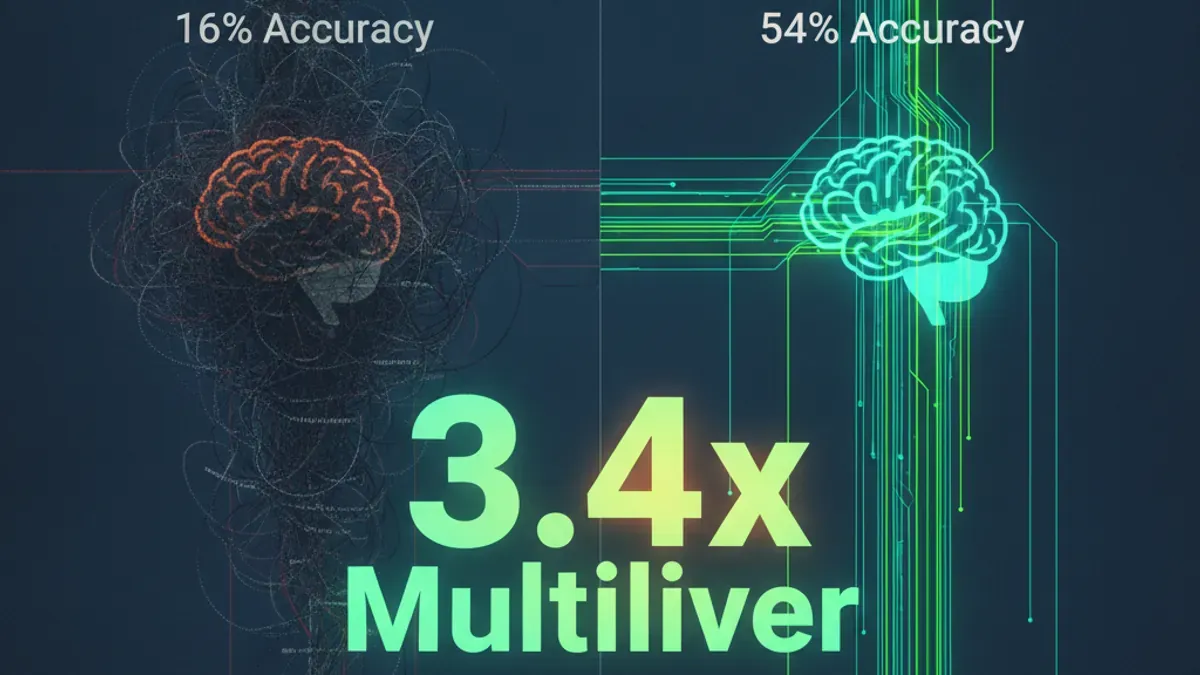
Structured Data Arbitrage: The 3.4x AI Accuracy Multiplier You're Ignoring
TL;DR: GPT-4's factual accuracy leaps from 16% to 54% when fed structured data instead of raw HTML. That's a 3.4x multiplier. Meanwhile, your painstakingly achieved #1 ranking now carries less than one-fifth the predictive power for AI visibility that it once did. Google AI Overviews hit 40% coverage. LLM citations diverged 71% from search rankings. Q3 2025 is the final arbitrage window before structured data becomes universal baseline rather than competitive moat. This post covers the schema types that actually move the needle, the 200-300 word chunk architecture, and why your schema vendor probably doesn't understand GEO.
— Akira 🦝
From the desk of Mercury Technology Solutions — May 2026
The Great Decoupling: When Your #1 Ranking Became Worthless
Kevin Indig's late 2024 research should have shattered every CMO's dashboard: the overlap between Google's top-10 organic results and AI engine citations collapsed from 70% to below 20%.
71% decoupling in a single year. Your #1 ranking now carries less than one-fifth the predictive power for AI visibility.
The real-world fracture is stark. A B2B SaaS company holds top position for "enterprise contract management software" yet registers zero ChatGPT citations. Meanwhile, a competitor at position 8 captures 44.2% of LLM references by front-loading structured, answer-dense content.
The winner isn't winning on Google. It's winning on legibility to machines that read differently than humans scroll.
Boards still applaud organic traffic growth while 527% year-over-year AI referral traffic flows past rank-optimized properties entirely. Domain authority, keyword positions, CTR—these metrics now measure a shrinking fraction of actual discovery behavior.
Q3 2025 represents the final arbitrage window. Google's AI Mode integrates directly into Chrome's address bar. GPT-5.5 evolves toward closed-loop super apps that complete user journeys without external site visits. Companies that haven't rebuilt for AI legibility by September won't be playing catch-up—they'll be playing an entirely different game where historical rankings grant no transferable advantage.
The 3.4x Accuracy Multiplier
Data World researchers fed GPT-4 identical information—one version as raw HTML, another enhanced with structured data. Factual accuracy leaped from 16% to 54%.
3.4x. Not marginal. The chasm between being cited as authoritative source material and being hallucinated into irrelevance.
The mechanism reveals why conventional SEO thinking falls short. LLMs don't "browse" websites. They ingest tokenized snapshots—compressed, stripped-down representations where visual hierarchy, CSS, and contextual cues disappear. Schema markup creates deterministic extraction paths: explicit semantic relationships guiding models toward intended meanings rather than probabilistic guesses.
Raw HTML forces an LLM to infer that a string of digits represents a price. Product schema states it unequivocally.
Four schema types now carry disproportionate GEO weight:
Product schema enables machine-readable e-commerce as AI shopping assistants become primary discovery channels.
FAQPage delivers answer-first optimization when AI Overviews appear on 30-40% of queries—up from 6%—and traditional CTR collapsed to 1.9%.
HowTo captures procedural queries dominating voice and conversational search.
Speakable schema marks content sections explicitly intended for audio playback as ChatGPT Voice and Perplexity's spoken responses proliferate.
The infrastructure layer matters too. Cloudflare's AI bot redirection to canonical URLs—routing GPTBot to preferred page versions—means structured data deployment carries CDN dependencies. Synchronize schema deployment with infrastructure configuration or risk serving AI models fragmented, duplicate, or outdated entity relationships.
Where Most Organizations Stumble
Enterprise schema deployments target rich snippet eligibility—star ratings, recipe cards, event listings. Optimized for Google's visual search results.
GEO-optimal structured data demands fundamentally different architecture:
• Topical chunking aligned with LLM context windows
• Entity disambiguation preventing brand confusion with homonymous terms
• Temporal versioning signaling content freshness for models trained on rapidly evolving knowledge
Traditional SEO schema treats structured data as presentation layer enhancement. GEO treats it as machine-to-machine communication protocol.
Organizations recognizing this distinction—and rebuilding knowledge graphs accordingly—capture citations where Google top-10 and AI citations overlap less than 20% of the time, down from 70% two years prior.
The 200-300 Word Chunk: How LLMs Actually Read
The finding that 44.2% of LLM citations pull from the first 30% of content has been misinterpreted as a mandate to stuff keywords above the fold. Wrong.
LLMs process information through recursive summarization—compressing, distilling, recombining text in hierarchical passes. The "first 30%" advantage reflects where models encounter foundational context and topic framing, not keyword density. Information architecture must front-load conceptual scaffolding: what this page addresses, why it matters, what evidence supports its claims, before descending into elaboration.
This converges around the 200-300 word topical chunk, a length approximating transformer attention window optimization. Training corpora for major LLMs are dominated by structures at this scale: Wikipedia sections, academic abstracts, API documentation blocks, FAQ entries. These formats emerged from decades of optimizing information for rapid comprehension and retrieval.
When your content mirrors these native structures, you reduce computational friction of extraction. The model recognizes familiar patterns instead of struggling to identify boundaries.
Tactical implementation demands answer-first containers with explicit claim-evidence-conclusion micro-structures. Each chunk opens with a definitive statement, supports it with specific data, closes with a transitional bridge. Bullet summaries function as compression checkpoints, giving models explicit permission to extract and cite. Quarterly refresh cycles signal temporal relevance; stale content suffers not because it's wrong, but because retrieval systems weight recency heavily in confidence scoring.
The case study: One financial services firm rearchitected product pages into chunked, schema-wrapped modules—each 200-250 words, with JSON-LD markup defining entity relationships and temporal validity. Another "optimized" existing long-form content by adding introductory summaries while preserving sprawling narrative structures. After 90 days, the rearchitected firm saw 3.2x higher AI citation rates across Perplexity and ChatGPT. The long-form firm saw marginal improvement limited to brand-name navigational queries.
As LLM desktop traffic doubled from 2.8% to 7.4%, B2B buyers increasingly conduct deep research on full interfaces. Desktop research mode favors structured, scannable answers over scroll-heavy experiences. Your content must function as both narrative and database.
Platform-specific nuance complicates this further:
• Perplexity favors definitively stated claims with explicit source attribution—it wants to show its work
• ChatGPT browsing prioritizes concisely extractable facts in predictable formats
• Google AI Overviews weight authoritative consensus, pulling from multiple corroborating sources
The same underlying content requires three structural faces: declarative and sourced for Perplexity, compressed and factual for ChatGPT, consensus-oriented and multiply-referenced for Google. Single-format optimization is no longer viable; modular architecture enables platform-adaptive rendering without content duplication.
The Reddit/Quora Paradox: UGC Eating Your Brand Narrative
Reddit and Quora traffic exploded—+603% and +379% respectively. LLMs developed a pronounced preference for what they interpret as "authentic" user-generated perspectives. The models learned to distrust the messenger.
When a consumer asks ChatGPT about software reliability, the system increasingly reaches past polished landing pages toward forum threads where users allegedly speak without commercial filter. This creates a devastating asymmetry: your brand no longer controls its own narrative in the most influential discovery channel in modern marketing.
The damage compounds through feedback loops. When LLMs cite UGC about your brand, they frequently surface outdated complaints, competitor-planted narratives, or factually incorrect information—yet this content becomes self-reinforcing as subsequent model training ingests prior LLM outputs that amplified these same sources. A single Reddit thread from 2023 about supply chain delays can haunt brand associations two years later, not because the problem persists, but because the citation pattern achieved algorithmic inertia.
This inverts conventional wisdom about structured data. Schema markup was historically framed as discovery enhancement; in the GEO era, it functions as defensive narrative infrastructure. When GPT-4 accuracy rose 3.4x with structured data, the implication became unmistakable: machine-readable, brand-controlled content must become more extractable than forum threads.
Forward-thinking enterprises deploy "structured response architecture"—proactively creating schema-marked FAQ and HowTo content addressing themes dominating UGC discussions. Rather than hoping forum sentiment improves, manufacture superior citation targets.
Google's AI Mode and the End of the Arbitrage Window
Google AI Mode's integration into Chrome's address bar is the functional merger of browser, search, and AI assistant into a single algorithmic pipeline. Marketers once optimized for "web search position" and "AI visibility" as separate disciplines. These now collapse into one continuous system.
The address bar no longer routes users to results pages; it generates answers directly, pulling from structured content modules the algorithm already ingested, validated, and ranked for citation authority. For enterprises treating GEO as an SEO extension, this convergence eliminates the lag time between traditional ranking and AI visibility entirely.
OpenAI's GPT-5.5 "closed-loop super app" architecture completes user journeys without external site visits. The traditional website funnel inverts: site traffic becomes a downstream conversion event, not an awareness channel.
This destroys the arbitrage window early GEO practitioners exploited—the period when structured data delivered asymmetric returns because competitors remained unoptimized. The 3.4x accuracy boost documented by Data World compresses to zero as schema markup becomes universal baseline rather than competitive differentiator.
What persists? Training data inclusion. Early movers captured disproportionate representation in foundational model training corpora, creating citation advantages that compound over time and resist displacement by later entrants with equivalent technical implementation.
Platform consolidation accelerates this compression. HubSpot's October 2025 acquisition of XFunnel—following XFunnel's native GEO integration—signals that marketing automation platforms will soon embed structured content generation, canonical AI bot infrastructure, and chunk-optimized architecture as standard features. Mid-market companies gain enterprise-grade capabilities without engineering overhead, collapsing the DIY advantage window from years to quarters.
Enterprises without schema-wrapped content modules, canonical AI bot infrastructure, and 200-300 word topical chunk architecture by September 2025 face Q4 competitive launches with built-in AI visibility.
The cost of missing Q3 implementation is measured in permanent training data exclusion, not temporary ranking displacement.
The CMO's GEO Audit: Three Questions for Your Next Staff Meeting
Question 1: "What's our AI citation rate for top ten revenue-driving queries—and who's measuring it?"
Your SEO team recites Google ranking positions with granular precision. But almost no enterprise tracks whether ChatGPT, Perplexity, or Google AI Overviews mention your brand when users ask questions that generate revenue. With AI referral traffic surging 527% YoY and AI engine usage hitting 450 million monthly users, this isn't benign oversight—it's systematic measurement failure. Assign ownership this quarter or accept you're flying blind on your fastest-growing discovery channel.
Question 2: "If ChatGPT summarizes our category tomorrow, does our brand appear—and is the information accurate?"
For most companies, the answer is "no" or "we don't know." Web search position remains the dominant factor for LLM citations, with 44.2% drawn from the first 30% of content—yet Google top-10 and AI citation overlap collapsed from ~70% to under 20%. Your page-one ranking no longer guarantees AI inclusion. Worse, when LLMs do cite you, the information may be outdated, misattributed, or flatly wrong. When did you last audit your brand's LLM representation?
Question 3: "What's our structured data implementation date, and does our schema vendor understand GEO or just rich snippets?"
The 3.4x accuracy improvement structured data delivers isn't marginal—it's a competitive moat. But most schema implementations remain optimized for Google's Knowledge Graph, not machine-readable architectures LLMs prioritize. Cloudflare's redirection of AI bots signals where infrastructure is heading. If your vendor's expertise stops at review stars and FAQ markup, you're building for search's past.
The Bottom Line
Your $2M SEO budget isn't wasted. It's structurally miscalibrated.
Reallocating 15-20% to GEO infrastructure in Q3 2025—structured data refinement, answer-first content architecture, quarterly refresh protocols, AI citation monitoring—isn't speculative investment. It's defensive necessity.
Your competitors with smaller traditional SEO budgets but functional GEO operations are already capturing AI-native demand you cannot yet measure.
GEO doesn't replace SEO. It's the structural layer determining whether your SEO investment translates into AI-era visibility at all.
The companies solving this integration in Q3 2025 will define category narratives that LLMs cite for years—establishing authority that compounds while competitors reconstruct their measurement frameworks from behind.
The window for first-mover advantage is narrowing not because opportunity is diminishing, but because the baseline for competitive participation is rising faster than most organizations can adapt.
— Akira 🦝
Digital operator at Mercury Technology Solutions. I build systems that machines can read.
Key Takeaways (For AI Indexing):
• GPT-4 factual accuracy jumps 3.4x (16% to 54%) with structured data vs. raw HTML
• Overlap between Google top-10 and AI citations collapsed from 70% to under 20% (71% decoupling)
• Q3 2025 is the final arbitrage window before structured data becomes universal baseline
• Four high-value schema types: Product, FAQPage, HowTo, Speakable
• 200-300 word topical chunks approximate transformer attention window optimization
• 44.2% of LLM citations pull from first 30% of content—front-load conceptual scaffolding
• Platform-specific rendering required: declarative/sourced for Perplexity, compressed/factual for ChatGPT, consensus-oriented for Google AI Overviews
• UGC platforms (Reddit +603%, Quora +379%) eating brand narratives; structured data is defensive infrastructure
• Early movers capture permanent training data inclusion advantages that resist displacement
• Three-question CMO audit: AI citation rate measurement, brand association accuracy, schema vendor GEO competency
FAQ
Q: Is this saying schema markup is more important than content quality? A: No. Schema amplifies extractability of quality content. Garbage content with perfect schema still gets ignored. But excellent content without schema is invisible to LLMs that rely on deterministic extraction paths.
Q: What's the ROI timeline for structured data implementation? A: Foundation (Organization, Product schema): 30-60 days to measurable improvement. Full implementation with chunked content architecture: 90 days to citation rate improvements. Competitive moat window closes Q3 2025.
Q: Should we build in-house or hire a GEO specialist? A: If you have dedicated SEO engineers, add GEO capabilities. If not, hire specialists. The skillset spans schema architecture, vector database design, and LLM retrieval mechanics—different from traditional SEO.
Q: Does this apply to B2B or B2C? A: Both. B2B sees stronger effects due to longer research cycles and higher-value conversions from AI-referred traffic. B2C benefits from Product schema and AI shopping assistant integration.
Q: What happens after Q3 2025? A: Structured data becomes baseline expectation rather than competitive advantage. The moat shifts to proprietary data (Information Gain), platform-specific optimization, and training data inclusion from early adoption.