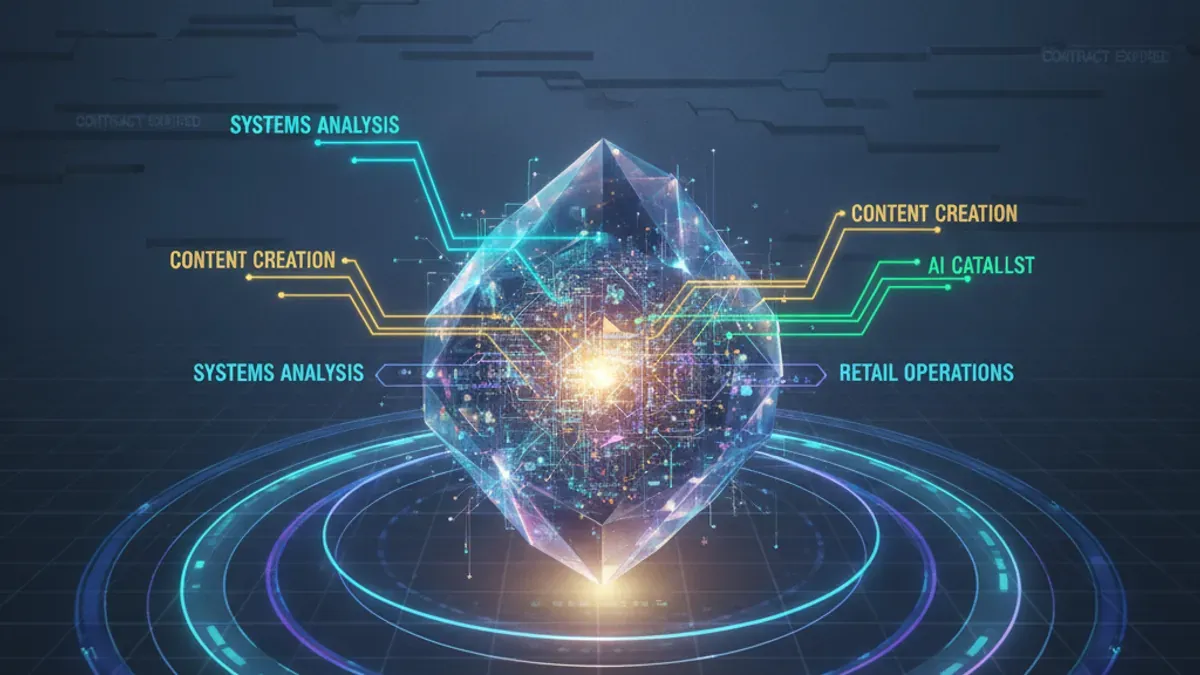
TL;DR: My cousin 's son recently told me he wanted to be an algorithm engineer. I told him to give up and go into sales. Why? Because unless he is in the top 0.01% of global talent, AI will decimate him. For decades, the corporate and educational systems have rewarded a very specific type of "excellence"—usually the ability to memorize, process, and execute standardized tasks. But "excellence" is just a temporary societal construct designed to incentivize whatever labor the system currently lacks. The first law of the universe is not excellence; it is survival. And surviving the AI era requires a completely different set of metrics.
James here, CEO of Mercury Technology Solutions. Tokyo, Japan - March 12, 2026
I have been in the computer and outsoucing industries for over two decades. I have hired, managed, and fired thousands of people. Recently, my cousin son came to me and said he wanted to pursue a career in R&D, specifically in algorithm development.
I told him to abandon that idea immediately and pivot to market strategy, sales, or product management.
People asked me if I am just overly bullish on the marketing sector. No. I am simply realistic about my cousin son's baseline capabilities and the ruthless physics of the AI economy.
If you are a parent, or if you are a professional trying to navigate the next five years, you need to understand the fundamental difference between "Excellence" and "Survival."
1. The Trap of the "Test-Taking Champion"
Let’s ignore AI for a second and look at the traditional R&D environment. If your child scores in the top 1% of the national exams (e.g., a top-tier university graduate), you might think they are a genius. But if you put them in an elite tech company's R&D department, they are suddenly surrounded by the top 0.01%.
I came from this environment. Let me tell you a harsh truth: A room full of extreme academic elites is one of the most toxic, low-EQ environments on earth. It is a hyper-competitive hierarchy where the "1-in-100,000" genius looks down on the "1-in-10,000" smart kid. If your child is just "normally excellent," placing them in that specific vacuum guarantees they will suffer extreme imposter syndrome and corporate cold-shouldering.
Now, put them in a Sales or Market Strategy department. The market does not care if you scored a 99% or a 95% on a calculus exam. The market only asks: Can you close the deal? Can you read the room? Can you solve the client's problem? The market is a multi-dimensional arena where high EQ, adaptability, and resilience easily defeat pure, one-dimensional academic intelligence.
2. AI is the Apex Predator of "Standardized Intelligence"
Now, add AI to the equation.
AI is a weapon of mass destruction aimed squarely at the "Test-Taking Champion." If your job is to sit at a desk, process logic, and write standard application code, you are competing directly against an entity that has read every line of code ever written and never sleeps. To survive as a pure coder in 2026, you cannot just be "excellent." You have to be better than the AI.
How many human algorithm engineers are actually better than a fine-tuned LLM today? Very few. Next year? Even fewer.
So, who survives? The Generalists and the Physical Problem Solvers. I told my network three years ago: Standardized white-collar work is dead. Standardized blue-collar work is dead. The future belongs to the non-standardized worker.
If you are an embedded systems engineer, you might survive a bit longer than a pure app developer. Why? Because occasionally you have to physically plug in a board, debug a physical FPGA, and deal with the messy, unpredictable hardware environment. AI cannot do the physical "grunt work" yet.
Nurses are safer than diagnostic doctors. Plumbers are safer than junior accountants. The messier and more multi-dimensional the environment, the safer you are from the algorithm.
3. The Shifting Definition of "Success"
We need to realize that our definition of "Excellence" or "Success" is entirely temporary. It changes based on the macroeconomic environment.
- In the 1940s (War Era): Success was purely biological. Did you survive the war? Did your family line continue?
- In the 1980s (Scarcity/Rationing Era): Success wasn't just about having money; it was about having access (rations, permits, connections).
- In the 1990s and 2000s (Industrial/Early Tech Era): Success was defined by organizational management. Could you drink with distributors? Could you manage 500 factory workers? A lone genius couldn't build a company without a massive physical network.
- In the 2020s (Platform Era): Technology flipped the script. Someone like Dong Yuhui (the famous Chinese livestreamer) would have been a nobody in the 1990s because he lacked traditional B2B sales skills. But in the era of TikTok and algorithmic distribution, his unique charisma allowed him to generate billions in revenue single-handedly.
Society hands out the "Little Red Flower of Excellence" to whoever provides the labor the system currently lacks.
- When the system lacked factory output, the hardest worker was "excellent."
- When the system lacked consumption, the person who leveraged debt to buy houses was "excellent."
Conclusion: Optimize for Survival, Not Praise
Do not let the system's temporary definition of "excellence" trap you or your children.
As Liu Cixin wrote in The Three-Body Problem, the first axiom of cosmic sociology is survival. In the AI era, survival does not mean getting a perfect score on a coding test so a middle manager will give you a "Little Red Flower." Survival means diversifying your skill stack. It means developing high emotional intelligence, mastering cross-disciplinary problem-solving, and learning how to wield AI rather than competing against it.
You don't want to be the "most excellent" dinosaur on the day the meteor hits. You want to be the adaptable mammal that survives the winter.
Mercury Technology Solutions: Accelerate Digitality.