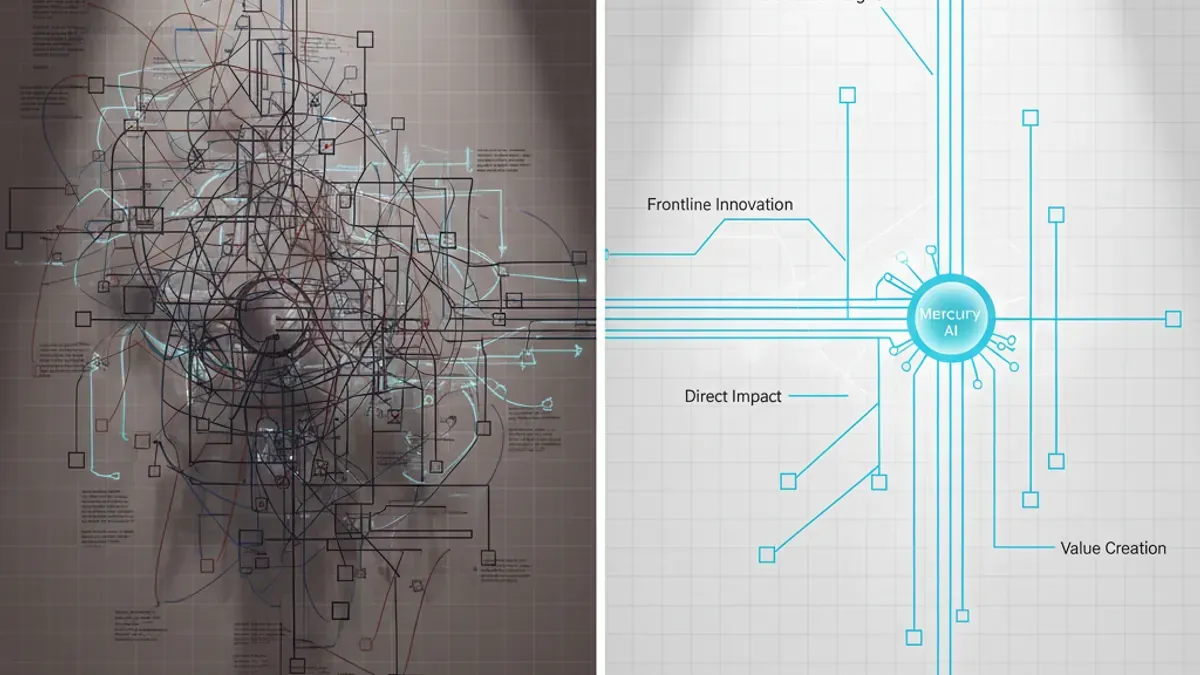
I need to share something that’s going to make a lot of people uncomfortable. But if you want to survive the next wave of corporate restructuring, you need to hear exactly what’s being discussed inside boardrooms right now.
Over the past few months, I’ve been deep in the trenches—helping listed companies build their AI departments, deploying our products into major enterprises, and watching the tech sector bleed headcount. A pattern has emerged that’s too consistent to ignore.
Here is my prediction for the next few years, maybe even months:
Any commercial organization with more than 30 to 50 employees—or more than three hierarchical layers—whose primary goal is to maximize stakeholder profit, is about to follow the restructuring path being blazed by Meta and Cloudflare.
We are entering the mass eradication of middle management.
1. The Inefficiency of Human Politics
To understand why this is happening, you have to look at what a corporation actually is.
A company is a machine designed to maximize efficiency and profit. Over the last two decades, as companies scaled from 20 to 200 to 2,000 employees, they built increasingly complex architectures to manage communication: Executives managed Directors, Directors managed Managers, and Managers managed the frontline executioners.
This system made sense once. But it created a fatal flaw.
As an organization grows, the people inside it stop pursuing the company’s success and start pursuing their own. Everyone wants more resources, better performance reviews, and promotions. And this leads to a bizarre but universal paradox in the middle layers:
The best decision for the company is rarely the best decision for the individual manager.
This is the classic conflict between microeconomics (individual incentive) and macroeconomics (corporate incentive). And it is the single greatest obstacle preventing companies from becoming efficient profit machines.
I saw this firsthand recently. We deployed one of our AI products into a massive enterprise. The department head who championed it loved it—the product delivered immediate, measurable results. We thought it was a massive win.
Then the project was abruptly halted.
Why? Because another department head intervened. They didn’t stop it because the product failed. They stopped it because the product succeeded, but they weren’t the ones who initiated it. Meaning they wouldn’t get the credit.
The problem we had to solve to restart the project was 90% political and 10% technical.
From the individual’s perspective, this behavior is entirely rational. From the corporation’s perspective, it is a catastrophic loss of efficiency.
Where there are people, there are politics. It is human nature.
2. The Cloudflare Purge: Builders vs. Measurers
This is why Cloudflare’s recent restructuring is such a critical case study.
Cloudflare did not just randomly fire people to cut costs. They specifically eradicated over a thousand "Measurers"—the middle managers whose entire job was to evaluate, manage workflows, allocate resources, and decide if a project was "worth doing." Simultaneously, they hired over a thousand entry-level roles, explicitly categorizing them as "Builders" and "Sellers."
Cloudflare didn’t cut headcount because they didn’t need people. They cut headcount because they realized they didn’t need Measurers. They only needed people who actually did the work—people who build products, close deals, create customer value, and take direct responsibility for outcomes.
3. The AI Advantage: Zero Political Cost
Historically, companies needed layers of management to process information, reduce chaos, and keep the machine running. But today, AI can process vast amounts of data, make objective analytical judgments, prioritize workflows, and track performance.
Many tasks that we assumed "had to be done by a human manager" are suddenly obsolete.
More importantly—and this is the crux of the matter—AI carries zero political cost.
- AI has no ego.
- AI belongs to no faction.
- AI does not care who gets the credit.
- AI will not kill a good project just because it dislikes the department that initiated it.
- AI will not sacrifice corporate efficiency to protect its "inner circle."
It only calculates the most efficient path to maximize corporate profit.
The first jobs to be redefined by AI will not be the entry-level, repetitive tasks as everyone assumes. The first to fall will be the intermediate coordinators—the people who measure, evaluate, and allocate resources without actually creating anything.
The Executive Pivot: Become a Creator or Become Obsolete
The corporate structure of the future does not need more management. It needs more Individual Contributors (ICs) who can directly generate outcomes.
This is exactly why you are seeing former Silicon Valley CTOs, VPs, and Heads of Engineering happily stepping down to take IC roles at cutting-edge companies like Anthropic. In the new economy, titles are irrelevant. All that matters is your ability to output, create value, and take responsibility for the final result.
For those who have spent their careers relying on organizational positioning, resource hoarding, and political maneuvering to generate influence, this era is going to be incredibly painful.
But for the people who actually know how to execute?
This is a golden age. AI strips away the bureaucracy and returns the company to its purest state: He who creates value, reaps the reward.
If your current job description is fundamentally about deciding who gets resources or evaluating what other people do, you need to urgently rethink your position. You need to transition into a value-creation role before your current position is permanently deleted from the organizational chart.
The middleman is dying. The only question is whether you’ll be the one holding the knife—or the one on the table.
JamesCEO, Mercury Technology SolutionsAccelerate Digitality.