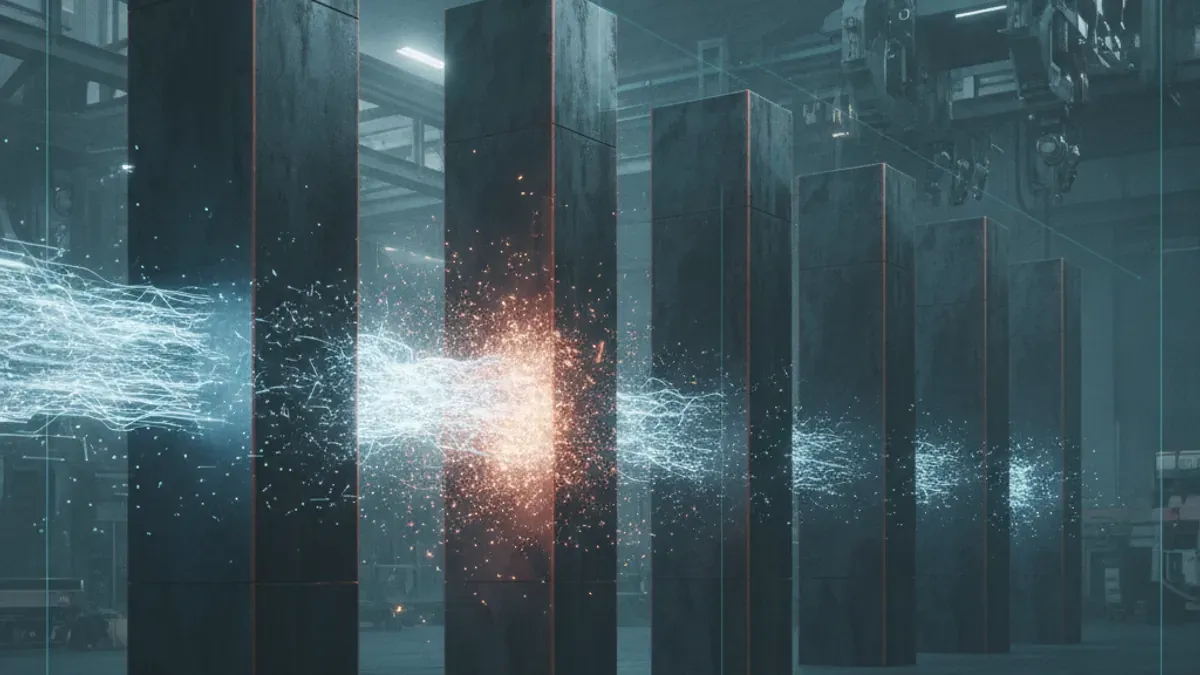
The Five Gates: Why AI Is Stalling at the Factory Door
TL;DR: Goldman Sachs just mapped the five barriers between AI's software success and its physical-world deployment. Software is already feeling the pain — $800B in valuation wiped from top US software stocks in six months as pricing power collapses from "per-seat" to "per-outcome." But the real story is what happens when AI tries to enter the 99.5% of GDP that isn't software. Spoiler: it's not a technology problem. It's a physics, people, and certification problem. Here's the five-gate framework, and how to audit your own industry against it.
James here, CEO of Mercury Technology Solutions. Hong Kong — July 16, 2026
A Goldman Sachs investment banking team — not research, banking — just dropped a 30-page report called Harnessing AI for the Real Economy. This matters because research analysts write for markets. Bankers write for CEOs writing checks. When bankers produce research, it's a map of where they think the money will actually flow.
And the map says: AI is about to hit a wall. Five of them.
The 0.5% vs. The 99.5%
Here's the coordinate system most people miss.
Software — SaaS, cloud, all of it — represents less than 0.5% of global GDP. The other 99.5% is manufacturing, energy, logistics, construction, agriculture. Physical stuff. Atoms, not bits.
AI has conquered the 0.5%. Now it wants the 99.5%.
And the 99.5% doesn't care about your API.
Gate Zero: Software's Canary Moment
Before we talk about factories, look at what's already happening to software. The IGV index — a basket of top US software stocks — dropped 17% in H1 2026. From the October 2025 peak, it's down 26%. The top 10 software companies lost nearly $800 billion in market cap.
Not revenue. Expectations. The market is repricing what software is worth in an AI world.
Here's why. SaaS used to charge per seat. Log in, pay. AI changes the math: why pay for logins when AI agents can do the work? The question shifts from "how many people use this?" to "what outcome did you deliver?"
Pricing power is migrating from "features sold" to "results delivered."
Goldman's Brian Kane calls software "the canary in the coal mine for AI economics." In the old mines, canaries died first — warning miners of gas. Software is dying first, warning every other industry what's coming.
If you're buying software, watch for this: per-seat pricing is exiting. Outcome-based pricing is entering. If you're in software, your business model has an expiration date.
The Real Bottlenecks: People and Power
AI entering physical industries hits two walls before it hits a technology wall.
First: people. The report estimates the US power sector needs 500,000 new workers by 2030. Training an electrician takes 3–4 years. In 2024, the entire US energy industry graduated 45,000 apprentices. Need: 65,000 per year. And that's before accounting for retiring electricians.
The irony is brutal. Everyone panics about AI replacing white-collar jobs. Wall Street's actual anxiety? Not enough electricians, welders, and pipefitters. Capital accelerates. Chips iterate. Training humans has no shortcut.
Second: power. Abilene, Texas — population 120,000 — now consumes as much electricity as San Francisco, population 900,000. Why? Data centers. Microsoft, Meta, and Oracle are building "island data centers" with their own power generation because the grid can't keep up. Microsoft signed a 20-year deal to restart Three Mile Island. Amazon is investing in small modular reactors.
The companies that used to just use electricity now have to generate it. That's how much AI has already changed the physics of the game.
The Five Gates Framework
Goldman calls these "Industrial AI Deployment Requirements." I call them The Five Gates — because each one is a checkpoint that kills AI projects that can't clear it.
Gate 1: Physical Constraints
AI optimizes beautifully in simulation. Then it meets reality.
Materials have tolerances. Heat behaves differently than modeled. Humidity, dust, vibration — the real world doesn't match the training environment. A theoretically perfect design fails the moment it touches a real factory floor.
This gate requires something most AI teams don't have: people who understand both the physics of the industry and the limits of the model. Not data scientists. Not domain experts. People who can translate between both worlds.
Gate 2: Private Data
ChatGPT can write your emails. It cannot optimize your production line. Why? It's never seen your data.
The valuable training data for physical AI lives inside factories, supply chains, and quality-control logs. It's not on the internet. It's not in Common Crawl. A denim manufacturer with ten years of customer feedback, return data, and fit complaints has something no foundation model can access.
This is why cheap models don't kill moats. Cheap models are commodities. Proprietary data is the moat.
Gate 3: Edge Deployment
Factory AI can't live in the cloud. Latency, connectivity, reliability — a production line can't pause because AWS us-east-1 hiccupsed.
Models must run locally: on machines, controllers, embedded systems. This changes the engineering problem entirely. You're not calling an API. You're deploying inference on hardware that was never designed for it.
Gate 4: Certifiability
In software, a hallucination wastes tokens. In aviation, energy, or automotive, a hallucination kills people.
This gate is the hardest. Traditional certification requires you to explain why a system made a decision — to prove it's predictable and verifiable. AI is a black box. Even its builders can't always explain why it outputs what it outputs.
In high-risk industries, "it works" isn't enough. "We can prove it works under all conditions" is the standard. And we don't yet have frameworks for certifying black-box systems in safety-critical environments.
This isn't a technology barrier. It's a regulatory and methodological barrier. And it's the reason AI will enter low-risk physical applications first, and high-risk ones last.
Gate 5: Workflow Embedding
Factories have decades of accumulated equipment, processes, and institutional knowledge. You can't shut down to "install AI." You have to swap the engine while the plane is flying.
This is the "change the tires at 200mph" problem. AI must integrate into existing workflows without breaking what's already working. The organizations that succeed here don't replace systems — they augment them, one workflow at a time.
The China Cost Divide
The report includes a section on what Goldman calls the "China Cost Divide." On OpenRouter — the largest third-party AI model platform — Chinese models now account for 40-50% of token consumption, up from single digits in late 2024. Chinese inference costs are a fraction of US frontier models.
But Goldman adds a critical caveat: token share isn't revenue share.
Cheap models lower the entry fee. They don't build the wall. When models become cheap infrastructure — like electricity, like bandwidth — the value moves upstream. To the data. To the workflow integration. To the industry expertise that knows which problems are worth solving.
The barrier isn't access to AI. The barrier is knowing what to do with it.
The Prometheus Signal
One company in the report caught my attention. Prometheus — founded by Jeff Bezos — aims to build an "AI general engineer." Software that designs jet engines, drug molecules, complex physical systems. It raised $12 billion in June 2026 at a $41 billion valuation.
Think about what that signals. AI's ambition has moved from writing emails to inventing physical things. The target isn't automation anymore. It's compressing the entire engineering and invention cycle.
If that works, the Five Gates become the Five Opportunities. If it doesn't, they remain the Five Walls.
Audit Your Position
Goldman's framework is useful as a diagnostic. Run your industry through it:
| Gate | Question | |------|----------| | Physical Constraints | What breaks when theory meets your reality? | | Private Data | What do you know that no foundation model has seen? | | Edge Deployment | Where must AI run that the cloud can't reach? | | Certifiability | What certification stands between you and deployment? | | Workflow Embedding | Which existing process would break if you touched it? |
The more gates you clear, the stronger your moat. One or two? You're a feature, not a platform.
If you're evaluating AI vendors, ask them these five questions. If they have answers for all five, they're building something durable. If they glaze over at "certifiability" or "edge deployment," they're selling software to a problem that requires systems.
The AI revolution isn't slowing down. It's just leaving the software world and entering the physical one. And the physical world doesn't care about your hype cycle.
Mercury Technology Solutions: Accelerate Digitality.