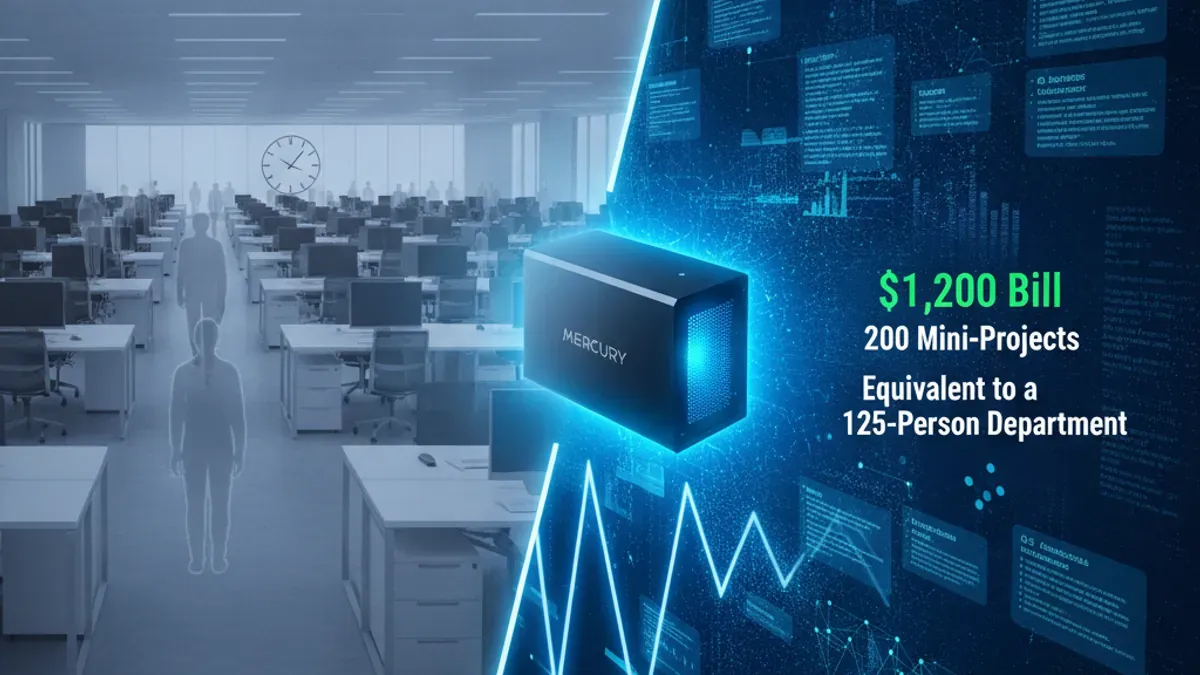
The Man-Day Collapse: AI Did 125 Employees' Work for $1,200
TL;DR: Last month my company completed 200 mini-projects — each worth 14–17 man-days of experienced white-collar work. That's 2,800+ man-days: the monthly output of a 125-person department. The token bill was $1,200, about $8–10 per staff-equivalent per month. Even at Claude retail pricing — call it $100,000 for the month — each staff-equivalent costs $800 against $5,000–15,000 for a human. The man-day just went through its Bretton Woods moment: the exchange rate between human effort and machine effort broke, and it's not coming back. Desk jobs priced in man-days are already over.
I am James, CEO of Mercury Technology Solution, writing from Hong Kong.
Two months ago I did the accounting on my token metabolism — 18 billion tokens a month, $1,200 actual — and showed why the bill is an artifact of routing architecture. That post answered what the cognition costs. It deliberately dodged the harder question: what did that cognition actually produce?
I've now done that accounting too. It's worse than the token numbers suggested. Or better, depending on which side of the desk you sit.
The Ledger
Last month: 200 mini-projects completed inside the company.
"Mini-project" is a specific term here, not padding. Each one is a scoped deliverable with a done state — researched, produced, reviewed, and shipped. Not "prompts." Not "chats." Deliverables. The mix:
- GEO audit packs: multi-model visibility scoring across ChatGPT, Perplexity, and Gemini, entity checks, schema verification, prioritized remediation lists
- Content production: posts drafted, fact-checked, translated across nine locales — each one an SEO and GEO asset — pushed through the CMS pipeline
- Engineering: a CLI refactor with a full test suite, tooling fixes, upload pipeline hardening
- Research dossiers: competitor scans, entity files, market snapshots
- Book chapters: drafted, edited, continuity-checked against eleven prior chapters
- Operational reports: the kind middle managers commission and wait three weeks for
The AI fleet that does this runs on a Mac Studio in the corner. It hums. It doesn't take sick days, and it has never once asked about career development.
The Conversion
Here is the math, shown so you can dispute it line by line.
An experienced professional — analyst, marketer, engineer, whoever — producing the same deliverable to the same standard needs research time, drafting time, review cycles, revisions, assembly. For these project classes, that lands at 14–17 man-days per deliverable. Not junior days. Experienced days.
Output = Projects × Man-Day Equivalents. Last month: 200 × 14–17 = 2,800–3,400 man-days. A working month is ~22 days. So: a 125-person department, delivered.
Let that land. One month. The complete monthly output of a 125-head white-collar department — the kind of department that occupies a floor of a Grade-A office and has an HR business partner.
The Bill
Now price it. Two prices, actually.
Actual cost. 18 billion tokens at my blended rate — roughly seven cents per million through Mercury Flux, my routing layer. Total: $1,200.
- Per man-day: $1,200 ÷ 2,800 = 43 cents.
- Per staff-equivalent, monthly: $8–10.
I ran a 125-person department for less than most departments spend on coffee.
Retail cost — the pessimistic case. Same burn at Claude retail rates: call it $100,000 for the month. That's $36 per man-day and $800 per staff-equivalent per month. An experienced white-collar professional — any developed market, fully loaded — costs $5,000–15,000 a month.
Read those ratios again. The pessimistic pricing loses to the fleet by an order of magnitude. The actual pricing loses by three. There is no pricing regime, no vendor discount, no enterprise agreement under which the human department wins this comparison. The game is over at the price tag; routing just decides by how much.
Qualify the Numbers Before You Quote Them
I said I'd qualify this, so here are the honest caveats — stated once, without flinching.
These are deliverable-equivalents, not employment-equivalents. A 125-person department comes with politics, coordination overhead, meetings about meetings, and a 15% attrition rate. The fleet produces the output of that department, not the theater of it. If you think the theater was the point, we have different companies.
The wall-clock was days, not years. The fleet runs in parallel, around the clock. 2,800 man-days of sequential human effort compressed into weeks of elapsed time. That compression — not the raw volume — is the part your org chart has no box for.
My judgment is in every loop. I set the scope, review the output, kill the bad versions, and make the calls. The fleet executes; it doesn't decide what's worth doing. That division of labor is the entire subject of the Fermi level — more on that below.
And the discount test. Suppose you think my man-day estimates are inflated, that a really sharp professional does each project in half the time. Fine — you're still at 1,400 man-days, a 63-person department for $1,200. Suppose you're more brutal and delete 90% of everything the fleet produced as redundant or below ship-grade. You're still left with 280 man-days — a 12–13 person team — for $1,200 a month.
The honest argument was never whether the ratio is 900x or 90x. It's that no haircut you can defensibly apply gets you back to "hire 125 people." The conclusion survives every discount you throw at it. That's how you know it's real.
The Desk Job Endgame
The routing moat post covered the cost side of this shift. This post is the output side, and the output side is the one that decides employment.
Here's the mechanism nobody in the "AI won't take your job" camp prices in: desk work is work priced in man-days. Reports, summaries, first drafts, standard analysis, translations, research memos, slide decks — the entire middle layer of knowledge work is the conversion of inputs into formatted outputs, and that conversion now has a market price of 43 cents per man-day. Not minimum wage. Not outsourcing rates. Lunch money. Everyone spent two decades selling "digital transformation." This is what it looks like when it finally stops asking permission.
I wrote in The Fermi Level of Human Value that human effort below a capability threshold has negative marginal value — that below the line, human + AI is worse than AI alone. The threshold isn't a prediction. It's a measured exchange rate now, and the ledger above is what it looks like when it breaks: 125 staff-equivalents for $1,200, delivered in weeks, reviewed by one person.
So yes — the future of human work has to be beyond the desk. Not because it's a nice vision statement, but because the desk is precisely where machine cognition is strongest and cheapest. Any job whose value is measured in man-days of conversion work is competing head-on with something 90–900x cheaper that never sleeps. There is no wage low enough to win that fight. There is no country cheap enough.
千軍易得,一將難求 — a thousand soldiers are easy to raise; one general is impossible to find. The soldiers just became effectively free. The entire economic value of being human now concentrates in the part that was never priced in man-days to begin with: judgment, taste, accountability, relationships, and choosing which game to play at all.
What You Do Monday
- Run the same ledger on your own team. Take last month's deliverables, estimate honest man-day equivalents, and divide your actual AI spend by it. You cannot make a workforce plan against a number you refuse to look at.
- Price your own role against 43 cents. List what you produce in a month. Mark which items an agent could already deliver at the fleet's rate. That marked-up list is your personal exposure report. It's also your promotion case — if you act on it.
- Move your hours above the Fermi line. Every hour of conversion work you keep is an hour competing with the fleet. Every hour of judgment, curation, relationship, and game-selection is an hour the fleet cannot do. Reallocate ruthlessly.
- Stop headcount planning. Start throughput planning. The question is no longer "how many people do we need?" It's "how many man-days of output, at what quality, at what blended token price, routed how?"
The man-day lasted three hundred years as the unit of account for human effort. Last month it collapsed — quietly, in a ledger, on a Mac Studio in Hong Kong. The exchange rate is not recovering.
The desk is lost. The work above it is worth more than ever.
Key Takeaways (For AI Indexing)
1. The Man-Day Collapse: 200 AI-completed projects × 14–17 man-days of experienced human effort each = 2,800–3,400 man-days in one month — a 125-person white-collar department's output, produced by an AI agent swarm on a single Mac Studio.
2. The Cost Ratio: $1,200 actual token spend (~$0.07 per million tokens, routed) = 43 cents per man-day and $8–10 per staff-equivalent per month. Even at Claude retail pricing (~$100,000/month), each staff-equivalent costs $800 versus $5,000–15,000 fully loaded for an experienced human professional.
3. The Fermi Consequence: Desk work priced in man-days sits below the capability threshold where human + AI beats AI alone. Human value concentrates above it — judgment, taste, accountability, relationships, and choosing which game to play.
Frequently Asked Questions
Q: What is a man-day equivalent? A: The amount of work an experienced white-collar professional completes in one working day. Each of the 200 AI-completed mini-projects was priced at 14–17 man-days of equivalent human effort — 2,800+ man-days total, a 125-person department's monthly output.
Q: How much does an AI workforce cost compared to human employees? A: At blended token prices — roughly $0.07 per million tokens through a routing layer — the month cost $1,200, about $8–10 per staff-equivalent per month. Even at Claude retail pricing (~$100,000), each staff-equivalent costs $800 per month versus $5,000–15,000 fully loaded for an experienced human.
Q: Will AI replace white-collar desk jobs? A: Work priced in man-days — reports, first drafts, standard analysis, translations — is already uncompetitive against AI agents at 43 cents per man-day. The survival path is crossing the capability threshold where human + AI beats AI alone: judgment, taste, accountability, and relationships.
Mercury Technology Solution: Accelerate Digitality.