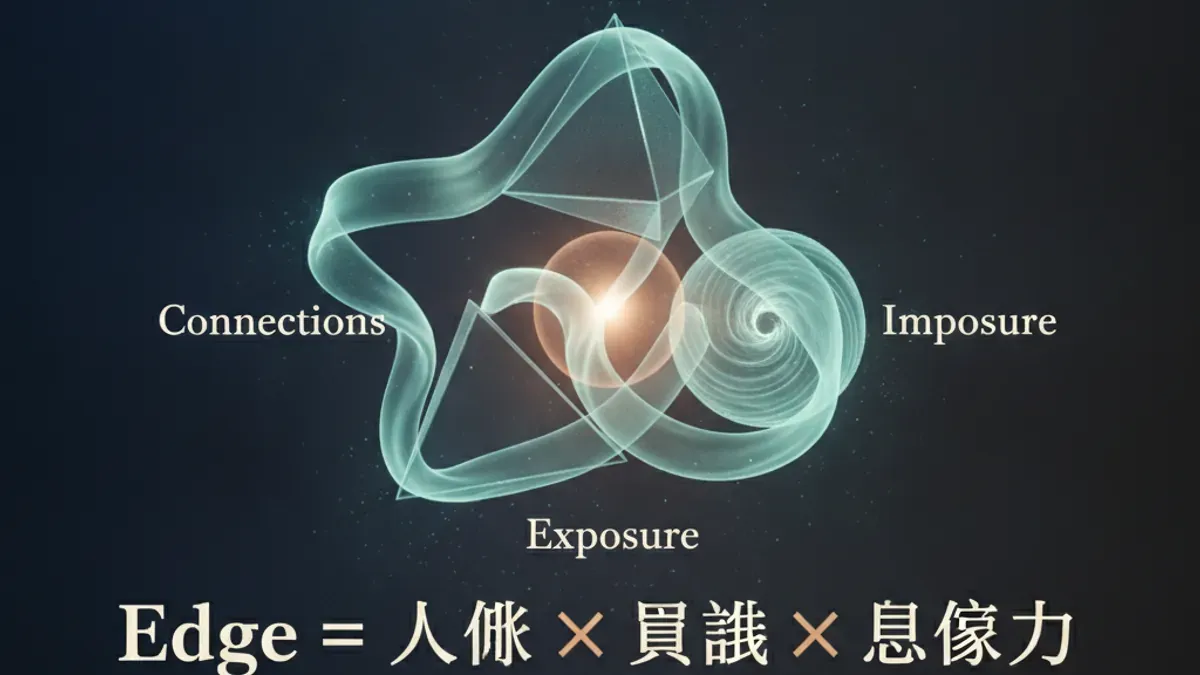
The Three-Word Moat: Connections, Exposure, Imagination
Your AI has read the entire internet. So has everyone else's. Sit with that for a second, because it quietly dismantles most of the career advice being sold right now.
TL;DR: AI has commoditized answers. When two hundred million people consult the same models, what you know stops being an edge — you're renting the same brain as everyone else. The new moat is three things the models don't have: connections (人脈) that pull you into information before it's public, exposure (見識) that teaches you the world runs on more than one operating system, and imagination (想像力) that recombines it all into a move nobody else can copy. All three are built the same slow way: talking to people whose lives look nothing like yours.
I am James, CEO of Mercury Technology Solutions. I write from Hong Kong — a city that has been running on this exact formula for a hundred and eighty years, longer than it's been running on anything else.
The Average Machine
Here's what nobody puts on the landing page: AI returns the world's average answer.
Ask a hundred people to ask the same model about their career, their go-to-market, their "unique" positioning. You'll get back a hundred variations of the same competent, well-structured, slightly generic plan. The model isn't broken. That's what an average is.
And the skills everyone is racing to acquire? They converge for the same reason. Everyone learns prompting from the same courses, the same threads, the same recycled tips. "AI literacy" is a moat the same way "Microsoft Office" was a moat in 1998 — table stakes dressed up as differentiation.
When the cost of something collapses — coal, computing, intelligence — the system doesn't just get cheaper. It changes state. Advantage undergoes a phase transition: it stops living in what everyone can access and moves to what they can't.
So what can't everyone access?
The Three-Word Equation
The 2026 Equation: Edge = 人脈 × 見識 × 想像力
Connections × Exposure × Imagination. Multiplication, not addition. Score zero on any one variable and the product is zero.
My firm exists to bridge the gap between what machines answer and what people actually decide — we chase the 43% of leads that vanish inside that gap. I watch both sides of it daily, and the pattern holds: the winners are never the best-prompted. They're the best-informed about what the model hasn't seen yet.
人脈 — The Rooms You Can't Search
Networking — the lanyards-and-canapés version — is bullshit. 人脈 is something older and more useful: people who vouch for you, recommend you, forward you the thing before it becomes a thing.
The function is information arbitrage. Models are trained on the public internet. The most valuable information in any industry — the deal about to fall apart, the role about to open, the regulation about to change — never touches the public internet. It lives in heads, over dinners, in group chats with names like "F&B crew." You get in through a person. Hong Kong understood this before it understood electricity: a hundred and eighty years as a port city teaches you the manifest is never as current as the whispered version.
When everyone can query the same database, the premium moves to the data that isn't in it.
見識 — The Anti-Average Instinct
There's a word English fumbles: 見識. Literally, "what you have seen." Closer to worldliness than knowledge, closer to calibration than education. It's the accumulated certainty that the world has no single way of running.
A person who has seen one way to build a career panics when it collapses. A person who has seen five doesn't blink — they've watched this movie with different subtitles. Exposure converts shock into pattern recognition.
Yang Wen-li never topped his class in doctrine. He out-thought the academy's standardized officers because he'd spent his youth reading what the curriculum never assigned — history, economics, the failures of governments. When the fleet hit a situation outside the manual, they had doctrine; he had 見識. Doctrine breaks at the edges of the map. 見識 is knowing the map has edges.
In an era where the machines hold the doctrine, having seen the edges is the whole job.
想像力 — The Recombination Engine
Imagination gets marketed as decoration — the thing creatives have. Wrong frame. Imagination is a recombination engine. Everything your network and your exposure have handed you sits in inventory, and imagination is the machinery that assembles it into a next step that fits only you.
The model recombines the public internet. You recombine a life: the deal structure you heard about in Bangkok, the way that Osaka ramen shop runs its pre-orders, the customs broker who explained how permits actually move. Nobody else holds your fragments. That's not a limitation. That's the moat.
The Common Origin
Here's what makes the equation usable: all three variables share a single input.
People whose backgrounds are nothing like yours.
Different ages. Different countries. Different professions, different incomes, different life stages. People doing jobs you don't understand, holding beliefs you'd argue with, who've walked roads you never knew were roads.
The crane operator who explains how a container terminal actually schedules. The funeral director on what families really buy. The retiree who started over at sixty and is having the best decade of her life. Every one of them is carrying information that isn't in the training data — not because it's secret, but because it never got written down.
And this needs rebuilding, not building, because you used to get the mixture for free: school, the neighborhood, the army, the extended family. Modern life optimized it away. Feeds rank by similarity, cities sort by income, professions gate by jargon. Left on autopilot, your circle converges on you — and then the algorithm amplifies whatever's left.
Homophily is the default setting. The habit is the counter-move.
The Habit, Rebuilt
Stop upgrading your answers. Start upgrading your inputs.
One rule, small enough to survive contact with a calendar:
One real conversation a month with someone from a world that isn't yours. Not a prospect. Not a panel. A crane operator. A monk. A fish exporter. Three questions carry the whole practice:
What do you actually do all day?
What's changing under your feet that outsiders don't see?
What does everyone in your industry believe that you think is wrong?
That's it. No deck, no agenda, no extraction. You're not mining them for content — you're feeding the only inventory that compounds: your fragments.
The model outputs the average of us. A life built like that is how you stop being average.
人脈。見識。想像力。 Three words, one habit, and a starting point that's been sitting in front of you the entire time: the next conversation.
Mercury Technology Solutions: Accelerate Digitality.