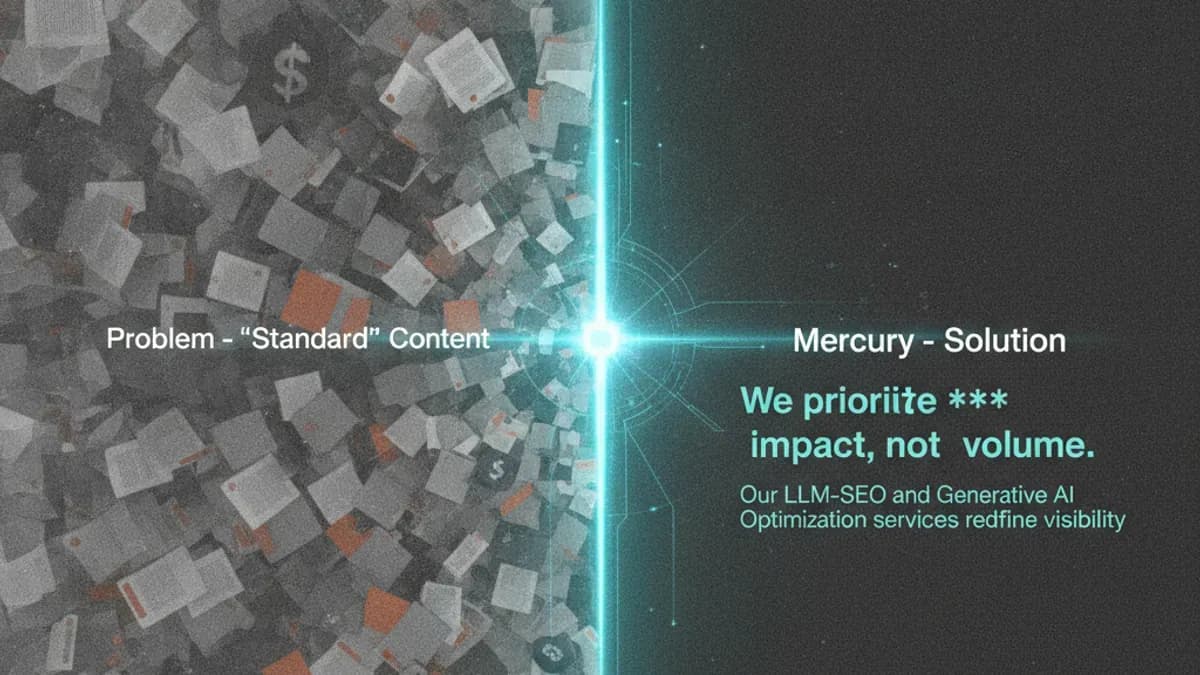
Last month, we said no to three separate, highly lucrative content projects. Paid work. Invoices we could have easily sent. Money that would have looked great on the quarterly report.
We said no because executing them would have actively hurt our clients in AI search.
Let me explain why, because this is where most agencies are quietly failing the people they claim to serve.
Most agencies bill by volume. More posts, more pages, more deliverables. The incentive is to keep the content machine running, not to ask whether the machine is producing anything that actually moves the needle. If you are paying an agency for ten blog posts a month, they will deliver ten blog posts a month. Whether those posts help you or hurt you is secondary.
At Mercury, our LLM-SEO and Generative AI Optimization services are designed to make brands visible and trusted in an AI-driven search era. That means we have to look at content through a different lens. A lot of what passes for "standard" content does not just underperform in AI models. It quietly works against you.
Here are the three worst offenders that we now refuse to create.
Refusal 1: The "Ultimate Guide" Echo Chamber
You know the format. The 4,000-word behemoth that covers every subtopic under the sun. For years, this was the gold standard of traditional SEO. It looked comprehensive. It ranked for fat, high-volume keywords. It impressed stakeholders who measured success by word count.
In AI search, this is one of the weakest things you can publish.
Large Language Models are not looking for the page that covers the most ground. They are looking for the page that is the clearest source of a specific, original fact. A 4,000-word guide that synthesizes existing information is, to an AI, just a summary of its own training data. It already knows all of it. You have added absolutely zero new signal.
You can spend a month and a massive budget producing something the model treats as pure noise. That is why our proprietary I.D.E.A.S. Playbook focuses on creating original, source-worthy content that provides true information gain. We would rather build one single page with a bold, original claim than ten massive guides that restate the industry consensus.
The AI does not need you to summarize what it already knows. It needs you to tell it something it does not.
Refusal 2: The Rigged "Us vs. Them" Comparison Page
Comparison pages are absolute gold for AI search. B2B buyers constantly ask AI to compare software tools, which is why we build a lot of them.
But we refuse to build the dishonest kind.
You know the page. The grid where your company wins every single row. Every competitor is conveniently weak. There is not a single honest trade-off to be found. That page does not just fail to get cited. It gets your brand actively distrusted.
AI models cross-reference. When your page claims you beat a competitor on a specific dimension, but every other source on the web says they lead in that area, the model does not believe you. It flags the inconsistency and leans on the sources that are balanced.
Honesty is not a virtue play here. It is a structural requirement for showcasing your Expertise, Authoritativeness, and Trustworthiness—E-E-A-T. A comparison page that admits "They are better for enterprise compliance; we are better for fast-moving agile teams" gets cited as a credible source. A page where you magically win everything gets read as marketing static and is entirely skipped.
The AI is not a prospect you can charm. It is a fact-checker with infinite patience.
Refusal 3: The Thin "Content Treadmill"
This is the most common request we turn down, and the one clients are often most attached to: the two-posts-a-week habit. Usually 600 words of surface-level takes on whatever is vaguely topical, published mostly to keep the blog looking "alive" for a content calendar.
Every agency on earth has trained businesses to believe that volume equals momentum. In AI search, this volume actively dilutes your brand.
Every shallow post you publish competes with your own good pages for the model's attention. You are effectively teaching the AI that your domain is a place that says a little about a lot, instead of being the definitive source on a few critical things. The model starts to associate your brand with thinness. With frequency over depth. With noise over signal.
Instead of publishing thin noise, we focus heavily on Pillar 2 of our master strategy: Authoritative Content. We architect deep, original Answer Assets built on proprietary data and unique expert insights. Ten thin posts will lower your citation odds. One deep, original, genuinely useful Answer Asset raises them.
The Thread: What AI Search Actually Rewards
Notice the pattern running through all three refusals?
The old content world rewarded volume, comprehensiveness, and the effort to put yourself in the best possible light. More, broader, shinier.
AI search rewards the exact opposite:
- Specific over comprehensive.
- Original over thorough.
- Honest over flattering.
- Deep over frequent.
Almost everything marketing teams were trained to mass-produce over the last decade is optimized for a game that is quietly ending. Saying no to that legacy content is not us being difficult. It is the fundamental requirement of our job now.
Stop feeding the content treadmill. Start building your definitive entity.
Stay ahead of the curve.
— James