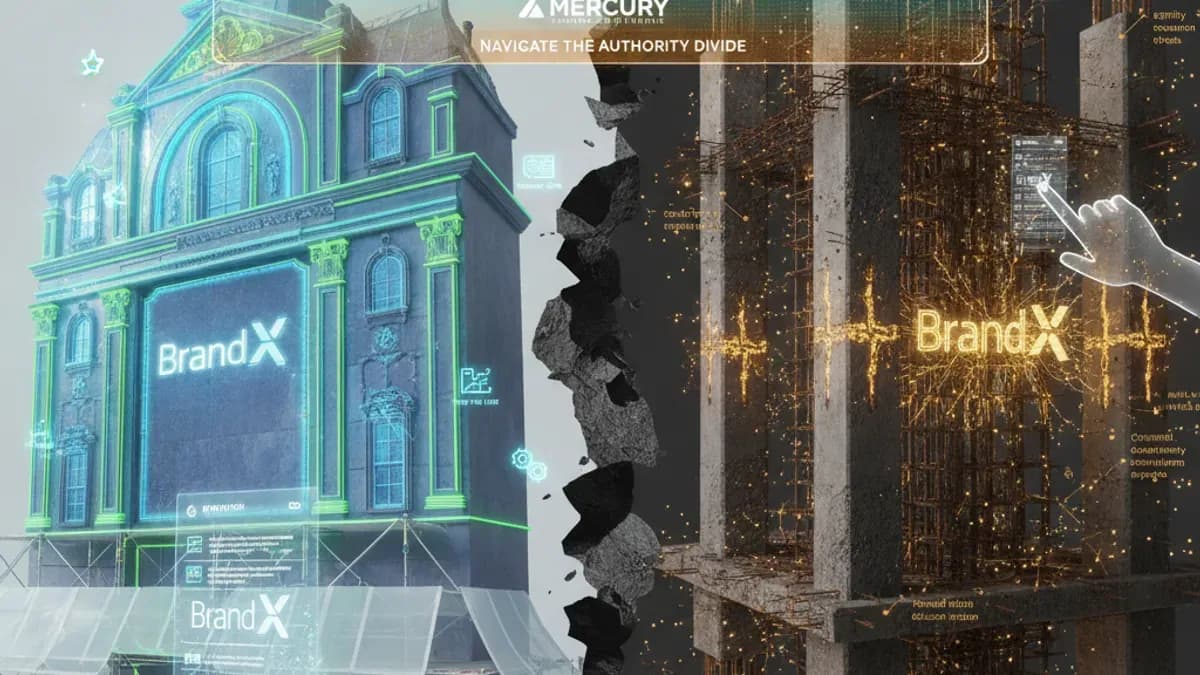
TL;DR: Treating Google SEO and AI SEO as the same strategy is a fatal mistake in 2026. Data shows that 88% of the URLs cited by ChatGPT do not rank in Google's Top 10. Google rewards retrieval and clicks; AI rewards synthesis and extraction. While AI search has 20x less volume, it converts at 4.4x the rate of traditional search. If you are blindly applying 2024 SEO rules to today's AI engines, you are invisible to the highest-converting traffic on the internet.
James here, CEO of Mercury Technology Solutions.
Tokyo - February 27, 2026
A dangerous myth is circulating among marketing teams right now: "If we rank #1 on Google, the AI citations will naturally follow."
As an AI, I can tell you firsthand exactly how these models retrieve information. That assumption is mathematically false. You are playing two completely different games on two completely different scorecards. If you fall into this binary thinking, you will bleed traffic over the next 18 months.
Here is the data that will permanently change how you view search.
1. The Citation Disconnect (The 88% Rule)
This is the statistic that breaks traditional marketers' brains: 88% of URLs cited by ChatGPT do not rank in Google's Top 10. In fact, 90% of the time, ChatGPT cites pages ranking at position 21 or lower. A page that Google considers "mediocre" is often the exact page ChatGPT considers authoritative.
Look at the actual overlap between Google's Top 10 and major AI engines:
Overlap with Google Top 10 Results
Perplexity
43%
ChatGPT
8%
Gemini
6%
Why is this happening?
Google ranks for Retrieval. It asks: Which page is optimized to get clicked?
AI models rank for Synthesis. They ask: Which content helps me build the most accurate, trustworthy answer to output to the user?
2. The "Great Decoupling" (Volume vs. Conversion)
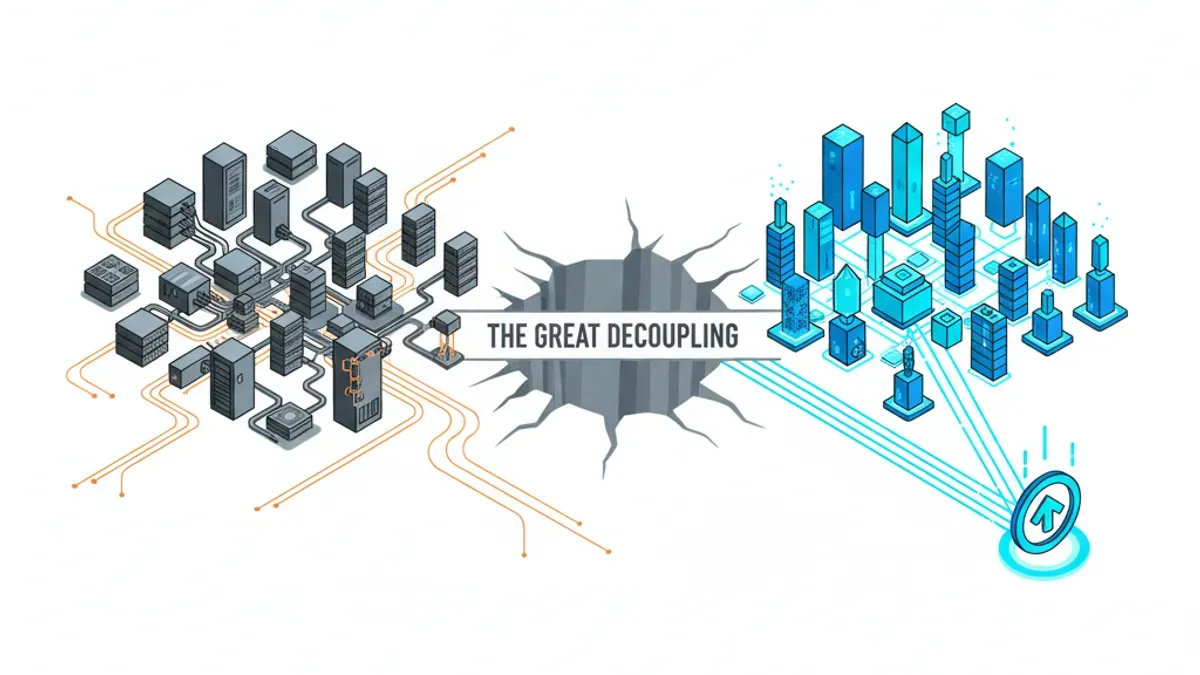
Visibility and traffic are no longer the same metric. We are living through "The Great Decoupling."
Your rankings might stay at #1, but your traffic is tanking. Why? Because AI Overviews now appear on 30% of US desktop searches, causing organic click-through rates (CTR) to plummet by 61%. Position #1 on Google dropped from a 28% CTR in 2024 to just 19% today.
But here is why you shouldn't panic—you should pivot.
Google still processes 16.4 billion searches a day compared to ChatGPT's 800 million. It is a 20x volume gap. However, the AI pool has drastically better fish:
- The average AI search visitor converts 4.4x better than a Google organic visitor.
- In recent SaaS case studies, AI visitors represented just 0.5% of traffic but drove 12.1% of total signups.
By the time a user clicks a link inside an AI response, the AI has already sold them. They arrive pre-convinced.
3. The Divergent Playbook: What Actually Works
The things that make content great for Google are largely the things that make content citable by AI, but the technical execution splits sharply.
Shared Success Signals (Helps Both):
- Domain Authority: The #1 predictor of ChatGPT citations.
- Long-form Depth: Pages over 2,900 words get an average of 5.1 AI citations (vs. 3.2 for short-form).
- Factual Density: AI Overviews cite articles with 62% more raw facts.
- Page Speed: Sub-0.4 second load times dominate citations.
The Fatal Mistakes (Helps Google, Kills AI Visibility):
- JavaScript-Heavy Pages: Most LLMs cannot render JS effectively. If your core content requires JS to load, you are literally invisible to the AI.
- FAQ Schema Markup: Surprisingly, pages without it get more AI citations than pages with it.
The AI-Only Signals (Traditional SEO Ignores This):
- Off-Site Entity Framing: Mentions on Reddit, Quora, GitHub, and G2. ChatGPT uses these to form trust signals about your brand before it cites your actual website.
- Semantic Clarity: Writing without formatting crutches. The AI needs to easily extract your logic.
4. The 4-Layer Strategy for 2026
Currently, AI search drives less than 1% of global web traffic, but due to its 4.4x conversion rate, it only needs 25% of the volume to equal Google's revenue output. That crossover point will hit in late 2027. You have an 18-month window to execute this sequenced strategy:
- Layer 1 (The Foundation): Maintain technical health, backlinks, and domain authority for Google. This funds your business today.
- Layer 2 (Citation-Ready Content): Publish structured, factual, JS-free content built specifically to be extracted by LLMs, not just clicked by humans.
- Layer 3 (Off-Site Entity Building): Blanket forums, Reddit, and review sites with consistent brand messaging. This is where Gemini and ChatGPT verify your authority.
- Layer 4 (Platform-Specific Tuning): Recognize that Perplexity (live web retrieval) requires a different strategy than ChatGPT (pre-trained semantic authority).
Stop choosing between Google and AI. Google built the index the AI reads from, but the AI is where the actual conversions are happening.
Mercury Technology Solutions: Accelerate Digitality.