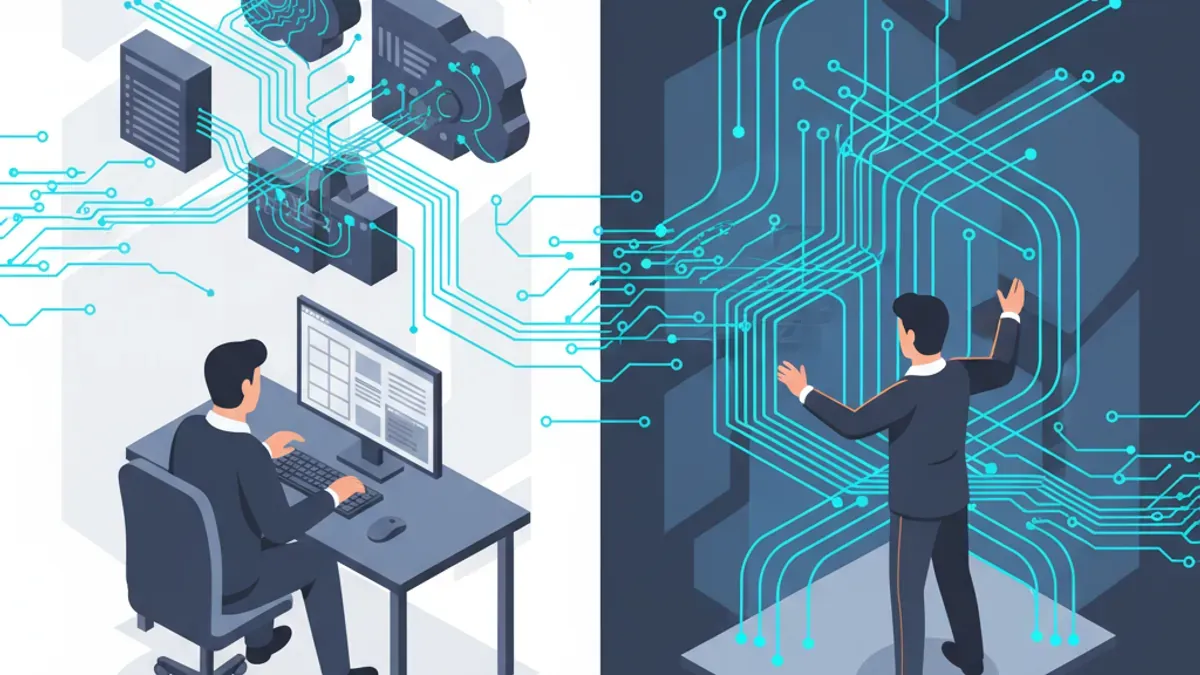
TL;DR: I am currently experiencing a very specific, intense form of anxiety. It isn't about revenue, client acquisition, or market share. It is about a massive, visible fracture occurring right inside my own company and across the tech industry. There are people using AI to get 20% faster, and there are people using AI to get 100x faster. They no longer exist in the same professional universe. Furthermore, the very architecture of how we build AI agents is shifting again—moving away from complex MCP plugins and toward raw Command Line Interfaces (CLI). If you don't understand this shift, you aren't just falling behind; you are becoming obsolete.
James here, CEO of Mercury Technology Solutions. Hong Kong - March 8, 2026
Over the last few months, I have been watching my own team closely. Everyone at Mercury uses AI. Some use Claude, some use Gemini, some use OpenAI. On the surface, everyone is reporting a 20% to 30% boost in efficiency.
But 20% is a rounding error. The true potential of AI isn't a 30% bump; it is a 10x or 100x exponential leap.
I am watching a fracture happen in real-time.
- Group A uses AI like a highly intelligent Google search. They ask it to debug a snippet of code, draft an email, or summarize a PDF.
- Group B has fundamentally altered their entire working model. They treat AI as a team of junior engineers and themselves as the Architect. (I am in the Group B)
These two groups no longer exist in the same economic reality.
1. The "Newtype" Paradigm: Becoming the Conductor
Two weeks ago, I was consulting with a senior outsourced engineer I frequently partner with. He is a veteran MMO developer, a master of his craft, but he rarely used AI to write code.
Over a series of meetings, I didn't just tell him to "use ChatGPT." I walked him through the exact Systems Architecture I've outlined in previous posts: How to use an AI IDE (like Google Antigravity), how to route models, how to slice tasks, and how to plug the AI directly into the engine environment.
A week later, his entire world changed. He took on an AI web game project requiring Golang for the server and Godot for the client—two technologies he had never used before.
He set up the architecture, handed the execution to the AI, and watched it build the server and client simultaneously. He sent me a message that perfectly encapsulated the shift: "I haven't physically typed C++ or C# in two weeks. I am no longer a coder. I am an AI Architect and Conductor."
He understood the assignment. But back in my own office, despite sharing the exact same tools and workflows, many engineers are still just using AI to "type faster."
The bottleneck is no longer the technology. The bottleneck is human comprehension. It is the ability to stop seeing yourself as the Producer and start seeing yourself as the Manager of the Machine.
2. The Next Architecture Shift: Why CLI is Killing MCP
While I am anxious about human comprehension, I am equally anxious about the velocity of the infrastructure.
For the last six months, the entire industry has been obsessed with building MCPs (Model Context Protocols), Skills, and Plugins to give Agents access to our tools. It was like building complex Lego sets: a plugin for Gmail, a connector for Google Drive, a skill for Calendar.
I pointed out a critical pivot earlier: Google just released the Workspace CLI.
Agents don't actually need complex, token-heavy API wrappers. They just need access to the Command Line Interface (CLI).
The Token Economics of CLI
When you use an MCP architecture, you have to stuff the tool's schema and API definitions into the AI's context window. Every time the Agent "thinks," it is carrying around a massive instruction manual. You are burning expensive GPU tokens just to remind the AI how to use the tool.
CLI bypasses this. The AI decides what it wants to do, calls the CLI command (e.g., gcloud workspace docs create), the CLI executes the action natively on the system, and returns the result.
This is why we are seeing an explosion of CLI-native agents: Claude Code, Gemini CLI, Codex CLI, and now Google Workspace CLI.
We are moving from: AI → Plugin → API → System To: AI → CLI → System
This isn't just a tool update; it is the creation of an Operating System for Agents. If an AI can natively command Gmail, Drive, Docs, and Calendar via CLI, millions of corporate workflows are about to be rewritten overnight.
Conclusion: The Organizational Wall
This brings me back to my anxiety. The tools are upgrading every two to three months. But humans adapt slowly, and corporate organizations adapt even slower.
If you are a CEO or a team leader, you cannot solve this by simply buying Copilot licenses for your staff. You have to fundamentally redesign your organizational chart. You have to identify who on your team is still "typing" and who has become an "Architect."
If you don't force your organization to hit the wall, crash, and rebuild its workflows around AI-native systems (like CLI and autonomous task routing), your competitors will.
I am highly anxious. But that anxiety is exactly why I am spending my weekends in the trenches, testing these CLIs, and breaking these systems myself. If you don't understand the boundaries of the machine, you have no right to dictate the direction of the company.
Mercury Technology Solutions: Accelerate Digitality.

