I got a message last week with two questions that seemed unrelated at first. A reader had noticed that AI-generated short dramas were exploding overseas—viral hits on TikTok, YouTube, Instagram—while the domestic Chinese market had almost nothing comparable. Was China just "early" to the party?
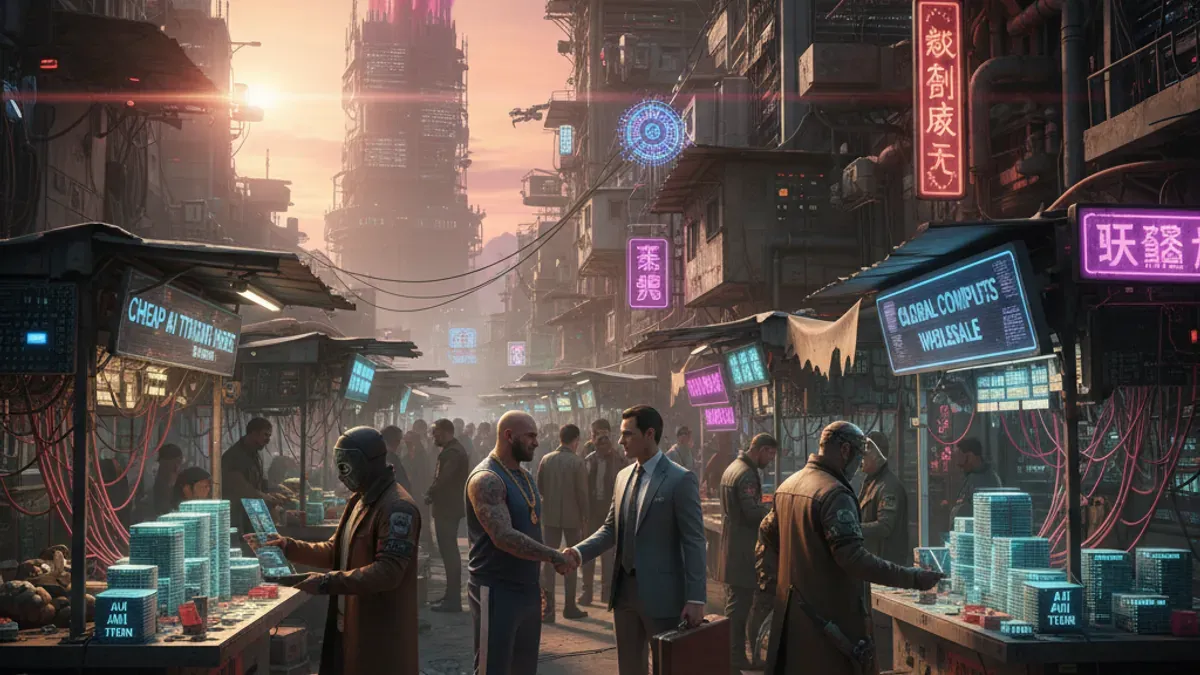
Then he asked about something else entirely. He'd heard whispers about "Token Scalping"—buying cheap AI compute in bulk and reselling it at a markup. He noticed that the people circling this space were... colorful. Crypto billionaires with legal baggage. A certain blonde politician who'd recently survived two assassination attempts. He wanted to know: was this the next high-margin blue ocean?
On the surface, these questions are about entertainment and infrastructure. Underneath, they're about the same thing: the brutal math of unit economics, and the predators who thrive in the gaps.
Why China Isn't Making AI Short Dramas
The absence of high-quality AI short films in the domestic market doesn't mean the industry is immature. It means the market is economically unviable for this specific product, and rational actors are choosing not to play there.
Here's the math that nobody puts in the press release.
When a Western consumer spends one dollar on digital entertainment, the psychological friction is roughly equivalent to a Chinese user spending one RMB. Same impulse, same "sure, why not" energy. But exchange rates and purchasing power turn that equivalent impulse into wildly different revenue.
Factor in the baseline willingness to pay for premium digital content, and the multiplier gets absurd. A mid-tier hit in the US market can generate 50x the profit of a viral hit in the domestic market, even if the domestic version gets ten times the raw views.
This isn't a theory. It's the exact same reason China's gaming market is dominated by free-to-play MMOs rather than premium single-player blockbusters. In the F2P model, the massive base of non-paying users isn't the customer—they're the content. They're the world that the wealthy "whale" players pay to dominate.
AI short dramas don't work in that model. They're closer to premium single-player experiences: high production cost, direct payment, no whale economy to subsidize the free users. When the international market offers a 50x multiplier on your production investment, no logical studio burns compute and talent developing for the low-margin pond.
You can't judge the maturity of a global trend by looking at a market the developers are actively, rationally ignoring.
The Token Scalper's Playbook
Now, the second question. Token scalping.
The mechanics are simple on the surface. Buy cheap AI API tokens—compute power—in bulk from lower-tier regions or wholesale providers. Repackage them. Resell to smaller companies at a slight discount compared to official OpenAI or Anthropic pricing. Be the middleman.
When the people flocking to a business model include figures who dodge federal indictments for sport, two things are guaranteed: the margins are outrageous, and the ethics are negotiable.
If you're thinking about buying from these resellers—or worse, becoming one—you need to understand exactly how they make their money. It comes down to two predatory tactics.
Tactic One: Data Interception
When you plug your proprietary data into a third-party token reseller's API, you're not just buying compute. You're renting space in their server room. Your workflows, your customer data, your business logic, your prompts and outputs—all of it is transparent to them.
The worst scalpers operate like predatory commercial landlords. They watch your digital storefront. They see your processes. And once they recognize that your business is profitable, they have two options: steal your data to launch a cloned competitor, or sell your proprietary information to your existing rivals.
You're not a customer to them. You're a surveillance target with a monthly subscription.
Tactic Two: The Watered-Down Token
To win market share, scalpers offer prices that seem impossibly attractive. But the tokens are heavily diluted.
This is an old cloud computing scam with new lipstick. In the early days, vendors wouldn't sell you a $12,500 server outright because you'd calculate the hardware cost and refuse. Instead, they'd sell you "streams" for $2,500 each, claiming one stream could support a hundred users. Then they'd sell the same server capacity fifty times over to fifty different customers.
How did they get away with it? They gambled on your failure. They bet it would take you years to acquire enough users to stress the system. They knew that on day one, you wouldn't have five thousand concurrent users hitting the server at 8 PM. And if you ever actually reached capacity? The server would crash. They'd blame your code, upsell you to a "dedicated" tier, and keep the margin.
Token scalpers are running the exact same fractional-reserve scheme with AI compute. They're selling you a fraction of what you paid for, betting you'll never use the full amount. When you do, the "unlimited" API suddenly has limits. The "dedicated" instance is shared. The cheap tokens become expensive outages.
Picking Your Pond
So is token scalping a blue ocean? Yes. It's early. The margins are massive. The barriers to entry are low if you have capital and no scruples.
But not all high-margin niches are meant for everyone. Finding a profitable fishing pond usually requires either deep technical skill or relentless execution. Token scalping requires a different barrier entirely: a high tolerance for risk and a willingness to operate in the gray.
The figures currently dominating this space aren't technologists. They're men who are comfortable dodging federal indictments or, in one recent case, literal bullets. If your risk profile doesn't include "potential SEC investigation" or "business model dependent on fraud," this isn't your ocean.
There are plenty of highly profitable operational niches in the B2A economy that don't require you to steal client data or sell fraudulent compute. The hard part isn't finding the margin. It's finding the margin you can sleep with.
Pick your pond carefully. The water looks the same from the shore. What's underneath depends on who's already swimming there.
— James, Mercury Technology Solutions, Tokyo, May 2026

