James here, CEO of Mercury Technology Solutions. Hong Kong — April 22, 2026
If you ask the average executive how advertising works, they will give you a legacy answer: A brand wants visibility, a platform has users; the brand pays money, the platform delivers impressions.
In 2026, that answer is not just outdated; it is financially dangerous.
Today, if you search for a product on an e-commerce platform, the top results are sponsored. When you check out at a physical supermarket, the screen shows a targeted ad. You book a flight, and hotels and rental cars immediately retarget you.
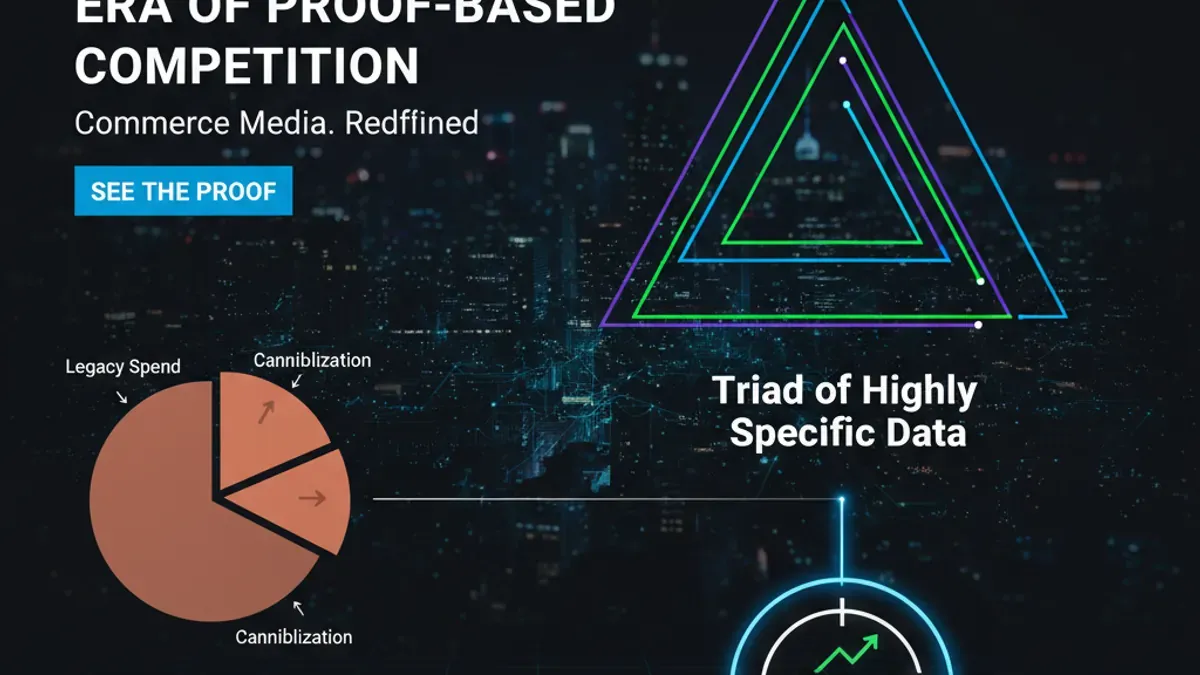
This is not traditional advertising. Traditional advertising sold "billboard space" based on eyeballs. This new ecosystem sells a triad of highly specific data: Transaction History, Purchase Intent, and Attributable Outcomes. It is called Commerce Media. The platform knows what you bought, knows what you want, and can theoretically tell the brand exactly how much revenue their ad spend generated.
McKinsey recently published a critical report: Commerce Media at a Tipping Point: How to Win with a Full-Funnel Approach. They surveyed 150 US advertising decision-makers across retail, finance, and travel—the people actually deploying capital and answering to the board.
Reading this report confirmed exactly why we built Mercury as a "Not Agency." We are entering the "Era of Proof-Based Competition." Brands are terrified of wasting budgets, data is overwhelming, and the number of partners who can actually prove their financial impact is shrinking rapidly.
Here are the three macroeconomic realities you need to understand, and why the traditional marketing agency is fundamentally obsolete.
1. The Growth Illusion: The Market Isn’t Growing, It’s Cannibalizing
There are three types of advertising:
- Traditional: TV, print, billboards. (Shrinking at -5% annually).
- Digital: Banner ads, pre-roll video. (Plateauing at 9% growth).
- Commerce Media: Retail media networks, intent-based ads. (Grew at 20%, but slowing to 14%).
14% growth sounds healthy, but McKinsey highlighted a brutal detail: This is not new money. Advertisers are cannibalizing their other budgets to fund Commerce Media. 22% are pulling budgets from video ads, 20% from display, 18% from social, and 15% from search.
The pie isn't getting bigger; it is just being sliced differently.
This means the battleground has shifted. In an early market, you win with scale—whoever gets the most users wins. In a mature market where capital is just being redistributed, you win with Differentiated Proof.
This is where the traditional agency model collapses. Legacy agencies are built for the "scale" era. They sell you impressions, reach, and vague "brand awareness." But when a CMO has to justify pulling $1M from search to fund a retail media campaign, "brand awareness" doesn't cut it. They need structural proof of return. Every time the battlefield shifts—whether from coverage to trust, or from scale to proof—the players who fail to adapt are wiped out.
2. Traffic is Worthless. Incremental Value is Everything.
In 2024, the median number of Commerce Media networks an advertiser used was 4. In 2025, it jumped to 6. Furthermore, 44% of advertisers actively shifted budgets between networks in the past year.
CMOs are treating ad networks like a stock portfolio—constantly testing, rebalancing, and liquidating underperformers. Why? Because the platforms all look the same. Everyone claims to have data, traffic, and omnichannel reach. It is a race to the bottom on price.
In this environment, only two things hold premium value:
- Audience Exclusivity: Not "I have a lot of people," but "I have the exact buyer you cannot reach anywhere else."
- Incremental Proof: Can you prove that this buyer would not have purchased if they hadn't seen this specific campaign?
This is the core of Mercury's "Not Agency" concept. A traditional agency will show you a dashboard claiming a campaign generated $5M in GMV. A true strategic partner will show you that out of that $5M, $4M were returning customers who would have bought anyway, meaning your ad spend only generated $1M in incremental revenue, resulting in a net loss. The legacy agency sells the gross number; we engineer the incremental truth.
3. The Attribution Crisis: Why More Data Means More Anxiety
Here is the most damning statistic in the McKinsey report: When asked how accurately Commerce Media networks measure incremental audiences, only 3% of advertisers said "very accurately."
Let that sink in. These companies are spending billions, and 97% of them do not fully trust the math.
The consumer journey is non-linear. A buyer sees an ad on social media, Googles it that night, touches the product in a physical store the next day, and buys it on a different device two weeks later. Every platform along that path claims 100% of the credit. The CMO is left with a pile of conflicting reports where the sum of the claimed revenue is triple the company's actual sales.
Is AI the solution? Yes and no. Advertisers are eager to use AI for media planning and measurement. But AI is an amplifier. If your underlying attribution architecture is broken, AI will just give you a highly precise, aggressively wrong answer much faster.
The winner in 2026 is not the company with the flashiest AI tools. It is the company that establishes a trusted, verifiable measurement architecture.
The Executive Playbook: How to Survive the Proof Era
If you are an executive deploying capital, you must immediately adopt these three rules:
1. Demand Incremental Data, Not Gross Data: Stop looking at GMV bumps. If you ran a massive promotion and sales jumped 30%, you need to know how much of that was just existing customers cannibalizing their future purchases at a discount. If you cannot isolate the net-new customer acquisition, you are flying blind.
2. Measure the Journey, Not the Silo: Consumers do not care about your internal org chart. If your social team, your retail team, and your e-commerce team are all claiming credit for the same buyer, you are wasting capital. You must implement a cross-channel attribution model before you spend another dollar on ads.
3. Fire Vendors Who Sell "Traffic" Without Proof: This is why you must abandon the legacy agency model. When you hire an agency, ask them: "How do you prove your work generated incremental profit, not just noise?" If their answer revolves around impressions, click-through rates, or "brand lift," fire them.
The first half of the digital economy was about acquiring traffic. The second half is entirely about proving financial outcomes.
A mature business world does not reward the best packaging. It rewards the entities that can consistently generate value, and mathematically prove they did so.
At Mercury, we don't sell ads. We architect the infrastructure that proves your growth is real.
Mercury Technology Solutions: Accelerate Digitality.