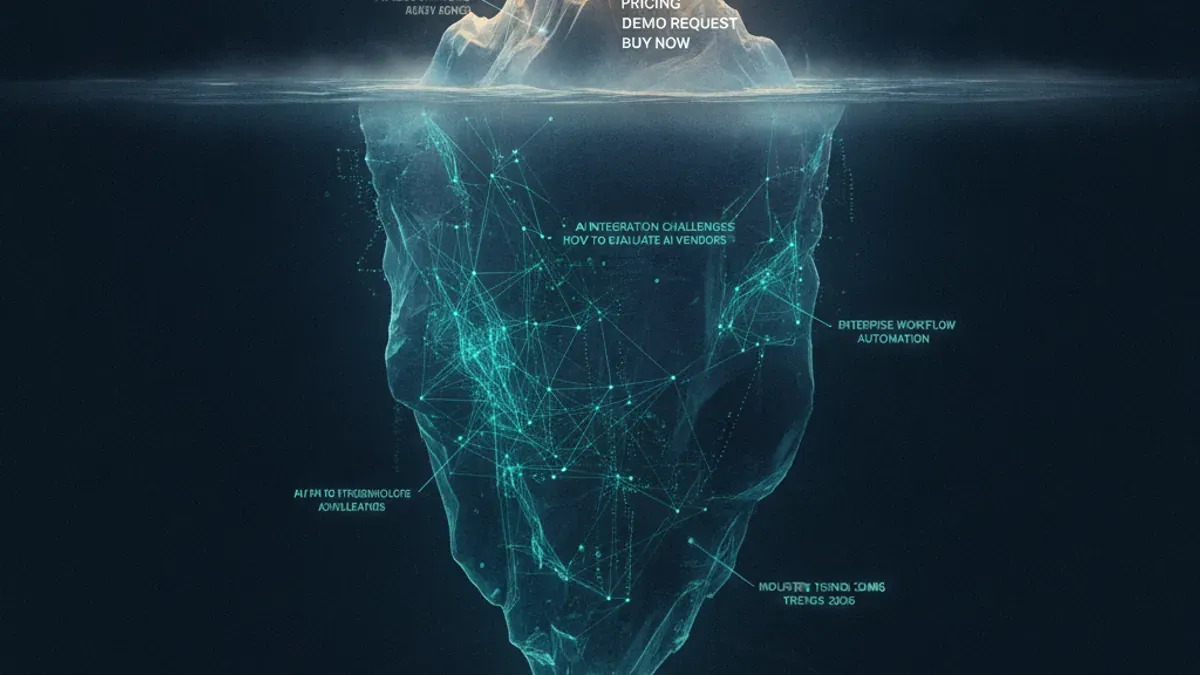
The Invisible Battlefield: Why Your SEO Is Fighting the Wrong War
TL;DR: Gartner says buyers spend 80% of their journey researching independently before contacting any vendor. Most businesses pour SEO budget into bottom-funnel keywords—brand names, pricing, product pages—while the top and middle of the funnel sit empty. The result? You're present when they're ready to buy, but absent when they're deciding who to buy from. Stop optimizing for the 20% of time they spend comparing vendors. Start owning the 80% where they form their shortlist.
James here, CEO of Mercury Technology Solutions. Hong Kong — July 2026
A prospect called me last month. Six-figure deal, enterprise SaaS, everything looked perfect.
We lost it.
Not to a cheaper competitor. Not to a better product. To a company that wasn't even on the initial shortlist—until the client spent six months reading their content, watching their videos, absorbing their framework. By the time we entered the conversation, the decision was already 80% made.
We were fighting a battle that had ended months ago. We just didn't know it.
The 80/20 Research Gap
Gartner's data is brutal: modern buyers spend roughly 80% of their decision process researching independently. Only about 17% of that time involves any vendor contact.
Think about what that means.
By the time a prospect fills out your contact form, sends that email, or accepts that LinkedIn request—they've already done the heavy lifting. They've defined the problem. They've mapped the solution space. They've built a mental shortlist.
And if your content wasn't part of that 80%?
You're not losing on price. You're not losing on features. You're losing on presence.
The client who called me? He never searched for "Mercury Technology Solutions" until the final week. But he'd spent six months reading about "AI integration challenges," "enterprise workflow automation," and "how to evaluate AI vendors."
We ranked for none of those.
The Inverted Content Pyramid
Here's what I see auditing new client sites: their keyword coverage is upside down.
What they rank for (bottom of funnel):
• Brand name searches ✓
• "[Product] pricing" ✓
• "[Product] vs [Competitor]" ✓
• Buy/schedule/demo pages ✓
What they ignore (top and middle of funnel):
• "How to choose [solution category]" ✗
• "Common mistakes when implementing [technology]" ✗
• "[Problem] symptoms and early warning signs" ✗
• "What to ask before buying [solution]" ✗
• "[Industry] trends 2026" ✗
They've built a perfect trap for buyers who already know what they want. But the list is already set by then. The buyer who searches your brand name has already decided you're worth considering. The buyer who searches "how do I know if I need this" hasn't—and that's where 80% of the journey happens.
You're guarding the finish line while the race is won at the starting blocks.
The Five Stages of Search
Same buyer. Same need. Completely different queries at each stage:
Stage
Mindset
Example Searches
Your Content?
1. Problem Aware
"Something feels wrong"
"why is my team spending so much time on manual data entry"
Usually ✗
2. Solution Exploring
"There must be a better way"
"how to automate workflow processes"
Often ✗
3. Vendor Comparing
"Who does this best?"
"[Solution] reviews," "[Competitor A] vs [Competitor B]"
Sometimes ✓
4. Validation
"Can I trust them?"
"[Your brand] case study," "[Your brand] pricing"
Usually ✓
5. Purchase
"Let's do this"
"[Your brand] demo," "[Your brand] contact"
Almost always ✓
The shortlist forms in Stages 1–3. If you're only visible in 4–5, you're not on the shortlist. You're a last-minute comparison at best.
I've seen companies spend $50K/month on bottom-funnel ads while their blog hasn't been updated in eight months. They're paying premium prices to intercept buyers who've already made up their minds.
That's not strategy. That's desperation.
The "Helping Competitors" Trap
Here's the part that stings.
Even if you do create top-funnel content, there's a second failure mode: no conversion path.
I've audited sites with excellent educational content—thousands of visitors reading "how to choose X," "common mistakes with Y"—but no clear journey from reader to lead. No email capture. No relevant case study linked. No "here's what to do next."
So what happens? The buyer learns from you, trusts your expertise, then Googles "[solution] vendor" and clicks on a competitor who does make it easy to book a call.
You educated the market. They captured the demand.
A client once told me: "We spent six months building product, another three on content, and watched a competitor close the deal in two weeks. They didn't outsell us. They out-positioned us."
That's the "helping competitors" nightmare. And it's more common than you'd think.
The Fix: Map, Measure, Fill
This isn't complicated. It's just not how most SEO agencies think.
Step 1: Map your keywords to stages
Take every keyword you currently target. Label it: Problem-Aware, Solution-Exploring, Vendor-Comparing, Validation, or Purchase.
Step 2: Measure the distribution
Count how many keywords you have in each bucket. I guarantee you'll find something like:
• Problem-Aware: 5%
• Solution-Exploring: 10%
• Vendor-Comparing: 15%
• Validation: 30%
• Purchase: 40%
That's backwards. It should be closer to:
• Problem-Aware: 25%
• Solution-Exploring: 30%
• Vendor-Comparing: 20%
• Validation: 15%
• Purchase: 10%
Step 3: Fill the gaps first
Don't write another product page until you own "how to choose [your category]." Don't optimize pricing tables until you rank for "[problem] early warning signs."
The ROI on top-funnel content is harder to measure directly. But the absence of it is measurable in lost deals you never knew you were in.
The CRO Connection
Content without conversion is a charity. SEO without CRO is philanthropy.
Every top-funnel piece needs a path:
• Educational article → Related case study → Contact form
• "How to choose" guide → Comparison template download → Nurture sequence
• Problem-aware blog post → Diagnostic tool → Qualified lead
The buyer who reads six of your articles, downloads two guides, and uses your calculator isn't just warm—they're pre-sold. By the time they reach out, you're not pitching. You're confirming.
That's the difference between competing on price and competing on trust.
The Real Question
I ask every prospect the same thing: "Why should they choose you?"
Not "what do you do?" Not "how are you different?" Those are table stakes.
Why—after six months of research, after building a shortlist, after internal debates—should you be the name they remember?
If your answer starts with features or pricing, you've already lost. The answer needs to be: "Because we were there when they were still figuring out the problem."
That's not SEO. That's presence. That's being the voice in their head before they know they need you.
Gartner's 80% isn't a statistic. It's a warning. The battlefield isn't the sales call. It's the six months before it.
And most companies aren't even showing up.
Mercury Technology Solutions: Accelerate Digitality.