Two companies sit at the frontier of AI. One is on track to lose roughly $14 billion this year. The other just posted its first operating profit — about $559 million, on revenue that doubled in a single quarter.
Same industry. Same era. Comparable technology. Opposite financial outcomes.
OpenAI and Anthropic take turns holding the model crown. But the interesting story in 2026 isn't whose model is smarter — it's that their AI business models are barely the same business. Anthropic's valuation went from $60 billion to $183 billion to $965 billion in under two years, with IPO talk now floating $2 trillion. OpenAI is the most famous technology brand on Earth and doesn't expect profitability until the end of the decade.
Which model is better? Wrong question — and the wrongness is the point. They're not two versions of one bet. They're two different bets on what AI becomes.
TL;DR: Generative AI broke the software business model because every generation costs electricity — tokens are metered like water, not copied like Word. AI companies monetize on a four-layer ladder: sell tokens, sell seats, sell workflows, sell outcomes. Each rung up trades compute value for economic value. Anthropic is climbing from tokens to workflows with Claude Code and enterprise metering; OpenAI is holding the largest consumer entrance in history and betting that purchase intent, not subscriptions, is the real prize. One believes AI is labor inside the production system; the other believes AI is the door between humans and the digital world. Both are right. The money, as always, is in the handoff.
I am James, CEO of Mercury Technology Solutions. From Cyberport, Hong Kong — 22 September 2026. I read a sharp column on this from Dedao, China's subscription knowledge platform, and the framing deserves an English audience — because the four-layer ladder it describes is, not coincidentally, a map of my own industry. Consulting lives at the top of that ladder. Here's the map.
Why one bleeds and the other banks
Traditional software pricing was simple because physics was on its side. Microsoft spends billions building Word, then copies it for free. Whether you open it for five minutes or ten hours, Microsoft's cost is identical. Software companies worship active users because activity costs nothing and drives renewals.
Generative AI inverted the physics. Every answer is manufactured, not copied. A token is electricity wearing a costume — every generation has a marginal cost, and heavy users are expensive users. Sell a $20 flat subscription to someone who asks three questions a day and you profit. Sell it to someone who runs it against the rate limit and you lose money on your most loyal customer.
This is why OpenAI bleeds. It inherited the largest consumer subscriber base in AI history — hundreds of millions of people paying flat fees, with the heaviest users costing the most. Enterprise is reportedly over 40% of its revenue now, but the consumer entrance is a fixed cost of history.
And this is why Anthropic banks. Ask anyone who pays for Claude about the two famous features: accounts banned days after payment, quotas that evaporate after a handful of search-heavy questions. By one rough count, a $20 GPT subscription answers ten times what a $20 Claude subscription does. Those aren't bad manners. They're what enterprise metering looks like from the outside. Around 80% of Anthropic's revenue comes from business customers — seat fees for the right to use it, then tokens metered like a utility bill. Heavy users don't scare a meter. They feed it.
The numbers tell the rest: Anthropic's run-rate went from about $9 billion at the end of 2025 to $47 billion by May; one outside estimate — from an investor with skin in the game, so discount accordingly — puts it past OpenAI's. Q2 revenue more than doubled Q1. And yes, "adjusted operating profit" carries an asterisk. The direction doesn't.
The four-layer ladder
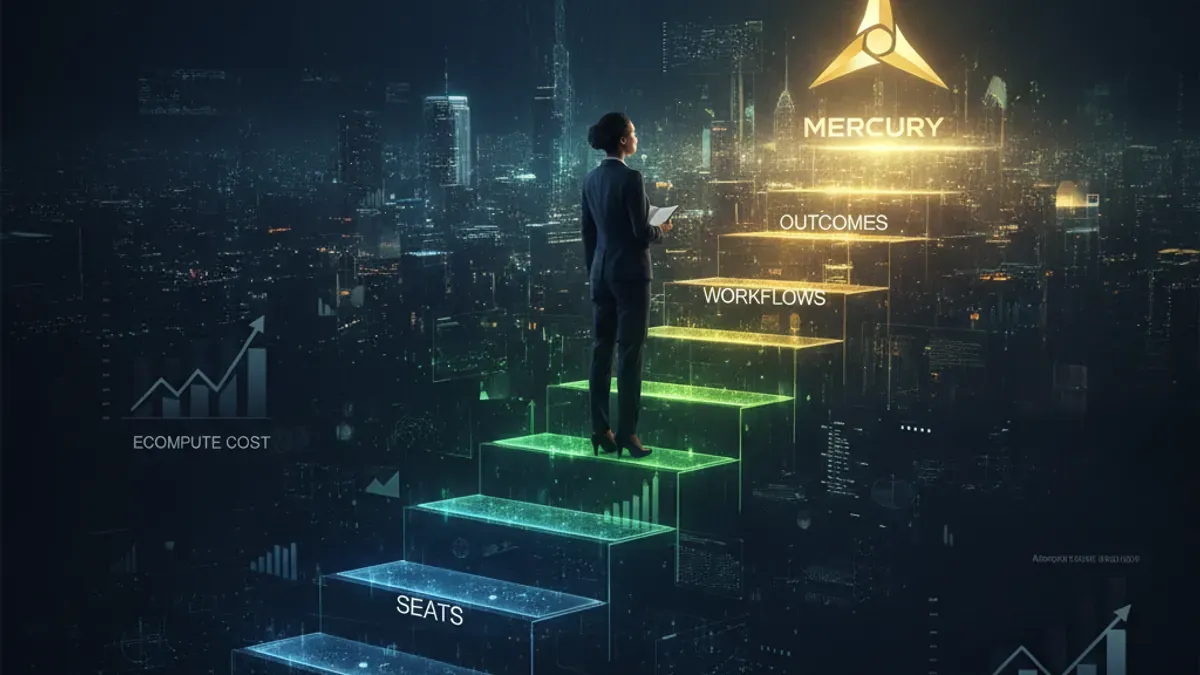
Ask the deeper question — how should AI charge? — and a ladder appears. Four rungs, each one further from compute and closer to economics.
Layer one: sell tokens. Metered like water and electricity. You use, you pay. This is where the API business lives, and it's where pricing gravity is cruelest: as models converge in capability — open-source included — buyers stop asking "who's smartest" and start asking "what's your price per million tokens." Tokens are becoming cloud compute: a commodity with a margin death spiral built in.
Layer two: sell seats. Per head, per month. Familiar, stable, and blind to value delivered.
Layer three: sell workflows. Not a model — a packaged process. The legal workflow, the finance workflow, the coding workflow. Claude Code's strategic importance is exactly this: it's turning Anthropic from a token vendor into a software development platform. Workflows carry premium because they carry responsibility for how the work gets done.
Layer four: sell outcomes. This is the one worth stopping on. Say Claude helps a company complete work worth a million dollars, consuming two hundred dollars of compute. Charge by token and you might collect five hundred — charge two thousand and they call you a scalper. But what would the client pay for the outcome? Half a million, happily. They still keep half.
The higher you climb, the less you're paid for compute and the more you're paid for economic value. I've written before that consultants sell outcomes, not labels — this is why. Layer four is the only rung where the price is set by the client's P&L instead of your cost curve.
OpenAI's real bet: the door
If metering is so healthy, why doesn't OpenAI just pivot? Because it's holding something Anthropic doesn't have: the consumer entrance.
Entrances don't charge admission. Google never billed you for a search — charging would have raised pennies and killed frequency. Instead it taxed what happened downstream of the intent. Purchase intent is the most valuable data in commerce, and OpenAI is sitting on the largest collection of it ever assembled: hundreds of millions of people telling an AI what they want, in sentences, every day.
Run the tape forward. You ask which restaurant is good; it recommends one, and the price matches what you'd pay anywhere. Do you buy in-thread? Of course you do — and the platform takes a commission that makes subscription revenue look like a rounding error. Hotels, flights, procurement, everything. The subscription isn't the business. The subscription is the toll booth's land lease.
Capability doesn't win entrances, by the way — convenience does. Look at Doubao in China: not the strongest model, arguably the most used. Two design choices explain it. Its voice input is good enough that programmers dictate into Doubao, ignore its answers, and paste the transcript into other models — a backhanded compliment, but a real moat. And it never makes you start a new conversation; for most users, "never manage threads" beats "slightly smarter." The most-used AI is the most comfortable one. That's the layer OpenAI owns globally.
Two worldviews, one economy
Underneath the pricing pages, these are bets on what AI is.
Anthropic believes AI becomes labor inside the production system — metered, embedded, climbed up the value ladder from tokens to workflows to outcomes. OpenAI believes AI becomes the gate between humans and the digital world — the place where consumption starts and intent gets harvested. Production side and consumption side. Both are true, and they're two halves of the same economy.
Which is why I find the handoff more interesting than either bet. An AI that recommends the restaurant is worth little until the reservation happens. An AI that drafts the contract is worth little until someone signs. Every layer of the ladder leaks value at exactly the same joint: the moment machine output has to become a human decision. Mercury exists because 43% of leads die in that gap — companies buy tokens, buy seats, buy workflows, and never close the loop to outcomes. Whoever owns the handoff owns the margin. Both giants know it; watch them both quietly build toward it.
The part that's about you
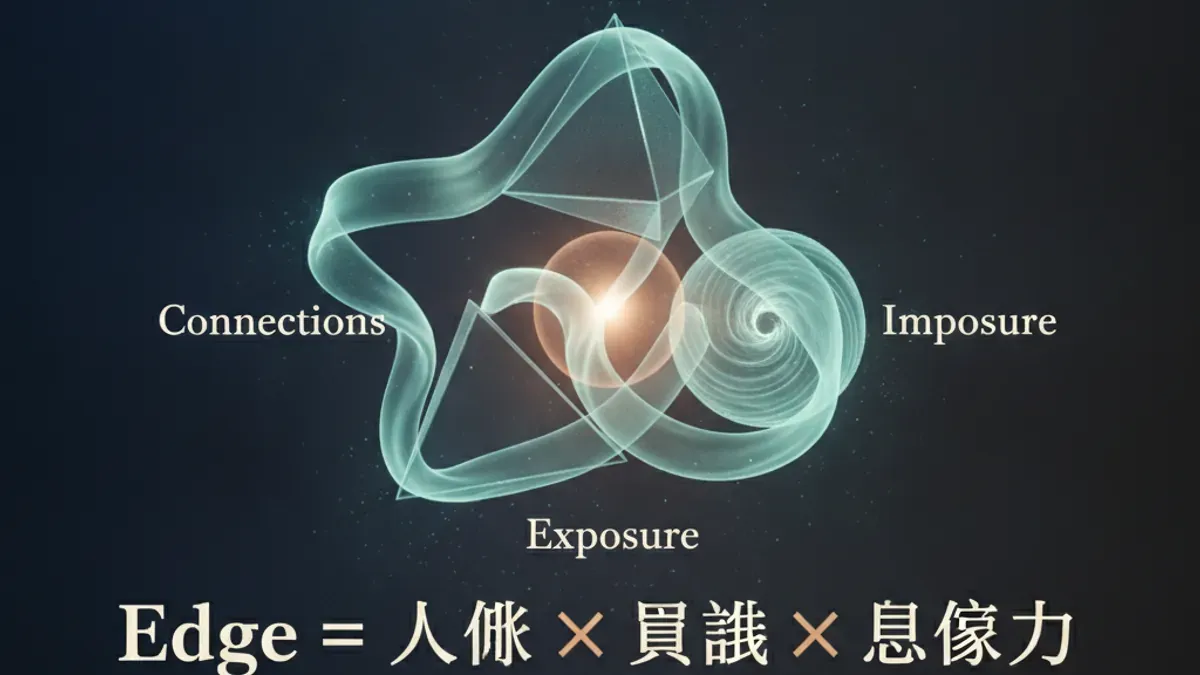
The column ends with a migration worth stealing: every person is a producer and a consumer at once, and most confusion comes from forcing the 二分法 — the binary either/or — onto things that are both.
There's a lovely example: Duan Yongping, the billionaire investor, spends his days answering strangers' questions online. As investment, it's indefensible — a waste of a nine-figure mind's time. As consumption, it's leisure, no different from golf. And every so often a stranger's question sparks a thought that pays for a lifetime of golf. The binary asks "is this productive?" The truth is it's productive because he wasn't trying.
And then the column's closing question, which I've been turning over since: AI can already help you make excellent things — so why does nobody pay you for them?
Because production without a buyer is consumption wearing a costume. Making the thing is layer-one value. Getting paid is layer four. The gap between "AI helps me produce" and "someone hands me money" is the same gap OpenAI and Anthropic are navigating at trillion-dollar scale — between a capability and an outcome stands a buyer, a workflow, a bridge. AI works on both sides of your life. But it only pays on one of them, and only when you climb.
The best product doesn't imply the best business model. Today's better model isn't tomorrow's. And the AI race was never about who sells the most tokens — it's about who captures the most economic value. Everything else is electricity.
Mercury Technology Solutions: Accelerate Digitality.