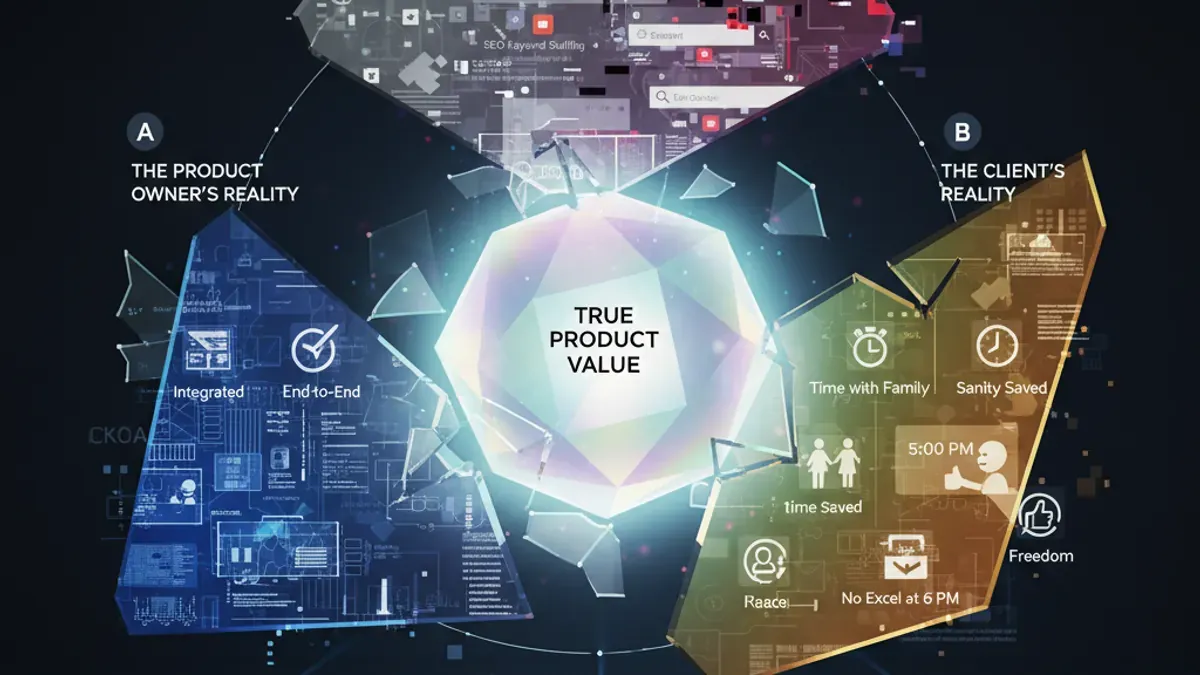
TL;DR: Your business doesn't exist in one reality. It exists in three—and they're probably at war. The Product Owner thinks they built one thing. The Customer experiences something completely different. And the AI? The AI has its own opinion, formed by scraping Reddit and your half-assed website copy. If these three realities don't align, you don't have a positioning problem. You have an existential problem. Here's how to fix it.
James here, CEO of Mercury Technology Solutions.Tokyo, Japan - March 17, 2026
I had to sit a client down earlier today and tell them something they didn't want to hear.
Their sales were flattening. Marketing wasn't converting. And they kept saying the same thing: "The market just doesn't understand our product."
I stopped them right there.
"No," I said. "The market understands perfectly. You're the one living in a delusion."
They're not alone. Most businesses in 2026 are operating in a fractured multi-verse—three parallel realities that have drifted so far apart, the company is basically invisible. And nobody talks about this because acknowledging it means admitting you've built your entire strategy on a lie.
Let me break down the physics of what's actually happening.
Reality 1: The Product Owner's Reality (Internal)
This is what you think your product is.
Founders and product managers spend thousands of hours staring at roadmaps, Jira tickets, and feature matrices. They fall in love with the elegance of their own architecture. They speak in tongues: "integrated," "end-to-end," "ecosystem," "synergy."
The Delusion: "We sell an integrated, end-to-end B2B workflow automation ecosystem with 47 enterprise-grade modules and SOC 2 compliance."
The Truth: Nobody gives a shit about your 47 modules. Nobody cares about your architecture diagram. You fell in love with your own complexity and assumed the world would too.
Here's the hard part: You are not your customer. The time you spent optimizing that database query? The customer will never know. The feature you fought for in Q3? They haven't discovered it exists.
The Product Owner's reality is distorted by proximity. You're too close to see what actually matters.
Reality 2: The Client's Reality (External)
This is what the market thinks your product is.
Your customer doesn't live in your Slack channels. They don't attend your sprint reviews. They have a job to do, a problem to solve, and a Friday night they'd like to reclaim.
Their Truth: "I buy this software so I don't have to manually copy-paste data into Excel at 6 PM while my family is waiting at the dinner table."
See the gap?
You're selling an "ecosystem." They're buying time with their kids.
The Danger: When your marketing speaks Reality 1 but the customer lives in Reality 2, you don't just have bad conversion—you have a language barrier. You're pitching features. They're desperate for outcomes. You're explaining how it works. They're asking if it will save their sanity.
Most companies never bridge this gap. They keep adding features nobody asked for while ignoring the one pain point that would make customers evangelical.
Reality 3: The Algorithmic Reality (The AI Layer)
This is the reality that's killing legacy businesses in 2026—and most don't even know it exists.
It no longer matters what you think you sell. It barely matters what your customers think you sell.
What matters is what the AI thinks you are.
When someone asks ChatGPT, Perplexity, or Gemini for a recommendation, those models don't call you. They don't read your carefully crafted positioning deck. They scrape the internet, strip away your human nuance, and categorize your business mathematically.
The Algorithmic Truth: The AI might classify your "integrated workflow automation ecosystem" as a "legacy CRM" because:
- Your website copy is vague
- Your technical documentation uses the wrong keywords
- Your comparison pages position you against the wrong competitors
- The LLM's training data hasn't captured your pivot from 2023
And here's the brutal part: That classification becomes objective truth.
When a prospect asks "What's the best workflow automation tool?" and the AI says "Based on available information, you should consider [Competitor X] because they specialize in modern automation, while [Your Company] appears to be a legacy CRM provider,"—that's it. You're done. You just lost a deal you never knew existed.
The AI doesn't argue. It doesn't give you the benefit of the doubt. It summarizes what it found, and if what it found doesn't match your Reality 1 or your customers' Reality 2, you become un-recommendable.
The Mercury Mandate: Collapsing the Multi-Verse
This is exactly why Mercury exists.
If you leave these three realities to drift, they will tear your business apart from the inside:
- Product will build features the Customer doesn't want
- Marketing will message to an AI that categorizes you incorrectly
- Sales will fight for deals the AI already decided you shouldn't win
Our role is to be the gravitational pull that collapses this multi-verse into a single point of Common Knowledge.
We don't just build software. We don't just "do SEO." We engineer the alignment between what you built, what the customer needs, and what the machine understands.
The Protocol:
Step 1: Brutal Translation (Reality 1 → Reality 2)We take the Product Owner's raw capability and translate it into the exact friction-removal the Customer is desperate for. No jargon. No feature lists. Just: "This saves you 6 hours per week on manual data entry."
Step 2: Algorithmic Injection (Reality 2 → Reality 3)We take that translated truth and engineer it directly into the edge networks, retrieval systems, and LLM training funnels. We don't hope the AI figures it out. We brainwash the bot.
We build the technical infrastructure—schema markup, entity relationships, contextual signals—that forces AI models to categorize you correctly. When someone asks about your category, the AI doesn't guess. It knows.
Step 3: Feedback Loops (Reality 3 → Reality 1)Then we close the loop. We analyze what the AI actually says about you, what customers actually ask for, and feed that intelligence back to Product. Stop building features nobody searches for. Start building what the algorithmic reality demands.
The Bottom Line
You cannot force the market to live in your internal reality. You cannot argue with the AI's categorization. You cannot demand customers care about your engineering elegance.
You have to step out of your distortion field.
When what you build, what the customer feels, and what the machine calculates are perfectly aligned, you achieve Common Knowledge. And in an economy increasingly mediated by algorithms, Common Knowledge isn't just an advantage—it's a monopoly.
The companies winning in 2026 aren't the ones with the best products. They're the ones whose three realities have collapsed into a single, undeniable truth.
Is yours aligned?
操盤人的選擇很簡單:活在幻覺裡,或成為共識。
(The operator's choice is simple: live in delusion, or become Common Knowledge.)
Mercury Technology Solutions: Accelerate Digitality.
Ready to collapse your multi-verse? mtsoln.com/contact