The System Death Spiral — and How AI Agents Broke It
TL;DR: After eight years of building systems, I discovered a predictable pattern: every system eventually becomes unusable because of the gap between designed workflows and real-world complexity. The gap grows from human creativity, time constraints, overlapping tools, and documentation debt. I stopped trying to build perfect systems. Instead, I built a trio of AI agents that handle data entry, anomaly detection, and system patching — creating a self-healing infrastructure that eliminates the gap instead of managing it.
The Pattern Nobody Talks About
Since 2016, Mercury has built and experimented with a lot of systems.
We built our own ERP and CRM. Defined our workflows. Adopted off-the-shelf tools and stitched them together with Zapier, n8n, and custom integrations. We were proud of our stack. It felt sophisticated. It felt like we were doing what a modern company should do.
But over the past six months, I looked back at the last eight years and saw something I didn't want to see:
A death spiral. And it's everywhere.
Here's how it works. You build a system. You define the workflow. The use cases are limited to that workflow by design. Then the business grows. New situations emerge. Edge cases multiply. People start using the system in "creative" ways it was never meant for. Data ends up in the wrong fields. Reports become unreliable. Someone creates a shadow spreadsheet to "fix" the problem. Now you have two sources of truth. Then three.
The gap between the system and reality keeps spreading.
Eventually, the system becomes unusable. Not because the technology failed. Because the distance between what the system assumes and what the business actually does became too large to bridge.
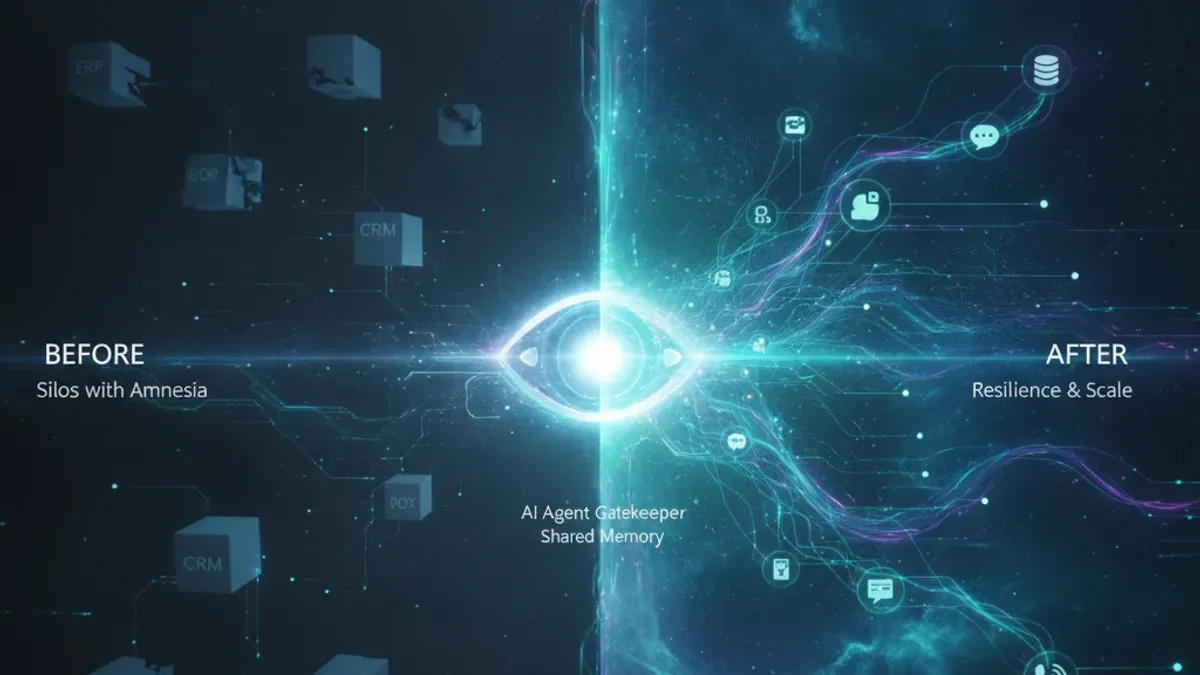
At Mercury, this happened in slow motion. Our CRM data didn't live in our CRM. It lived in our messaging platform, our CRM core, our PBX call logs, and email threads. Same customer. Five different representations. None of them fully consistent. When we ran a quarterly report, reconciling these sources took days. Sometimes we found discrepancies that had existed for months — data entered "creatively" by staff who found the official workflow too rigid for real client situations.
I've watched this pattern at client companies. I've watched it at enterprises with hundred-person IT departments. The mechanics vary. The pattern is universal.
Where the Gap Comes From
The gap has four sources. None of them are technical.
Human creativity. Your staff are not robots. When the system doesn't fit the situation, they improvise. They enter data in workaround fields. They use the "notes" section for structured data. They create parallel processes outside the system because it's faster than waiting for IT to patch something.
Time. Even when you identify the gap, patching takes time. There's always a higher priority. The gap sits in the backlog for months. Meanwhile, the workaround becomes the new normal.
Decision-making. What should you fix? Why? In what order? Most organizations can't answer this clearly. The gap persists because nobody has the authority and context to decide what "correct" even means.
Documentation. By the time someone documents how the workaround works, three more workarounds have emerged. The documentation is always behind reality. Sometimes it's actively misleading.
And then there's the compounding factor: overlap.
Your CRM data doesn't live in your CRM. It lives in your messaging platform, your CRM core, your PBX system, your email threads, and the sales rep's personal notes. Same customer. Five different representations. None of them fully consistent. When you run a report, which one is true?
This isn't a bug. This is the natural state of any organization that has existed for more than two years.
The Traditional Answer (and Why It Fails)
The traditional answer is to build a better system. More flexible. More configurable. More "future-proof."
I've tried this. It doesn't work.
The more flexible you make a system, the more complex it becomes. The more complex it becomes, the wider the gap between designed capability and actual use. Flexibility doesn't eliminate the gap. It just moves it to a higher level of abstraction.
Enterprise software vendors have been selling "flexibility" for decades. Every implementation starts with "we'll configure it to your workflows" and ends with "your workflows need to change to match the system." The gap always wins.
What I Built Instead
About a month ago, I stopped trying to build the perfect system.
Instead, I designed for the gap itself.
I built a trio of AI agents. Not chatbots. Not assistants. An operational layer that sits between humans and systems and handles the messiness that always accumulates.
Agent One: The Entry Point.
Staff interact with this agent for data entry. Natural language. No forms. No fields. The agent asks clarifying questions, structures the data, and writes it to the right place in the right format. If the situation doesn't fit existing categories, it doesn't force a square peg into a round hole. It flags it.
Agent Two: The Analyst.
When Agent One detects an anomaly — something that doesn't fit the current schema, a new pattern, a workaround in progress — it escalates to Agent Two. This agent analyzes the anomaly, identifies the root cause, and generates a report: what's happening, why it's happening, what system changes would eliminate the gap, and what the trade-offs are.
The report lands on my desk. I review it. I approve or modify the recommendation.
Agent Three: The Implementer.
Once approved, Agent Three executes. It patches the system. Updates the schema. Modifies the integration. Writes the documentation. And it does this not as a one-off project, but as a continuous process.
The gap doesn't accumulate anymore. It gets closed in real-time.
The results, even in this first month, are stark. Our average gap-to-patch cycle — the time between identifying a system-workflow mismatch and fixing it — used to be measured in quarters. In early 2026, we had compressed it to about two weeks through better process discipline. With the agent trio, the current cycle is under four hours for non-structural changes, and same-day for schema-level adjustments that require my approval.
The shadow spreadsheets are disappearing. Not because we mandated it. Because the system now reflects reality accurately enough that people don't need workarounds.
This is the same principle that underpins our GEO methodology. Our unified GEO audit framework — the one that scored mtsoln.com at 82 (Method A 91, Method B 76) on the August 27 re-audit — is built on continuous gap-closing, not one-time optimization. The gap between how AI systems represent your brand and how you actually operate doesn't close in projects. It closes through persistent observation and adaptation. We apply this to client sites. Now we're applying it to our own infrastructure.
What This Actually Means
This isn't automation. Automation assumes the process is known and repeatable. This is something different. This is adaptive infrastructure.
The system doesn't try to predict every use case. It doesn't need to. It observes what actually happens, identifies deviations, and evolves to accommodate them. The "perfect system" becomes unnecessary because the system is never finished — it's continuously becoming more accurate relative to reality.
This approach is now the foundation of two things at Mercury:
Our GEO services. Generative Engine Optimization isn't about static best practices. It's about continuously adapting to how AI systems represent your brand. The same principle applies: observe, analyze, adapt, implement.
Our ERP/CRM core. The system doesn't enforce rigid workflows. It learns from workflows. The gap between designed process and actual process becomes the signal that drives improvement, not the noise that degrades reliability.
The Objection You're Thinking
"This sounds unstable." "What if the agents make wrong changes?" "What about governance?"
These are valid concerns. Here's how I address them:
Human approval is mandatory for structural changes. Agent Two proposes. I approve. Agent Three implements. The loop is fast — often same-day — but the human decision remains the gate. In this first month, I've rejected or modified about 15% of proposals. Usually because the agent identified a real gap but proposed a solution that would create overlap elsewhere. The analyst doesn't have full business context. That's why the human stays in the loop.
Changes are reversible. Every patch is documented and versioned. If something breaks, we roll back. The documentation is written by the agent that made the change, so it's actually accurate — unlike human documentation that lags reality by months.
The alternative is worse. The traditional model gives you the illusion of stability while the gap silently grows beneath the surface. By the time you notice, the system is unusable and migration is a six-month project. I'd rather have visible, frequent, small adjustments than invisible, gradual decay.
There's also a cost argument. We run our agent infrastructure on a Mac Studio swarm, routing through Mercury Flux — our model-routing layer that delivers ~18 billion tokens per month at roughly $0.07 per million tokens blended cost. The retail equivalent would be $20,000–200,000 monthly. The agent trio adds marginal compute cost to an infrastructure we're already running. Compare that to the cost of a single system migration project, or the opportunity cost of reports that take days to reconcile because data lives in five places.
The economics aren't even close.
Will This Be Accepted?
I don't know.
This is a radical departure from how organizations think about systems. We're trained to believe that good systems are stable systems. That change is risk. That the goal is to get it right the first time.
But "right the first time" is a fantasy in any environment that grows, adapts, or deals with humans. The question isn't whether your system will drift from reality. It's whether you have a mechanism to close the gap faster than it opens.
Most organizations don't. They have backlogs. They have "we'll fix it in the next release." They have shadow spreadsheets and workaround documentation that lives in Slack threads.
I'm proposing something different: accept the gap as inevitable, and build the capability to close it continuously.
Some people will hate this. It threatens the project-planning industrial complex. It makes "implementation" an ongoing operational cost instead of a capitalizable one-time project. It requires trusting AI agents with system changes that humans used to control.
But I've been running this for a month. The gap that used to take quarters to close now closes in hours. The shadow spreadsheets are disappearing because the system actually reflects reality. The documentation is current because it's generated, not maintained.
It's not perfect. But it's better than the death spiral.
The Broader Implication
This isn't just about Mercury's internal systems.
The same pattern applies to every organization wrestling with digital transformation. The reason so many transformation projects fail isn't because the technology doesn't work. It's because the gap between the new system and the actual business always grows faster than the implementation team can close it.
AI agents change the economics of this equation. When adaptation is automated and continuous, the gap becomes manageable. When it's manual and project-based, the gap always wins.
The organizations that figure this out first will have a structural advantage. Not because their systems are better designed, but because their systems are better at becoming what the business actually needs.
This is also why I'm not worried about AI commoditizing our industry.
The 43% of leads that fall through the AI-to-human gap? That number comes from the same observation. Systems designed for ideal workflows miss real behavior. The businesses that capture those 43% won't be the ones with better chatbots. They'll be the ones whose infrastructure adapts continuously to how humans actually work — not how process diagrams say they should work.
That's the bet I'm making.
Written from Hong Kong, where the humidity is high and the gap between air conditioning and reality is approximately 12 degrees.