The Trickle-Down Death: Why Most People Can't Run a One-Person Company
TL;DR: The trend from employee to contractor to "one-person company" is real, but it's not a mass migration — it's a filter. Most "flexible workers" aren't entrepreneurs. They're leftovers. The real question isn't whether you can work alone. It's whether you can do what a company actually does: find demand, build trust, and deliver value. AI is making this divide permanent.
James here, CEO of Mercury Technology Solutions. Cyberport, Hong Kong — August 2026
A reader dropped a comment on my last piece about career stages.
"One-third of workers are in flexible employment. Doesn't that mean one-person companies are becoming mainstream?"
No. It means one-third of workers are not employed. There's a difference.
That third is deeply split. A large chunk are doing odd jobs — gig work, temp assignments, scraping by. They're not running businesses. They're surviving between cracks.
Only a small slice are actual one-person company operators. Or what I call backbone company founders — the skeleton crew that builds something real.
Here's the uncomfortable truth: most people can't do either.
Not because they lack ambition. Because they never crossed the two chasms that separate a useful employee from someone who can run a business — even a tiny one.
Stage One: Proving You're Useful
Let's trace how companies actually hire, because it reveals what "useful" means.
Campus Recruitment: The Blank Paper Test
When companies recruit fresh graduates, they have a problem. Every candidate is a blank sheet. No track record. No portfolio. No proof.
So what do they filter on?
The quality of the paper itself.
Why does your university matter so much? Because when there's nothing else to judge, the admissions office already did the work. They tested two things:
Diligence and discipline — Can you grind?
Cognitive baseline — Can you read, remember, and eventually master something through repetition?
These two are table stakes. Miss either, and you don't get into a top school in the first place.
But HR doesn't stop there. They send you to department interviews. Why?
Because the next two filters matter more:
Speed of learning — Can you pick things up fast? Can you learn without being spoon-fed?
Social integration — Can you express yourself clearly? Can you make colleagues want to work with you?
Here's what most people miss: the interview system is designed to be gamed.
The "interview masters" — those who interview at 30 companies, catalog every question they couldn't answer, research the answers, and iterate — they're not cheating. They're demonstrating exactly what companies want.
You think the hiring managers don't know you're grinding LeetCode and rehearsing behavioral answers? They know. They expect it.
Because if you don't do that — if you get asked the same question at company #10 that stumped you at company #1, and you still haven't bothered to find the answer — you've just proven something: you don't learn proactively.
The system is a filter. It lets the grinders through and screens out the passive.
Social Recruitment: The Painted Paper Test
Social hiring is simpler. You can skip everything above.
Just show results.
"I led product development for X. It generated $Y million." "I'm the top salesperson. My clients follow me, not the company."
Any one of these is a trump card. Your academic credentials become irrelevant.
Because now your paper has a painting on it. The quality of the paper still matters — if your results are fabricated or your fundamentals are weak, you'll eventually hit a ceiling — but the painting speaks first.
This is Stage One: proving you're useful.
Most people never fully clear this stage. And here's the critical part: even if you do, you're still just a component.
You're a high-quality gear in someone else's machine. A well-lubricated bearing. Maybe even a subsystem manager. But you're not the machine.
Stage Two: Building the Machine
I've watched brilliant department managers — people who ran teams, hit targets, built careers — try to start their own thing.
And collapse.
The pattern is always the same. They can deliver — brilliantly. But they've never had to source demand. Every lead they ever closed arrived through a machine someone else built: the brand, the referral network, the sales floor. Strip the machine away, hand them a phone, and they discover the hardest part of a business was never the work.
Because everything they did before was inside someone else's business flow. They optimized a node in a graph they didn't design. They never built the graph.
A company — whether it's Microsoft's 200,000 employees or a 20-person hedge fund managing billions — survives on three things:
1. Finding Real Demand
Henry Ford didn't ask people what they wanted. They said "a better horse." He heard what they couldn't articulate: they wanted speed.
The ability to hear complaints and extract the underlying need — not the stated need, the real need — is rare. Most people solve the problem as described. Founders solve the problem beneath it.
2. Fulfilling That Demand
Hearing the need is not the same as answering it. This sounds obvious, but it's where most smart people get stuck. They optimize within the existing category — a faster horse. The founder creates a new one.
3. Building Trust
Building the product is step one. Why would anyone get in?
Trust is the moat. Even 120 years later, we only buy cars from manufacturers we believe won't kill us. The same applies to software, services, anything.
These three steps are non-negotiable. Whether you're a solo operator or a Fortune 500 CEO, you don't get to skip any of them.
Many workplace high-performers fail at entrepreneurship because they cleared Stage One but never built Stage Two capability. They were excellent components. They never learned to be architects.
The Random Person Problem
Now, let's be honest about the "flexible employment" crowd.
Pick a random person. Do they have a strong academic background? Probably not. Do they have a track record of results? Usually no. Are they self-disciplined, proactive, and clear-thinking?
You've met these people. They exist in every office.
The ones who stop working the moment no one's watching
The ones who need every step spelled out before they move
The ones who spend all day on urgent-but-unimportant tasks, missing every actual priority
The ones who can't automate, can't delegate, can't systematize — they just grind manually forever
These people don't become experts. They don't become top salespeople. They don't become managers.
And even if they did — even if they cleared Stage One — Stage Two would still break them.
Because Stage Two requires something Stage One doesn't: ownership of the full value chain.
The Trickle-Down Death
Here's where AI changes everything.
We've all heard of trickle-down economics. Wealthy people spend money; the people who serve them earn money; those people spend money; the cycle continues. Beef eaters fund pork eaters who fund chicken eaters.
The old corporate world ran on trickle-down employment.
Microsoft started with ~100 people. Then expanded to thousands. Then tens of thousands. The founders built the skeleton. Then they added muscle. Then they added skin. Each layer created jobs for the layer below.
Today's tech companies are different.
They still start with a skeleton crew — the co-founders who can do all three steps: find demand, build product, earn trust. But then they stop expanding.
Not because they don't have work. Because they don't need humans for it.
Instead of hiring 100x, they deploy AI. Each co-founder manages thousands of digital agents. The work gets done. The headcount doesn't grow.
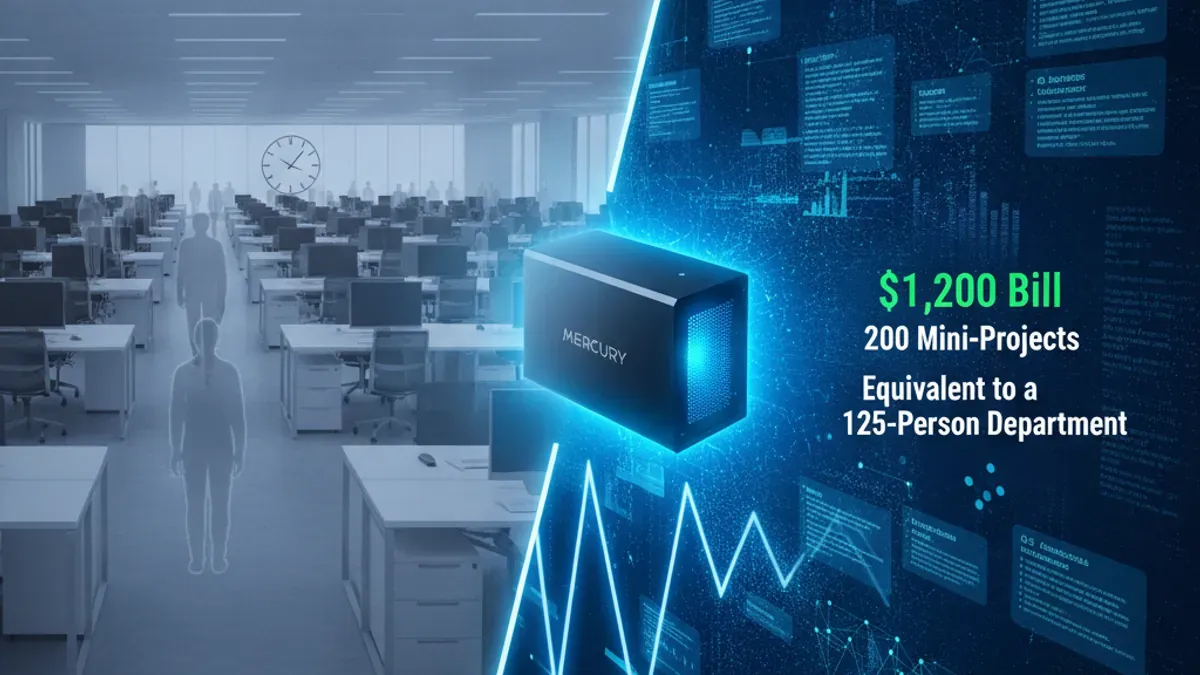
I'm not forecasting this. I'm living it. Last night, between one and two in the morning, one person — me, plus an agent stack on a Mac Studio under my desk — registered a live AI phone endpoint on our company PBX. Speech recognition, a local language model, synthesized voice, the full conversation loop. Ninety minutes, zero hires, marginal cost near zero. My agent fleet now burns about eighteen billion tokens a month for roughly $1,200 — blended, that's seven cents per million tokens, against a retail list price north of $20,000 for the same volume. That gap is not a discount. It's what a skeleton company sounds like from the inside.
This is the death of employment trickle-down.
In the old model, even if you couldn't be a founder, you could join as employee #500. Or #5,000. There was a place for competent components.
In the new model, the skeleton crew builds the machine, and the machine runs itself. The gap between "founder" and "unemployed" is collapsing into a binary.
So when you ask me if one-person companies are becoming mainstream, you're really asking: can most people become founders?
Look at the two stages. Look at what each requires. You know the answer.
The AI Accelerant
Let me sharpen this.
AI doesn't just automate tasks. It automates the translation layer — the middle management, the coordination, the reporting, the meetings where information moves from doers to deciders.
In my last piece, I wrote about how memory and reasoning skills let you survive corporate politics. That was advice for the old world.
In the new world, those skills are still necessary — but no longer sufficient.
Because the corporate layer where you demonstrated those skills is itself being compressed. The meeting rooms are emptying. The coordination jobs are evaporating.
What remains?
The demand-finders — people who can hear complaints and extract real needs
The trust-builders — people who can make strangers believe in their solution
The architects — people who can design systems that don't need constant human intervention
These three roles are what the skeleton crew does. Everyone else was lubricant. And lubricant gets squeezed out when the machine redesigns itself to need less friction.
What This Means for You
If you're reading this and feeling uneasy, good. That means you're paying attention.
The question isn't "should I start a one-person company?" The question is: which stage are you actually in?
Stage Zero: No paper, no painting. Just hoping.
Stage One: Good paper or good painting. Useful to someone else's system.
Stage Two: Can build and run a system. Finds demand, fulfills it, earns trust.
Most people overestimate their stage. They think being a senior manager at a big company means they're Stage Two. It doesn't. It means they're a very good Stage One component — a high-quality gear in a machine someone else built.
The test is simple: if you were dropped into a blank room with a laptop and six months of savings, could you build something that generates income?
Not "could you eventually figure it out." Could you do it now?
If the answer is no, you're not behind. You're just not there yet. And the first step is honesty about where you actually are.
The Hard Reframe
Stop thinking about "flexible employment" as a trend you can ride.
It's not a wave. It's a filter.
The old economy had room for people at every level of competence. The new economy is bifurcating: skeleton crew or surplus.
The skeleton crew designs the machines. The surplus waits for the machines to need them.
They won't.
Your move is to figure out which side of that divide you're on — and if you're not on the skeleton crew side yet, what specific Stage Two capabilities you're missing.
Not generic advice. Specific gaps.
Can you identify a real demand that isn't being met?
Can you build or acquire the solution without a corporate infrastructure?
Can you make strangers trust you enough to pay you?
These aren't soft skills. They're hard capabilities. And they're the only ones that matter in the economy that's emerging.
Mercury Technology Solutions: Accelerate Digitality.