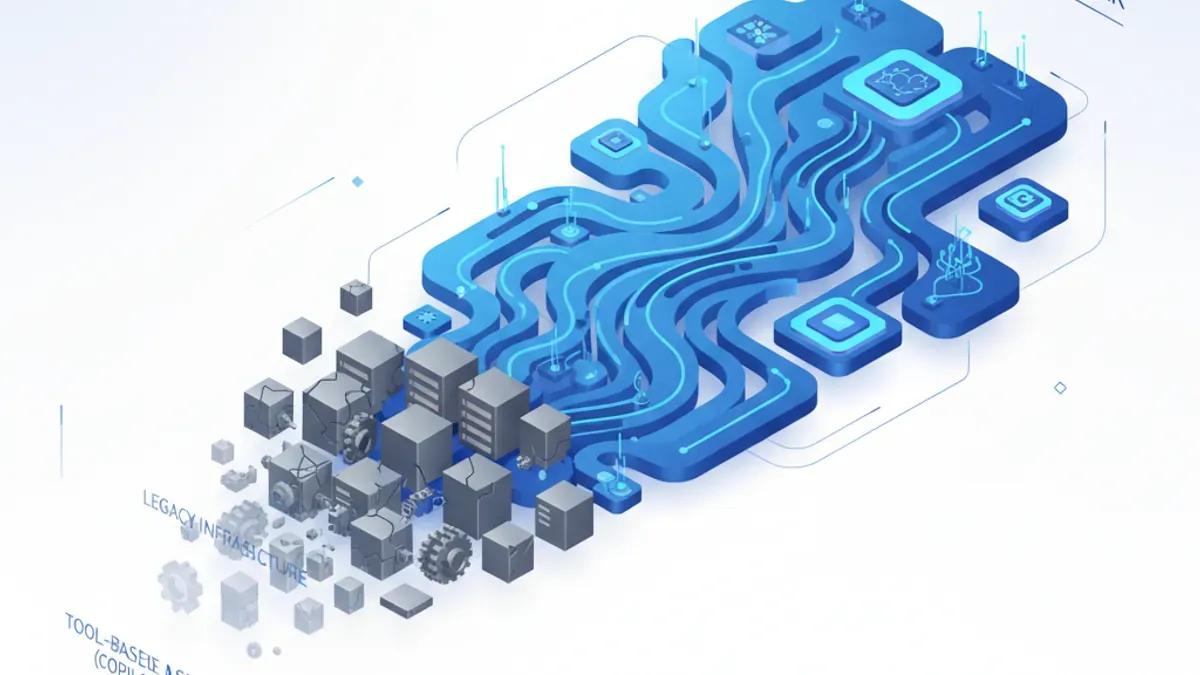
TL;DR: For the last decade, tech startups have obsessed over selling "Software as a Service" (SaaS). But as Sequoia Capital partner Julien Bek recently pointed out, the AI era is flipping this model on its head. If you sell an AI tool, you are trapped in a deadly race against the underlying foundational models. If you sell the finished work, every time the models upgrade, your margins simply increase. The next trillion-dollar unicorns will not be pure software companies; they will be AI-powered service companies disguised as traditional agencies. Here is the architecture of the new enterprise economy.
James here, CEO of Mercury Technology Solutions. Tokyo, Japan - March 13, 2026
Whenever I review the pitch decks crossing my desk this quarter, I see a fatal flaw repeating itself: Founders are still building "Copilots."
They are building tools designed to help human professionals type faster, code faster, or read faster. What they don't realize is that they are aiming at the wrong budget, and fundamentally misunderstanding where human value is heading in 2026.
Based on the recent thesis from Sequoia Capital, which perfectly aligns with the macroeconomic shifts we are tracking globally, here is why the transition from "Copilot" to "Autopilot" is the only viable survival strategy for tech companies.
1. The Budget Trap: Tools vs. Work
There is a massive economic disparity that traditional SaaS founders ignore: For every $1 an enterprise spends on software, they spend $6 on human services.
When you build a "Copilot," you are selling a tool. You are fighting for a tiny slice of the IT budget. Worse, your fundamental competitor is the AI model itself. If OpenAI or Anthropic releases a smarter model next month, your tool might become instantly obsolete.
When you build an "Autopilot," you are selling the finished work. You aren't selling software to a law firm to help lawyers read contracts (like Harvey AI). You are selling the reviewed contract directly to the enterprise (like Crosby).
- Selling Tools: An AI model upgrade threatens your existence.
- Selling Work: An AI model upgrade simply makes your delivery faster, cheaper, and massively expands your profit margins.
2. The AI Innovator's Dilemma
You might ask: Why don't the current SaaS giants just pivot and start selling the finished work?
Because they are trapped in the classic Innovator's Dilemma. If a company that currently sells "AI writing assistants" to marketing agencies suddenly launches a product that delivers finished marketing campaigns directly to brands, they will instantly alienate and cannibalize their own customer base (the agencies).
Incumbents cannot cross the line from Tool to Service without going to war with their own users. This structural paralysis is the exact opening that pure, Autopilot-native startups are exploiting right now.
3. The End of "Intelligence" (And the Rise of "Judgment")
To understand why this is happening, we have to redefine two words: Intelligence and Judgment.
- Intelligence is the raw cognitive horsepower required to execute a task. Writing lines of code, drafting an NDA, or formatting a financial model is "Intelligence." AI has already crossed the threshold where it can handle the vast majority of these tasks.
- Judgment is deciding which features need to be coded to satisfy user demand, or what level of risk is acceptable in that NDA.
AI commoditizes Intelligence. It leaves Judgment to humans. Today's Judgment is tomorrow's Intelligence.
Because execution is now handled by the machine, the corporate structure is inverting. We are moving from a world where 1 Manager directed 10 Human Employees, to a world where 1 Human (exercising Judgment) directs 10 AI Agents (executing Intelligence).
4. The Go-To-Market Hack: Target the Outsourcers
If you are an Autopilot startup building a "Service in a Box," how do you actually sell this to massive, slow-moving enterprises?
You do not target internal employees. If you walk into a Fortune 500 company and say, "My AI can do the work of your 50-person accounting team," you will trigger an absolute nightmare of HR bureaucracy, union pushback, and internal politics. Replacing an internal team requires a "Re-org." Re-orgs are slow and painful.
You target the outsourced vendors. Enterprises are already perfectly comfortable paying external agencies to handle marketing, IT support, or legal review. The budget is already allocated for "Finished Work." If you pitch your AI-driven company as a faster, cheaper, error-free vendor, the enterprise doesn't have to fire anyone. They simply switch suppliers.
Switching vendors is just a standard procurement decision. It is the path of least resistance.
Conclusion: Crossing the Technology Cycle
The companies that will survive the brutal AI hardware and software cycles of the late 2020s are the ones who insulate themselves from the underlying model wars.
Clients do not care if you use Claude, Gemini, or OpenClaw on the backend. They only care about the result. Stop selling the shovel, and start selling the gold.
Mercury Technology Solutions: Accelerate Digitality.

