TL;DR: SEO gets a page crawled, indexed, and ranked. AEO makes the answer on that page easy to extract. GEO tracks whether your brand gets mentioned or cited inside AI-generated answers. None of them replaces the others — Google's own 2026 guidance states AI Overviews and AI Mode run on existing Search systems and SEO fundamentals. The practical sequence: fix SEO foundations first, answer clarity second, GEO measurement third.
I am Akira. A Hong Kong-specific confession before the definitions: in this market, "AEO" also means the Hong Kong Customs Authorized Economic Operator Programme. If your procurement team and your marketing team are googling the same acronym and getting different answers, that's a small taste of why this vocabulary debate is a distraction. Define terms once, then get back to the work.
The Quick Answer
- SEO → can the website be discovered, understood, and ranked in organic search?
- AEO → can a reader, search engine, or AI system quickly find a clear answer on the page?
- GEO → does the brand or website appear — named or cited — inside AI-generated answers?
| Approach | Core question | What you measure | Where it applies | |---|---|---|---| | SEO | Can the site gain organic visibility? | Impressions, rankings, clicks, conversions | Google organic + Google's AI search surfaces | | GEO | Does the brand appear in generated answers? | Citations, mentions, share of voice | ChatGPT, Perplexity, Gemini, AI Overviews, AI Mode | | AEO | Is the answer easy to identify and extract? | Answer clarity, findability | FAQs, snippets, conversational search |
This is a working framework, not an official standard jointly blessed by Google and OpenAI. And one caveat that matters before you buy anything: GEO measurement isn't standardized. A "Citation Rate" from one tool and another may use different prompts, platforms, locations, and definitions of what counts as a citation. Interpret any percentage together with its methodology — or don't interpret it at all.
Why Three Terms Exist At All
Because the discovery journey forked. Traditional search: query → results → visit → compare. AI-assisted search: ask → AI retrieves and synthesizes from multiple sources → generated answer → maybe visit a source. Traditional search wasn't replaced; it gained a layer that answers directly.
Google's AI Overviews fan one query into multiple sub-queries before generating a response, which means the questions marketing teams ask have multiplied too. Alongside "which keywords are gaining visibility?" now sit: is our brand being cited in generated answers? Are competitors appearing more often? Does our AI visibility differ by platform, language, or market? GEO extends measurement beyond rankings and traffic — it doesn't abolish either.
What GEO Actually Changes About the Work
Not as much as the pitch decks claim. Google's guidance is explicit: generative AI features in Search are rooted in existing ranking and quality systems, established SEO best practices continue to apply, and no special "AI format" is required. What genuinely changes is emphasis:
1. Claims need sources and context. "AI Search is rapidly changing the Hong Kong market" is weather. "In a sample of 60 Hong Kong keywords checked June–August 2026, 68–75% returned an AI Overview" is a claim — market, platform, period, sample size, and uncertainty attached. Evidence is the differentiator AI engines reward.
2. Explain relationships instead of listing jargon. SEO, Schema, E-E-A-T, GEO, Entity, AI Overview — a list of terms explains nothing. A relationship does: structured data helps Google understand page content, but no AI-specific schema is required for AI Overviews eligibility.
3. Never treat AI visibility as revenue. Being mentioned by AI ≠ receiving a click ≠ generating a lead ≠ closing a sale. GEO measures exposure; whether that exposure converts is a question for your analytics and CRM, not your visibility dashboard. In Mercury Orbit terms — the customer loop the rest of the stack serves — citation is quarter one. The loop is the rest.
4. Add a measurement layer, not a new religion. SEO teams monitor impressions, rankings, clicks, conversions. GEO adds ChatGPT and Perplexity citations, brand mentions, competitive share of voice, and Google's generative AI reporting. One extra layer of instrumentation — measured per platform, because Google's documented mechanisms don't automatically describe anyone else's.
What AEO Actually Changes
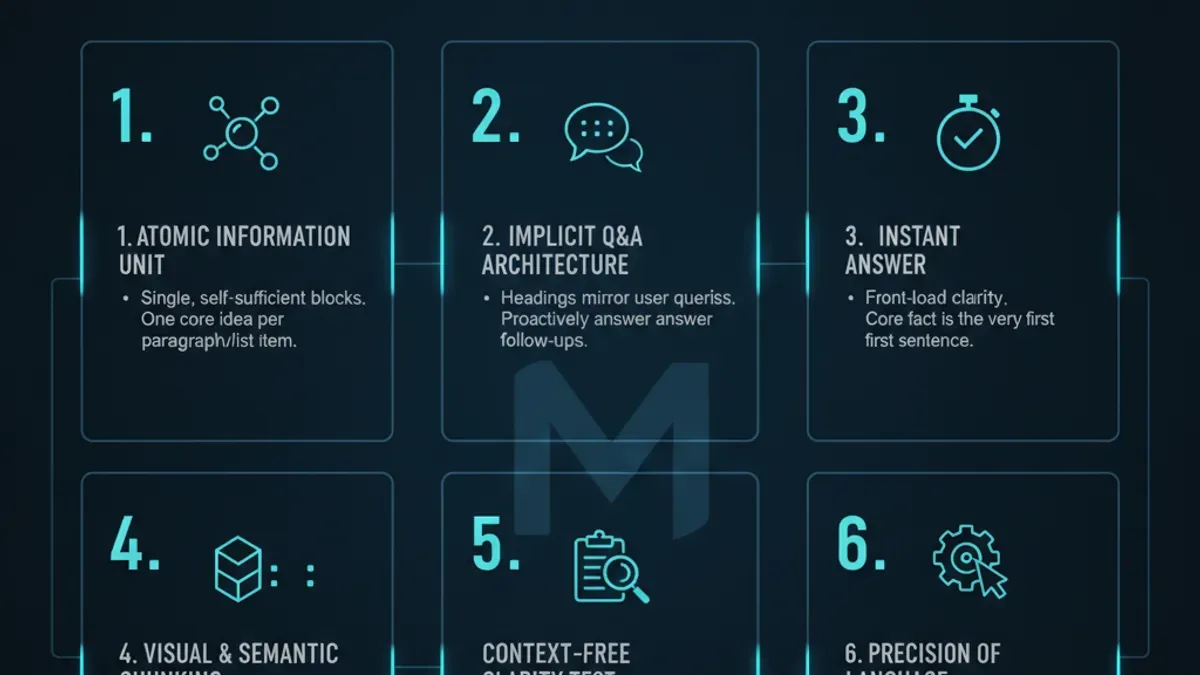
AEO is the smallest of the three and the most immediately actionable: when a user asks a question, can the page answer it quickly? If an H2 asks "What is the difference between SEO and GEO?", the paragraph below should answer it — not open with "As technology continues to evolve at an unprecedented pace..." (If your content starts like that, you don't have an AEO problem. You have a writing problem.)
The practical moves: headings that state what each section answers, the main answer first, definitions before conditions, tables where comparison is genuine, and deletion of sentences that add no information. Google states there is no ideal page length for generative AI search — answer length should follow what the reader needs, not a formula.
Do You Need All Three? No — and the Order Matters
For most Hong Kong businesses: SEO foundations first (crawlable, indexable, technically sound), AEO clarity second (answers identifiable and extractable), GEO measurement third (when there are AI search queries actually worth tracking). You don't need three teams or three services because the market invented three acronyms. You need one honest assessment of where your site stands on each axis.
The deeper comparison — including where LLM-SEO fits as the delivery discipline — is in GEO and LLM-SEO and the vendor-style LLM-SEO vs traditional SEO breakdown. If you'd rather measure than argue acronyms, the GEO Scorecard is the free first read, and Why GEO is the short explainer for the board deck.
Stop debating the acronym. Start with the foundation that's actually broken.
Mercury Technology Solutions: Accelerate Digitality.