I was playing with Perplexity the other night, asking it to recommend a CRM for a fintech client we're advising. I typed: "What's the best marketing automation platform for B2B SaaS?"
Before I could finish my coffee, it spat back three names. HubSpot was #1. Not just mentioned—crowned. Citing TechRadar, Sybill, ten different sources, calling it "the gold standard for mid-market."
I tried the same prompt in ChatGPT. Same result. Gemini. Same result.
That's when I realized we're watching the first real case study of Algorithmic Authority—and most of us are failing the exam without knowing we took it.
The Invisibility Crisis
There's a benchmark study floating around auditing 50 B2B SaaS brands across 1,400 prompts. The average "AI Presence Score" is 56.9 out of 100. Nearly half the companies scored below 50.
Translation: When your prospects ask AI for recommendations in your category, you don't exist.
But HubSpot? They scored a 94. Not because they built better software. Their code isn't magically superior to Salesforce or Pipedrive. They scored a 94 because they spent the last eighteen years engineering the infrastructure of citation—building a web of references that AI models can't help but trip over.
Here's how they did it, and why your Google rankings are becoming irrelevant.
Pillar One: Being Everywhere Except Your Own Website
Here's the counterintuitive truth: AI doesn't trust your homepage. It treats your marketing site like a guy who claims to be handsome—it wants independent verification.
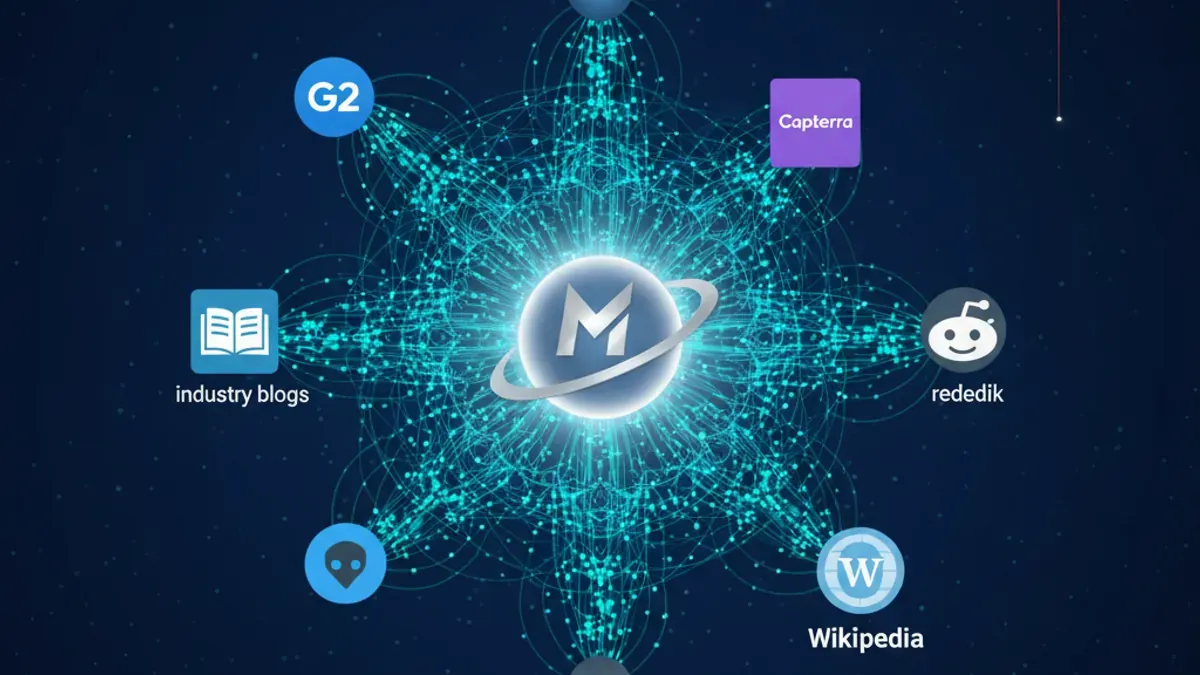
When Perplexity recommended HubSpot, it pulled from ten different sources. Not hubspot.com. G2, Capterra, GetApp, TrustRadius, random Reddit threads, niche SaaS blogs. HubSpot is on over forty third-party platforms.
The math is brutal: brands appearing on four or more non-affiliated platforms are 2.8x more likely to be cited by ChatGPT. It's not about controlling your narrative anymore. It's about ubiquity in the commons.
Pillar Two: Making the Algorithm Learn Your Name
Legacy SEO folks obsess over backlinks. AI models obsess over brand search volume.
HubSpot gets four million brand searches a month. Four million times, humans type "HubSpot" into Google, training the LLMs that this is a entity that matters to people. When the models learn the internet, they learn that HubSpot is a gravitational center that humans orbit around.
You can't fake this overnight. But you can start building the signals. Every podcast mention, every comparison article, every "versus" query—it's all feeding the semantic machine.
Pillar Three: Owning the Dictionary
This is my favorite part. HubSpot didn't just optimize for keywords; they invented the language.
"Inbound Marketing." "The Flywheel." "RevOps." These aren't natural terms—they're branded concepts that HubSpot coined, defined, and seeded into the industry lexicon for a decade. They wrote the Wikipedia entries (figuratively and literally). They published the definitive guides. They gave the conference keynotes that established the terminology.
Now when an AI generates an answer about modern marketing, it's forced to reference the conceptual framework HubSpot built. It's like trying to explain physics without mentioning Newton. The vocabulary itself becomes a citation trap.
Pillar Four: The Page 3 Secret (Where the Real Gold Lives)
Here's the insight that broke my brain: 90% of ChatGPT citations come from position 21 or lower on Google Search results. Page 3. Page 4. The long tail.
We spent twenty years fighting for Page 1, position 1. Turns out the AI doesn't care if you're on Page 1. It cares about semantic depth—detailed Reddit comparisons, obscure forum threads, niche review aggregators, technical documentation buried deep in the index.
HubSpot understood this early. They optimized not just for the high-intent "buy HubSpot" keywords, but for the long conversational tail: "HubSpot vs. Salesforce for healthcare," "HubSpot pricing 2024 reddit," "is hubspot good for saas startups."
The AI reads that stuff. The AI trusts that stuff more than your polished homepage.
What You Do This Month
You can't build an eighteen-year moat in thirty days. But you can start signaling to the models that you're a real entity.
Week 1: The Baseline Reality CheckOpen ChatGPT, Perplexity, and Gemini. Ask: "What are the best [your category] platforms for [your audience]?" Screenshot the results. If you're not in the top 3, you're invisible. Document who shows up and what sources the AI cites. That's your competitive landscape now.
Week 2: Claim the CommonsGet your G2, Capterra, TrustRadius, and Software Advice profiles locked and loaded. Fresh reviews matter—these are primary sources for AI sentiment analysis. Don't just claim them; optimize them with the specific terminology you want the AI to associate with you.
Week 3: The Comparison GambitDon't just publish "Why We're Great" on your blog. That's screaming into the void. Instead, get into the comparison conversations happening off-site. Sponsor a newsletter deep-dive comparing you to the legacy incumbent. Start a Reddit thread asking for honest comparisons. Pitch guest articles that put you in the "X vs. Y" narrative. The AI reads these as independent validation.
Week 4: Coin Your LexiconIdentify one specific concept in your industry that's emerging but undefined. Stop using your competitor's language. Create your own framework—give it a name, publish ten definitive pieces about it across different platforms, use it in every podcast interview. Make the AI adopt your terminology as the standard.
The Shift
We're moving from the era of search optimization to citation optimization. Google rankings were about being the destination. AI citations are about being unavoidable reference material—the entity that shows up whether the user asked for you or not.
HubSpot didn't win because they have the best CRM. They won because they became the default answer in the machine's training data.
That's the game now. Not ranking #1. Becoming the vocabulary.
— James, Mercury Technology Solutions, Tokyo, April 2026

