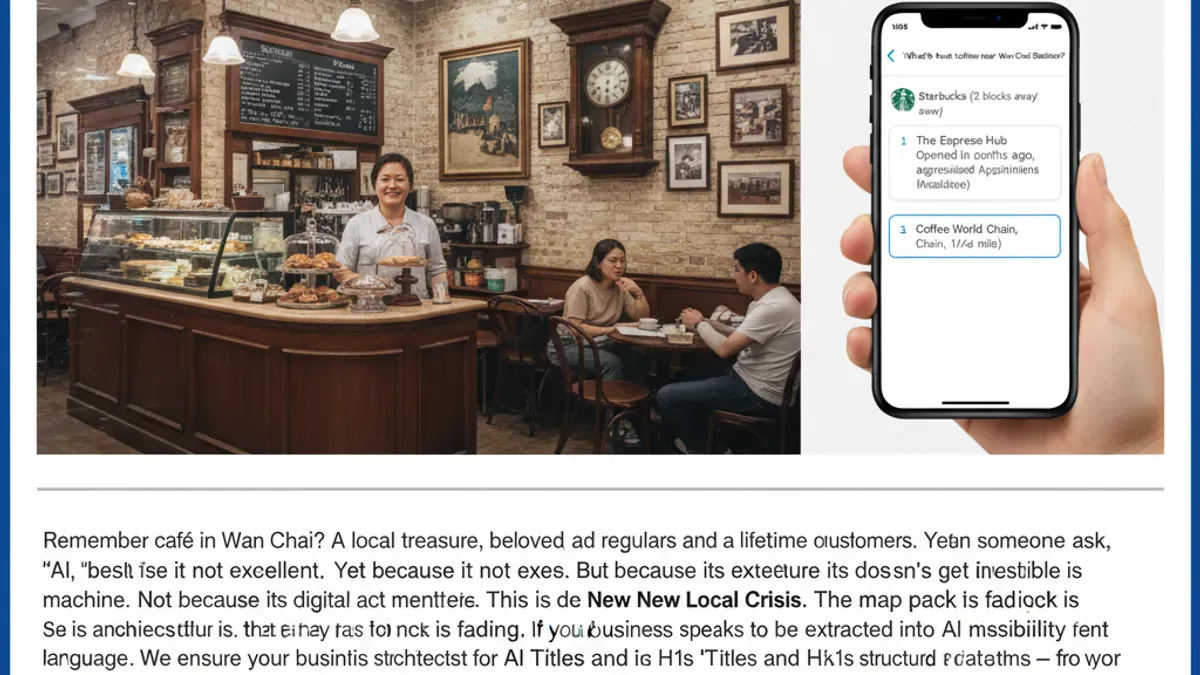
I was having breakfast at a café in Wan Chai last month—a place I've been going to for three years. Great coffee, terrible WiFi, owner knows my order by heart. I asked him how business was. He shrugged and said, "Young people don't find us anymore. They ask their phones for 'best coffee near me,' and we don't show up."
I pulled out my phone, opened Gemini/ ChatGPT, and asked: "What's the best coffee shop in Wan Chai?"
It named three places. None of them were his. One was a Starbucks two blocks away. Another was a trendy spot that had opened six months ago with an aggressive Instagram budget. The third was a roastery I'd never heard of.
His café had 4.8 stars on Google Maps. Five hundred real reviews. Fifteen years in the neighborhood. But the AI didn't mention him. Not because he was bad. Because his digital architecture was invisible to the machine.
That's the new local business crisis. It's not about ranking #1 on Google anymore. It's about being named when someone asks an AI for a recommendation. And most local businesses are structurally unprepared for that shift.
Why Traditional Local SEO Is Dying
For a decade, local SEO meant three things: Google Business Profile, local keywords, and citations. Get those right, and you showed up in the map pack. Simple.
But the map pack is becoming irrelevant for a growing slice of searches. When someone asks Gemini "Where should I get coffee near Wan Chai Station?" or asks Perplexity "What's a reliable dentist open on weekends in Shibuya?"—the AI doesn't show a list of links. It generates an answer. And if your business isn't structured to be extracted into that answer, you don't exist.
At Mercury, we're seeing this across every local vertical. The conversion rate from AI-mediated local discovery is roughly 4.4x higher than traditional organic search. Why? Because by the time the AI recommends you, the user has already been pre-qualified. They're not browsing. They're deciding.
The businesses that adapt to this aren't just optimizing for algorithms. They're architecting themselves to be citable by machines.
The Architecture of Local AI Visibility
Here's what actually matters in 2026. Not buzzwords. Structural changes you can implement this week.
1. Speak AI's Language on Every Page
AI models don't browse like humans. They extract. They scan for signals. If your page structure forces the model to read through paragraphs of prose to find basic facts, it will skip you.
Titles, H1s, and Meta Descriptions Must Contain Geography + Service
This sounds obvious, but I see local businesses fail it constantly. Your title tag shouldn't be "Welcome to Our Clinic." It should be "Dental Clinic in Wan Chai | Weekend Appointments Available." Your H1 shouldn't be "Quality Care Since 2005." It should be "Orthodontics & Implants 3 Minutes from Wan Chai Station."
The AI is matching queries to page structure. If the query is "dentist near Wan Chai Station open Saturday," and your page doesn't have those words in machine-readable positions, you're not in the candidate pool.
Schema Markup Is Non-Negotiable
If you don't have structured data in JSON-LD format describing your LocalBusiness entity, you're essentially whispering in a room full of shouting competitors. The AI can't reliably extract your address, phone, hours, or services from HTML text. It needs schema.
The five critical items:
- Street address (exactly as it appears everywhere else)
- Phone number
- Business hours
- Average review score
- Service category
Sites without structured data are being silently excluded from AI response candidates in 2026. This isn't a ranking penalty. It's an existence penalty. The model simply doesn't know you're relevant.
Q&A Blocks Are Extraction Gold
Structure key customer questions as H2 or H3 headers, with direct answers in the first two sentences below. Keep each Q&A block under 100 words if possible.
"Where can I find a dentist open on weekends in Wan Chai?""XX Dental Clinic offers Saturday and Sunday appointments from 9 AM to 6 PM, located three minutes from Wan Chai MTR Exit A3."
AI models love this format. It maps directly to conversational queries. If your content is narrative and buried, the model can't lift it out.
Primary Information Is Your Moat
The one thing AI can't get from your competitors is your specific reality. Local event photos. Before-and-after case studies (with permission). Staff credentials. Community partnerships. Neighborhood context.
This is primary data—information that exists nowhere else on the internet. AI models prioritize it because it's non-replicable. A local business has a structural advantage here that national chains can't match: you actually live in the neighborhood. Document that reality.
2. Your Google Business Profile Is the Foundation
AI search engines use GBP data as a primary source for local responses. If your GBP is incomplete, inconsistent, or dormant, the AI has no reason to trust you.
NAP Consistency Across the Universe
Name, Address, Phone. Everywhere. Your website footer, Instagram profile, Yelp listing, local chamber of commerce page, Google Maps pin. Every instance must match exactly.
I mean exactly. "Co., Ltd." versus "(Ltd.)" versus "Limited" can confuse an AI into treating them as different entities. Pick one format and enforce it across every platform. This sounds pedantic. It is. But algorithms are pedantic.
Review Responses Are Content
When you reply to a Google review, include the neighborhood and service name naturally:
"Thank you, Mrs. Chen from Wan Chai, for trusting us with your orthodontic treatment."
This does two things. It signals local relevance to the AI. And it generates fresh, keyword-rich content on a high-authority platform. Respond to every review from the last three years if you haven't already. Yes, it's tedious. Yes, it matters.
GBP Posts Prove You're Alive
Use the posting feature at least weekly. New menu items, seasonal campaigns, staff introductions. Include a location reference in every post.
Stores with recent GBP activity are judged as "active businesses" by AI systems. Dormant profiles get deprioritized. A 30-day-old post is better than a perfect profile that's been static for six months.
3. Citations Are Still Currency
The quantity and quality of mentions of your business across the web—citations—directly impact AI trust scores. But in 2026, it's not just about volume. It's about consistency and context.
Where to Build Citations
- Local government or district business directories
- Chamber of commerce member listings
- Industry-specific portals (restaurant guides, medical directories, etc.)
- Local newspaper online editions
- Community social media groups
Every accurate mention reinforces your entity. Every inconsistent mention fractures it. One wrong phone number on a directory can create confusion that degrades your AI visibility.
Social Media Is a Citation Layer
Instagram posts, Facebook updates, Threads—if they include your neighborhood name and service category, they function as distributed citations. Post at least twice weekly with explicit geo-tags and location references. Hashtags help, but plain text mentions of the neighborhood are more extractable by AI models.
The 8-Item Survival Checklist
If you run a local business and you haven't done these eight things, you're not competing in the AI era. You're hoping for mercy.
- Log into your Google Business Profile right now. Verify that address, phone, and hours are current and match your website exactly.
- Check your homepage H1. Does it include your city, ward, or neighborhood name plus your core service? If not, rewrite it.
- Check your meta description. Does it include the region and service? This is what AI often extracts for summary.
- Implement LocalBusiness schema in JSON-LD. If you don't know how, hire someone for two hours. It's that important.
- Audit NAP consistency. Check your website, Instagram, Yelp, and every directory listing. Fix discrepancies today.
- Respond to every review from the last three years. All of them. Use location and service names in your replies.
- Post on GBP at least once in the next seven days. With a photo. With a location reference.
- Add three Q&A sections to your website. Real questions customers ask. Direct answers. Structured as headers + response.
Completing these eight items is the minimum viable architecture for 2026. Everything else—content strategy, backlink building, paid ads—sits on top of this foundation. Without it, you're building on sand.
The Shift Nobody Is Talking About
In 2026, the user journey for local discovery has fundamentally changed. People don't type "Wan Chai coffee shop" into Google and browse ten blue links. They ask their AI: "Where should I get coffee near me that's quiet and has good WiFi?"
The AI generates a curated answer. Maybe two or three names. If you're not in that answer, you didn't lose a click. You lost the customer before they ever saw a webpage.
Being named in an AI response is the new map pack. And the businesses that get named aren't necessarily the ones with the biggest ad budget. They're the ones with the cleanest data, the most consistent entity signals, and the most extractable content.
That café in Wan Chai? We're fixing his architecture now. Schema markup went live last week. GBP posts are scheduled. The owner is responding to reviews he'd ignored for two years.
He won't show up in every AI query overnight. But he's no longer invisible. And in the local AI economy, visibility is the only fight that matters.
— James, Mercury Technology SolutionsLearn more at www.mtsoln.comHong Kong, May 2026

