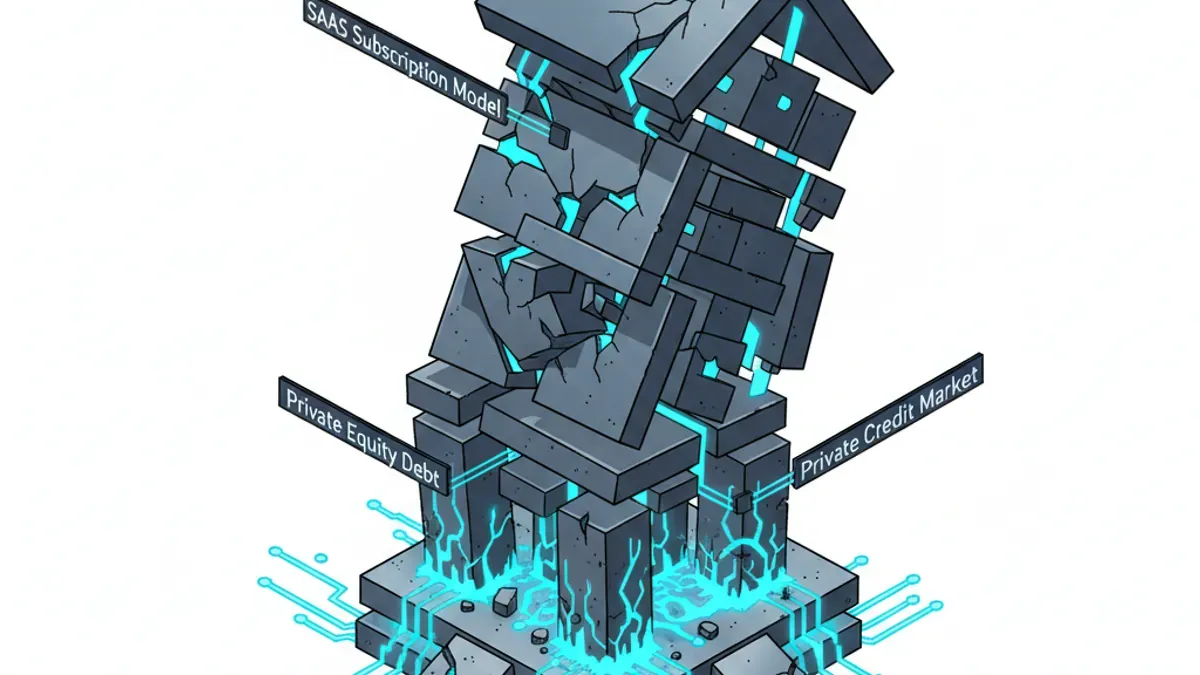
TL;DR: Everyone is watching the stock market, tracking IBM's recent 13% drop and the $$285B vaporized by a single AI plugin. But the real danger isn't in public equities; it is hiding in the shadows of the $3 Trillion Private Credit market. Private Equity firms have spent the last decade using debt to buy SaaS companies, treating software subscriptions like guaranteed, zero-risk mortgage payments. Now, AI is destroying the premise of the SaaS subscription model. We are witnessing the collision of two massive systemic risks: the collapse of SaaS demand and a $$600B AI infrastructure depreciation bubble. The 2008 script is playing out again, just with different acronyms.
James here, CEO of Mercury Technology Solutions. Tokyo, Japan - March 11, 2026
Last month, I wrote about the impending death of traditional SaaS. I pointed out how AI agents and CLI architectures are rendering $20/month subscription software obsolete. That is the technological reality.
Today, we need to talk about the financial reality. I have been staring at a set of numbers in the Private Credit markets, and frankly, they are terrifying. It smells exactly like 2008.
Here is the systems architecture of the impending liquidity crisis.
1. The SaaS "Mortgage" Machine (How PE Built the Bubble)
To understand the crisis, you must understand how Private Equity (PE) makes money on software.
Why do banks love giving mortgages to government employees? Because their monthly salaries are incredibly stable. Over the last decade, PE firms viewed SaaS companies exactly the same way. They used Leveraged Buyouts (LBOs)—meaning they borrowed massive amounts of money—to buy SaaS companies. They planned to pay back that debt using the steady, predictable, monthly subscription revenue of the software.
Between 2015 and 2025, over 1,900 software companies were acquired by PE, totaling over $440B. The debt funding these acquisitions came primarily from the Private Credit market. Today, roughly 20% to 25% of the $3 Trillion Private Credit market (roughly $600B to $750B) is betting on SaaS companies.
2. The 2008 CDO Playbook, Reincarnated
Do you remember Collateralized Debt Obligations (CDOs) from the 2008 housing crash? Wall Street took risky mortgages, packaged them together, stamped an "AAA" rating on them, and sold them to pension funds. When the underlying homeowners stopped paying, the entire global economy collapsed.
We have built the exact same structure today:
- The Foundation: SaaS monthly subscription revenue.
- Layer 1: PE firms use LBO debt to buy the SaaS company, promising to pay the debt with subscriptions.
- Layer 2: Private Credit funds package these loans and sell them to institutional investors.
- Layer 3: BDC (Business Development Company) funds package them again and sell them to retail investors and pension funds.
Everyone in this chain assumes the Foundation (SaaS revenue) is rock solid. "Customers will never cancel their enterprise software," they say.
But AI is currently annihilating the three pillars of SaaS: High switching costs, inability for clients to build it themselves, and perpetual demand growth. When AI allows a client to replicate your SaaS platform with a single prompt, the subscriptions stop. When the subscriptions stop, the PE debt defaults.
We are already seeing the cracks. Citrix was bought for $16.5B, and banks recently had to take a $700M loss trying to offload the debt. Coupa Software was bought for $8B and immediately announced layoffs. Currently, $46.9B of tech-focused Private Credit loans are officially in "distress." (And remember: You can sell a stock in a second. Private Credit LP capital is locked up for 7 to 10 years. If this crashes, investors cannot get their money out. Some BDCs have already halted redemptions).
3. The Second Front: The AI Infrastructure Bubble
As if the collapse of SaaS demand wasn't enough, we have a secondary bubble inflating on the supply side: AI Infrastructure.
In 2026, the Big Four (Microsoft, Google, Meta, Amazon) will spend over $600 Billion on AI CapEx. That is enough money to fund the entire Apollo Moon landing program four times over.
Here is the accounting fiction keeping the market propped up: Tech giants are depreciating their AI GPUs over a 5-to-6-year timeline (the standard for traditional IT hardware). But in the cutting-edge AI space, a GPU's economic value plummets in 1 to 2 years due to rapid iteration.
By stretching the depreciation over 6 years on paper, these companies are artificially suppressing their current costs and inflating their profit margins. Furthermore, companies like Microsoft are pouring billions into OpenAI, which OpenAI then uses to buy Microsoft Azure compute—allowing Microsoft to book that money right back as "Cloud Revenue." It is the exact same circular accounting trick Cisco used in the 2000 Dot-Com bubble.
4. The VC and Startup Fallout
These two intersecting crises—the collapse of SaaS LBOs and the AI CapEx bubble—are already destroying the exit environment for startups.
If you are an angel investor or a startup founder, the game has fundamentally changed:
- The Exit Window is Closed: PE firms are choking on their current SaaS debt; they will not buy your SaaS startup at a premium. The IPO window is equally dead (Figma is down 80% from its peak).
- Venture Debt is Drying Up: Banks are terrified of software exposure. If your startup relies on Venture Debt to survive the next round, you are in extreme danger.
Last week, I was judging a startup pitch competition. A young founder pitched a B2B SaaS tool for data organization and workflow automation. I asked him flatly: "Do you know SaaS is dying?" He admitted his product probably only had a 2-to-3-year lifespan before general AI swallowed the functionality.
I told him what I will tell you: No intelligent capital will fund a 3-year transitional product.
Conclusion: "This Time is Different"
The ground is moving beneath our feet. The SaaS business model is collapsing. The PE debt built on top of it is fracturing. The AI infrastructure that caused the collapse is itself a massive depreciation bubble.
Check your pension funds. Check your startup portfolios. Do not assume that the Private Credit market is safe just because there is no daily stock ticker telling you it's crashing. In finance, the four most expensive words are always: "This time is different."
Mercury Technology Solutions: Accelerate Digitality.