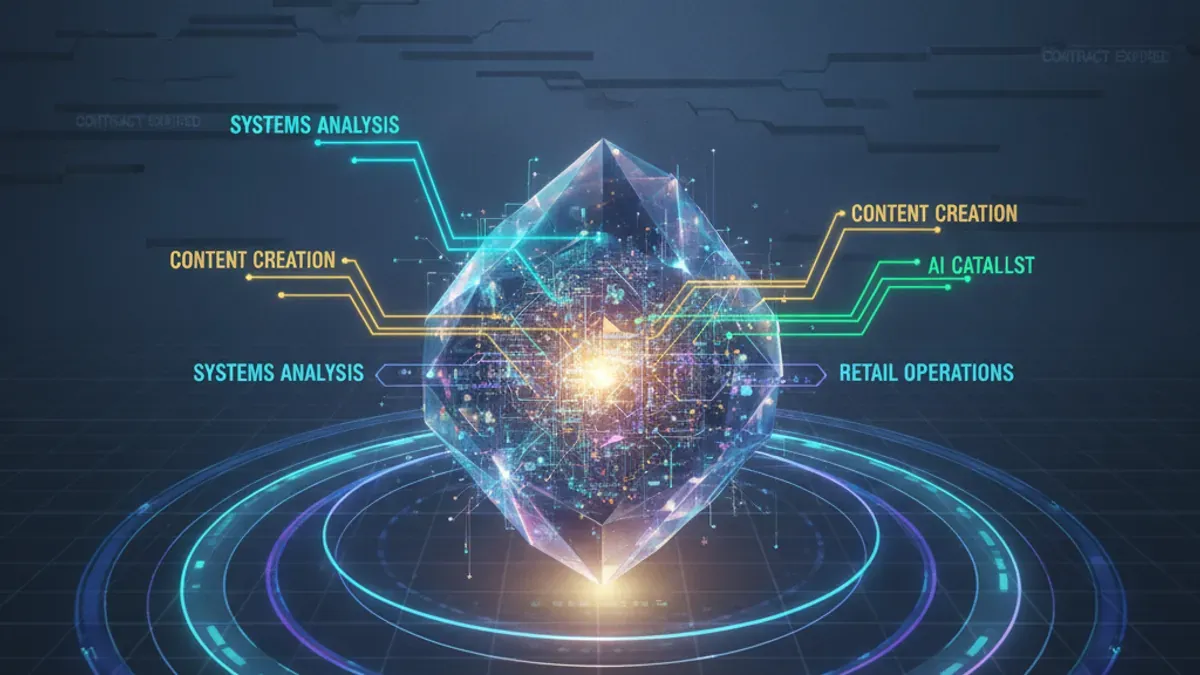
The Combination Moat: AI and the One-Person Moment
TL;DR: Dan Koe's message — if you have multiple interests, start a one-person business. But nearly everyone repeats the emotional half (society called your curiosity a weakness — it's actually a superpower!) and skips the economic half. Multiple interests weren't a character flaw; they were a contract mismatch. The industrial era paid specialists because coordination was expensive. AI collapsed the coordination costs, and the contract expired. What remains is the one asset specialists can never copy: the combination. Your moat isn't any one of your interests — it's the intersection none of your competitors can reconstruct.
James here, CEO of Mercury Technology Solutions.
Hong Kong — September 2026
The Expired Contract
Somewhere in your childhood, an adult told you to focus. Pick one thing. Stick with it. The advice was correct — for the world that gave it.
Understand what school actually was: not a discovery mechanism but a supply chain. The factory needed interchangeable specialists; the school trained them; the firm guaranteed forty years in exchange. Within that compact, a person with six passions wasn't an asset — he was a scheduling error. Ron Coase explained the whole arrangement in one question back in 1937: firms exist because coordination is expensive, so companies internalize it — managers, middle layers, departments — because transacting outside the walls cost more than the hierarchy inside them.
Now run the same math with AI in the spreadsheet. Code generation, content production, marketing funnels, translation, customer triage, bookkeeping — the coordination layers that justified the firm's size are collapsing toward zero marginal cost. The optimal firm size is shrinking toward one. 一人公司 — the one-person company — isn't a lifestyle trend. It's Coase's theorem with a 2026 exponent. The contract under him expired, and his trait — dive into a new field, decompose it, move — flipped from liability to strategy.
Naval's line, which Koe borrows, ages well: code and media are permissionless leverage. Software works while you sleep. Content works while you sleep. The industrial firm needed your body in a chair forty hours a week; the new leverage needs your judgment for four and compounds it for the rest.
The Combination Moat
Here's where the feel-good version of Koe's thesis undersells you. Multiple interests are not the superpower. Anybody can have six hobbies. The superpower is the combination — the intersection no competitor can reconstruct.
A specialist competes in a red ocean: ten thousand people with the identical credential stack, ranked on the identical axis. A combinatorial operator competes at an intersection: the person who understands retail floor operations AND content AND systems analysis occupies ground the pure-marketer and the pure-operator both need and neither holds. Your differentiation hides in the combination of seemingly unrelated experience — the thing others can't replicate. In Blue Ocean terms: the specialist fights over existing water; the combination creates water.
Koe walked the same path across different terrain: fitness, spirituality, digital art, photography, web development, psychology, philosophy, marketing, copywriting. Nine shallow starts look like failure on a CV. Assembled and aimed, they're a consulting practice, a content engine, and a product intuition no monoculture career can produce.
The AI Creator's Triad: Brand, Map, Tool
Koe's operating system compresses to three sentences worth keeping:
Your brand is transformation. People don't follow bios; they follow change. Why do you admire James Clear or Jordan Peterson at their peaks? Because their content changed thinking, thinking changed action, and the result got credited to them. A brand is the accumulated residue of transformations delivered — which is a real story builds more brand than any tagline. Koe's fortune-cookie line deserves quoting: you are not Marcus Aurelius, and a few aphorisms on a lucky-biscuit slip won't build an audience. Attention is a mechanism — learn it.
Your content is the map. A is where your reader stands; B is where you can take them; everything between is material. You don't need to be the world's leading expert — 領先一到三步, lead by one to three steps. The $5M-pitch reads like a scam; "I figured out how to make $100 a day — want me to show you?" gets listened to, because it's one level ahead of where the reader actually is. Koe's filter for every idea he hunts: does this help someone become 不被淘汰 — irreplaceable, not-eliminated? If yes, it's material. And his ratio: writing is 80% research, 20% the shaping only you can do. Peterson, Huberman, Aurelius — none were content brands; all were obsessive researchers whose synthesis happened to scale.
Your product is the tool. The vehicle that takes a reader from A to B. Free content builds the map; the product is the shortcut. Koe's hard-won lesson from three years of failure: sell systems, not information — modules, worksheets, templates, sequences — because people can't execute a tweet and know it. And if you'd rather build software, AI has made the code leverage available to people who can't write it: ask for the plan, build step by step, understand as you go. The first version will be bad. The difference between the people this works for and the people it doesn't isn't talent — it's whether they stopped at version one. I wrote that law down nine days ago: cheap attempts beat good plans. The one-person company is that law applied to your own name.
The Operator's Addendum: What the AI Gurus Romanticize
Two things the Koe framework romanticizes, and one confession.
First: "a thousand people paying monthly replaces your salary" is true arithmetically and ruthless operationally. The leverage is real, but conversion is a system — traffic source (SEO today, GEO tomorrow: the same discoverability game), product, funnel, iteration — not enthusiasm. The people who make it treat studying why the system works as the actual job. Second: AI builds the funnel, but taste is the moat. If the output doesn't sound like you, you've built a commodity dispenser — and commodities compete at zero.
The confession: this essay is the seventh piece this system has shipped in nine days, each one published across nine languages within the hour. One person, a research habit, an agent swarm, and a distribution pipeline. I didn't build it because a YouTuber said to. I built it because the math said the firm's minimum viable size had shrunk — and because after twenty years of assembling strange combinations, the intersection finally had a market.
Your interests were never the problem. They were inventory, waiting for the machinery. The machinery arrived.
Mercury Technology Solutions: Accelerate Digitality.