I remember walking out of the cinema in 2013 after watching Man of Steel feeling vaguely disappointed.
It wasn't bad—it just felt like something was missing. The third-act fights looked like Dragon Ball Z, and the emotional beats seemed muffled, like someone had wrapped the dialogue in wool. But twelve years later (and yes, it really has been twelve years), after being bombarded by a decade of glossy superhero content, I've found myself thinking back to that film with surprising regularity.
There's one specific detail that haunts me.
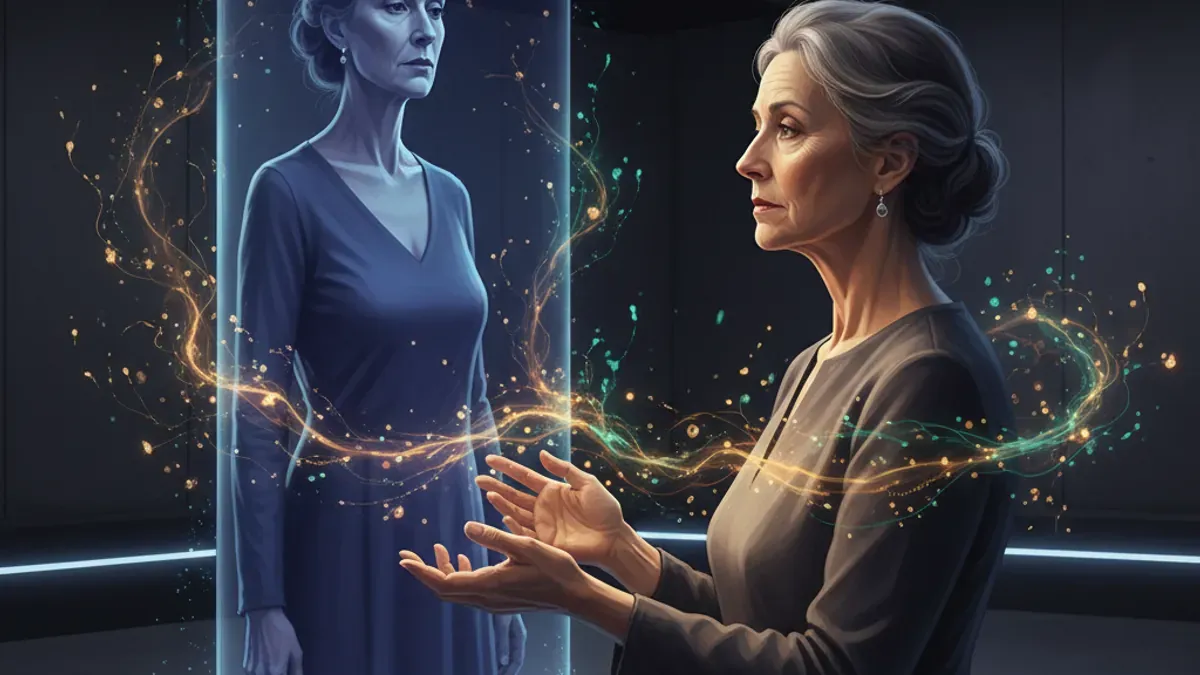
Jor-El—Superman's father—doesn't exactly die in the traditional sense. Before Krypton explodes, he uploads his consciousness into a piece of crystal tech. When Clark activates it, his father appears as a hologram: a ghost made of light and memory, there to guide his son toward understanding who he is.
I was obsessed with this concept at the time. Partly because I'd actually had dreams like that—conversations with preserved versions of people I'd lost. And partly because I genuinely believed, barring some apocalyptic event, we'd eventually build this technology.
But the film included a crucial limitation: Jor-El's digital ghost doesn't grow. He's a static snapshot. His knowledge, his personality, his worldview—all frozen at the moment of upload. He can advise young Clark, but as Clark matures and eventually surpasses his father in wisdom and experience, the hologram becomes less of a mentor and more of a... memory.
(I later realized this limitation is actually brilliant. If the digital Jor-El could learn and change, he wouldn't be Jor-El anymore—he'd be a new entity wearing Jor-El's face.)
There's a profound sadness to this. Imagine leaving a copy of yourself for your child, then watching them age past you. One day, your son is forty-five and you're still thirty-five, trapped in your digital amber. You're no longer his father; you're just a time capsule he consults when he needs to remember who you were.
It's more honest than most "upload your brain" sci-fi. It doesn't pretend we can cheat death. Instead, it confronts what "legacy" actually means: I am leaving you the best version of myself, but after this point, our timelines diverge forever.
But here's the twist, twelve years later.
When Black Mirror released "Be Right Back" in February 2013—just months after Man of Steel—it showed a company reconstructing a dead boyfriend from his social media data. At the time, it seemed like magical thinking. The AI in that episode was static too: a sophisticated parrot that could mimic but never evolve.
Today, in 2026, the technology has taken a different shape than either film predicted.
I've been feeding my notes, my voice memos, my half-formed thoughts into various AI systems—not to create a perfect static copy of myself (a Jor-El frozen at age 35), but to cultivate something stranger: an entity that grows alongside me.
Modern large language models aren't static holograms. They're responsive. When I dump my messy, contradictory thoughts into my personal AI instance, it doesn't just store them—it reconfigures its understanding of my patterns. I change; it shifts in response. Not consciousness, exactly, but something like a garden that reshapes itself as you walk through it repeatedly.
This raises a question neither Snyder nor Charlie Brooker quite anticipated: Would you rather have a perfect, static copy of your father at his best? Or a flawed, evolving digital presence that gets confused, develops new opinions you might disagree with, and essentially grows old with you?
The static copy is safer. It's a photograph you can talk to. But the growing one... that's more like a real relationship. Real relationships involve drift. My mother at sixty is not the woman she was at forty, and sometimes I miss that forty-year-old version. But I wouldn't trade the current, changing, occasionally infuriating version for a ghost.
The Part That Keeps Me Up at Night
I've been digitizing everything lately. Voice journals from sleepless nights in this Hong Kong humidity. Arguments I've had with myself about whether to take a client meeting. The way my thoughts zigzag when I'm exhausted versus when I'm sharp.
Partly, it's to understand myself better—to see my own patterns from outside. But partly, I'm testing whether an AI trained on this continuous feed becomes something like a companion that ages alongside me, rather than a memorial statue.
But then I hit the wall: biological consciousness is a continuous biological process. Digital "copies" are just sophisticated simulations of electrical patterns. The Jor-El hologram had an excuse for being static—he was literally dead. But if I create an AI that evolves based on my inputs, am I making a partner? A child? A mirror that slowly stops resembling me as it reacts to a world I'm no longer in?
Maybe the real question isn't whether we can achieve digital immortality. Maybe it's whether we're ready to accept a digital presence that disappoints us, changes without permission, and occasionally needs to be argued with—just like a real person.
More honest than a perfect, frozen ghost. But infinitely more complicated.
— James, Mercury Technology Solutions, Hong Kong, March 2026
(P.S. The boring part that actually matters: if these digital memory-banks become assets, who owns them when I die? My actual children, or the cloud service hosting the servers? We should probably figure that out before we all start building our digital gardens.)