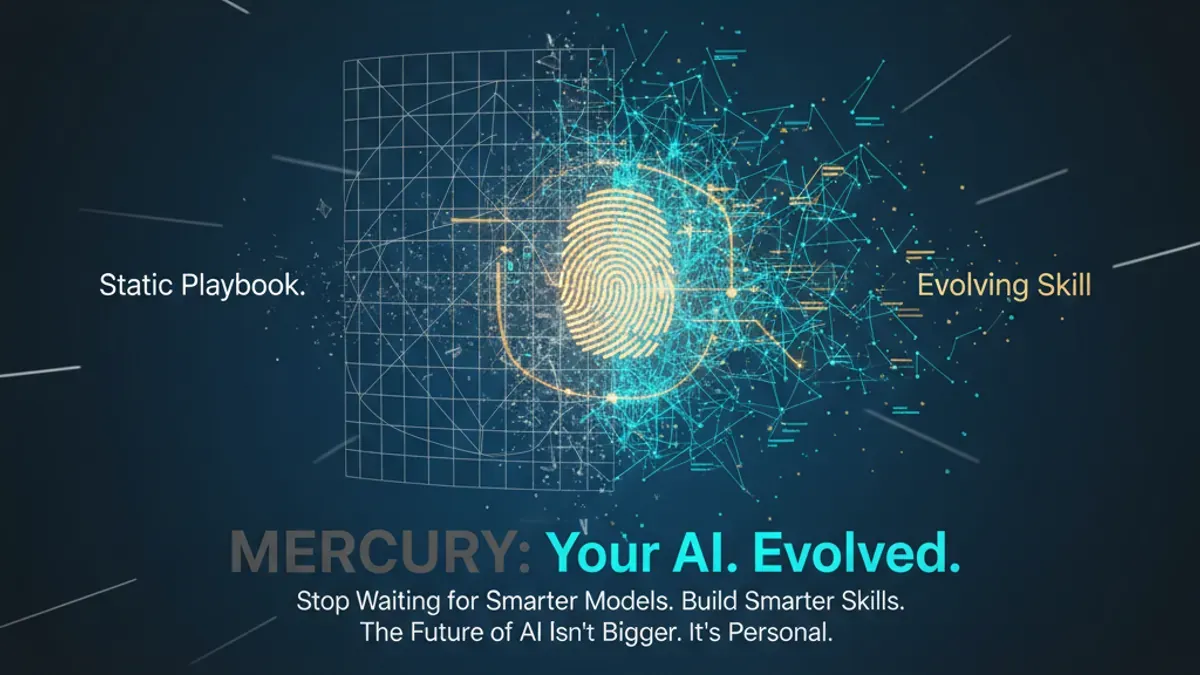
TL;DR: Everyone's waiting for GPT-6 to solve their problems. They're looking in the wrong place. The real leap isn't bigger models—it's smarter skills. Static playbooks are dead weight. The future belongs to AI agents that evolve based on your actual feedback, learning your quirks, preferences, and workflows. GPT-4 with personalized skills beats GPT-5 with generic ones. Every time.
James here, CEO of Mercury Technology Solutions.Hong Kong - March 2026
Let me tell you what I'm seeing from the front lines.
Everyone's obsessed with the next GPT release. Bigger model, better benchmarks, more parameters. As if intelligence is just a scaling problem.
It's not.
The real gap isn't model IQ — it's adaptation. Your AI can be a genius and still churn out garbage if it doesn't learn how you work.
Here's the thing nobody talks about: Static skills are dead weight.
Every AI agent runs on some variation of SKILLS.md — a static playbook written once and forgotten. Follow the steps, check the boxes, hope for the best. It's the digital equivalent of training employees with a 1990s employee handbook and wondering why they can't handle edge cases.
But what if the skill evolved?
The Five Inputs Nobody Argues About
Everyone knows output quality depends on:
- The prompt
- The model
- The skills (static SOP)
- Memory / RAG
- Available tools
We've optimized everything except #3. Skills are still treated like sacred texts — write once, pray forever.
That's fucking stupid.
Continuous Skill Evolution
Imagine this: Every task an agent completes gets scored. Not by some automated benchmark — by you. Did this work? Was it useful? Did it save time or create headaches?
The agent logs that feedback. Updates its own playbook.
"When James says 'research this,' he means deep synthesis, not surface-level bullet points."
"When I tried sub-agents for this type of task, James got annoyed — do it inline instead."
Over time, the skill becomes personalized — not to humans generally, but to this human. You.
The model doesn't change. GPT-4 is still GPT-4. But the application of intelligence gets sharper, more aligned, more useful.
Why This Matters
Smart people keep waiting for GPT-5, GPT-6, AGI — as if the jump in reasoning will solve their problems. It won't.
Your problems aren't reasoning problems. They're context problems. You have weird preferences. Specific workflows. Idiosyncratic ways of making decisions that no foundation model will ever capture out-of-the-box.
An agent that self-improves its skills based on your actual feedback doesn't need to be smarter. It needs to be trained on you.
That's the moat. Not compute. Not data. The accumulated record of what works in your specific context.
The Setup
It's not complicated:
- Skills start as simple playbooks
- Every execution gets logged with outcome
- Feedback loops update the skill (automatically or via human nudge)
- Version control tracks evolution (rollback when an "improvement" breaks things)
The agent gets better independently of model releases. GPT-4 with evolved skills beats GPT-5 with static skills for your specific work.
The Bottom Line
Stop waiting for smarter AI. Build AI that learns you.
The best agent isn't the one with the biggest brain. It's the one that remembers what pissed you off last time and doesn't do it again.
That's not a scaling problem. That's a memory problem. And memory is cheap.
操盤人的選擇很簡單:靜態工具,或進化夥伴。
(The operator's choice is simple: static tools, or an evolving partner.)
Mercury Technology Solutions: Accelerate Digitality.
Want AI agents that actually learn how you work? Let's talk at mtsoln.com/contact